


Why PCR tire prices differ for the same vehicle fitment
Two passenger car radial tires can carry the same nominal size, load index, speed rating, and rim fitment while showing a very different PCR Tire Price. Fitment confirms that a tire can be mounted and used within a stated vehicle requirement. It does not confirm that the two tires contain the same materials, are built to the same tolerances, or will deliver similar mileage, wet behavior, noise, rolling resistance, and supply consistency.
A low unit price is therefore meaningful only after the quotation is normalized. Comparing a 205/55R16 tire against another 205/55R16 tire without checking its full service description, construction details, production date, delivery terms, and intended operating conditions creates a false comparison. The visible size is only the outer layer of the purchasing decision.
Same Size Does Not Mean the Same Tire
The size marking identifies section width, aspect ratio, construction type, and rim diameter. It does not reveal the compound recipe, tread volume, belt package, bead construction, or casing durability. Even tires with the same load and speed markings can be tuned for different priorities. One may be developed for lower rolling resistance and regular highway use, while another uses a more robust casing and tread pattern intended to tolerate rougher roads, frequent braking, or sustained load.
Tread depth is frequently overlooked because it is not always prominent in a commercial quotation. A tire with less usable tread rubber can require less material and weigh less, reducing its initial price. Yet tread depth alone is not a mileage forecast. Wear behavior also depends on compound abrasion resistance, footprint pressure distribution, alignment sensitivity, inflation control, and driving conditions. A deep tread with poor heat management may not retain its advantage in demanding service.
Likewise, a similar-looking directional or asymmetric pattern may differ in groove geometry and rubber distribution. Wider channels can support water evacuation, but they also reduce the amount of rubber in contact with the road. Shoulder blocks, siping density, tie bars, and pitch sequence affect handling, noise, wear pattern, and mold complexity. These choices influence both material use and manufacturing cost.
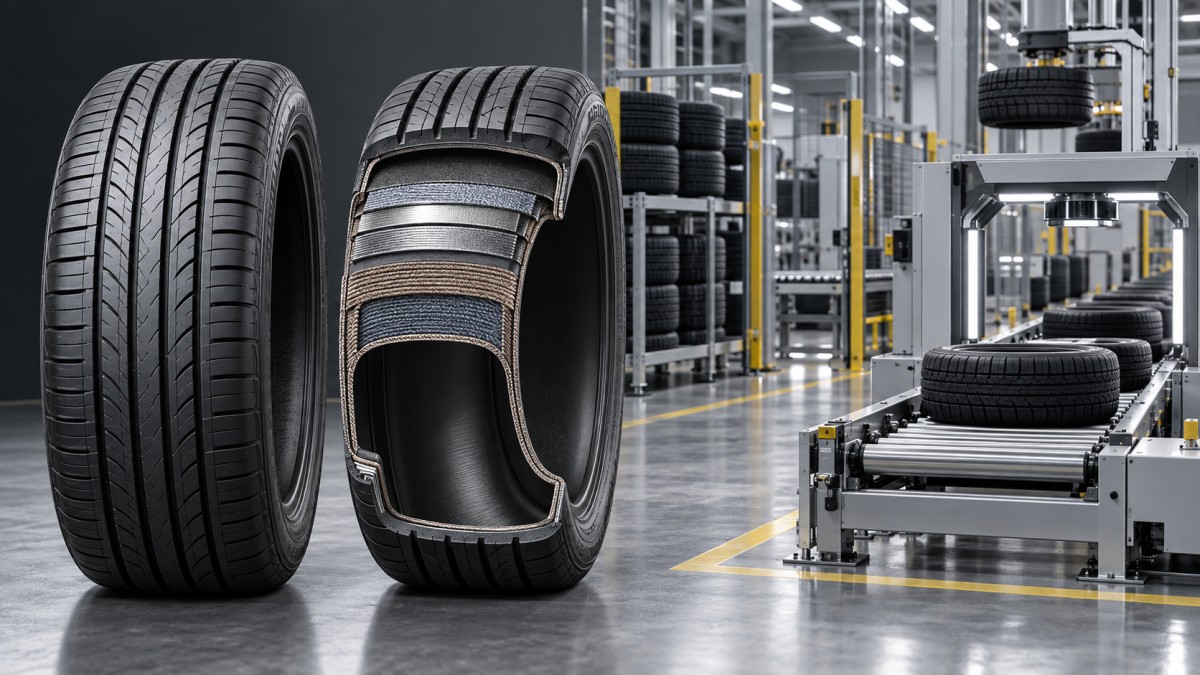
Rubber Compound Changes Both Cost and Service Life
A tire compound is a controlled mixture rather than a single raw material. Natural rubber, synthetic rubber, reinforcing fillers, oils, resins, sulfur, and other ingredients are selected to reach a balance among grip, heat resistance, rolling resistance, and wear. The target balance varies by tire position and road condition.
For example, a compound designed to retain flexibility at lower temperatures will not necessarily behave like one optimized for high-temperature highway operation. A tread formulated for strong wet grip may require different materials and mixing control from a harder, wear-focused compound. Price differences can emerge from the compound itself, but also from the consistency of weighing, mixing, storage, and batch control. A quotation that identifies only “rubber tire” does not disclose this level of difference.
Sidewall and inner-liner compounds also matter. The inner liner must limit air loss, while the sidewall needs to flex repeatedly without excessive heat build-up. Cost pressure in these less visible areas can affect air retention, ride comfort, fatigue resistance, and the margin available when inflation pressure is not perfectly maintained.
Carcass Construction Is Often Hidden in the Quote
A radial tire relies on coordinated layers: inner liner, carcass ply, bead area, sidewall, steel belts, cap ply where used, and tread. The exact configuration is seldom visible once the tire is installed. Differences in cord type, cord density, belt width, belt edge treatment, bead reinforcement, and gauge control can alter both production cost and resistance to impact, heat, and deformation.
Two tires may meet the same basic load marking but use different design margins. This becomes relevant where roads include potholes, sharp edges, heavy luggage loads, long high-speed runs, or repeated stop-and-go driving. A lower-priced tire can be appropriate for a defined operating profile; the problem begins when a price comparison assumes it is interchangeable with a tire designed for a tougher duty cycle.
The same reading discipline applies when tire categories are mixed in a quotation. Passenger car radial tires should be evaluated against comparable PCR products. Heavy-duty patterns use different construction logic, pressure ranges, and load requirements. For instance, the listed dimensions and load-pressure fields of PT20 belong to a heavy-duty tire context and should not be used as a benchmark for a passenger-car radial price merely because both are pneumatic tires.
Specifications That Need to Travel Together
Fitment should be compared as a complete record, not as a size alone. The load index and speed symbol are obvious starting points, but several adjacent details change the commercial meaning of the offer:
- Load and speed service description: Matching dimensions with a lower load or speed capability is not a like-for-like replacement. Extra-load versions also require separate comparison from standard-load versions.
- Run-flat, self-sealing, reinforced, or standard construction: These designs have different material content and manufacturing requirements. Their price should not be judged against a conventional equivalent.
- Seasonal or all-weather orientation: A tread intended to manage snow, frequent rain, dry heat, or mixed conditions will make different compromises in compound and pattern design.
- Approved rim-width range and actual rim application: The same nominal tire can perform differently on different rim widths. An offer that fits technically but sits near a rim-width limit may not be equivalent to one specified around the vehicle's original wheel geometry.
- Rolling resistance, wet grip, and external noise declarations where applicable: These values should be read together. A favorable result in one area can be associated with a trade-off elsewhere, so a single label item should not determine the selection.
Load capacity also requires a pressure condition. A tire may support its stated load only at a specified inflation pressure. Comparing maximum load figures without the corresponding pressure, or ignoring the vehicle placard pressure, can produce an invalid conclusion. The relationship becomes even more important for higher-load passenger applications and vehicles that operate fully laden for extended periods.
Manufacturing Control Affects Repeatability
Price differences also reflect how tightly a tire is controlled from component preparation through curing and final inspection. Uniformity depends on consistent component dimensions, accurate placement of belts and plies, controlled building tension, curing discipline, and inspection of finished tires. Variation can show up later as vibration, pull, uneven wear, balance weight demand, or inconsistent road feel across a batch.
This does not mean every lower-priced tire has a quality problem. It means the commercial comparison should identify the agreed quality basis. Useful documents include the full size and service description, pattern name, intended application, date-code policy, inspection criteria, claim handling process, and packing method. A generic statement that a tire is “premium quality” is not a measurable purchasing condition.
Certification and market-entry requirements also need to be attached to the exact product and destination, rather than assumed from a similar tire in the same catalog. A tire can be physically suitable for a vehicle while lacking the documentation, marking, or test evidence required for the intended market. The cost of relabeling, delayed clearance, replacement stock, or rejected goods can erase a small unit-price advantage.
The Delivered Price Must Include Logistics Variables
Freight has a disproportionate effect on tires because they consume volume as well as weight. Container loading pattern, tire orientation, packing materials, port charges, inland handling, insurance, duties, and destination delivery terms can make an apparently cheaper ex-works offer more expensive at receipt. A comparison should therefore state the same trade term, shipment mode, destination, currency basis, and validity period.
Production timing matters as well. A low quote attached to an uncertain production slot, mixed date codes, or fragmented shipment can create inventory and service issues. Freshness requirements should be agreed before order confirmation, especially when stock will move through a distribution network rather than be fitted immediately. The relevant question is not simply the age of one sample tire, but whether the delivered batch will be reasonably consistent with the agreed policy.
Turning Quotations Into a Like-for-Like Comparison
Start by separating offers that merely fit the vehicle from offers with the same intended duty. Group tires by complete size and service description, construction type, seasonal design, and required market documentation. Then compare the technical declaration with the expected operating conditions: annual distance, road quality, climate, loading pattern, speed exposure, and tolerance for noise or ride changes.
Next, convert the commercial offers to the same delivered basis. Include unit price, packing, freight, local charges, payment terms, expected date range, and the cost of any nonconforming stock procedure. Keep uncertain items visible rather than treating them as zero. This prevents a nominal price advantage from being accepted before the conditions that create it are known.
A sound PCR Tire Price comparison ends with a clear statement of what is actually equivalent and what is not. When the technical scope, delivery scope, and operating scope match, price becomes a useful negotiating measure. Until then, two tires that fit the same vehicle may represent two very different cost and performance commitments.
Chat Online