


Which vehicles benefit most from All Season Passenger Tires?
A vehicle benefits most from All Season Passenger Tires when it spends most of its time on paved roads, encounters rain and occasional light cold-weather conditions, and does not face prolonged snow, ice, extreme heat, or track-level driving demands. For a vehicle operator or portfolio buyer, the main advantage is not that one tire does everything perfectly. It is that one properly matched tire can cover the majority of real operating conditions without the cost, storage burden, scheduling disruption, and fitment risk of seasonal tire changes.
This decision matters when a mixed passenger-vehicle fleet must remain available throughout the year. A commuter sedan may travel dry urban roads on Monday, wet highways on Wednesday, and cold morning streets later in the season. Fitting a summer-focused tire may improve warm-weather response but reduce confidence as temperatures fall. Using a winter tire year-round may add unnecessary tread wear and reduce warm-road precision. An all-season option is often the most practical middle ground when winter severity remains moderate.
Vehicles that are usually strong candidates
The best candidates are mainstream passenger vehicles whose operating pattern is predictable: regular commuting, family transport, airport transfers, company cars, rental fleets, and light-duty service vehicles based on passenger-car platforms. These vehicles commonly require dependable wet traction, reasonable comfort, low operating interruption, and broad consumer appeal rather than a highly specialized seasonal capability.
Daily-use sedans and compact cars
Compact sedans, mid-size sedans, hatchbacks, and small crossovers often gain the clearest benefit. Their drivers usually cover mixed city and highway routes, where braking stability in rain, steering predictability, fuel consumption, and cabin noise are more relevant than maximum dry-cornering performance. A balanced tire helps keep the vehicle usable through changing weather without asking the owner to schedule two annual changeovers.
For fleet planning, these vehicles are also easier to standardize. A single all-season range can reduce the number of seasonal stock-keeping units while still serving several popular rim diameters and load requirements. This is particularly useful where vehicles are assigned across different routes or transferred between branches with slightly different weather patterns.
Family SUVs and crossovers used primarily on road
Road-oriented SUVs and crossovers are another good fit, provided the tire’s load index, speed rating, and size match the vehicle placard requirements. These vehicles are often used for school runs, business travel, weekend highway journeys, and urban driving. They may need extra load capacity compared with a small sedan, but they rarely require an aggressive off-road tread or a dedicated snow tire in mild climates.
The important distinction is between a crossover that stays on paved roads and one that regularly uses mud, loose gravel, steep unpaved access roads, or deep snow. The first can benefit from an all-season passenger pattern. The second may need an all-terrain, winter, or application-specific tire instead.
Executive cars and performance-oriented passenger vehicles
Higher-output sedans, coupes, and premium SUVs can also use all-season tires successfully, but the selection must be more careful. These vehicles may require wider sections, lower profiles, reinforced construction, or higher speed capability. Drivers may expect sharper steering response and stable straight-line behavior at highway speed, so the tire cannot be selected only for convenience.
In this part of the market, the decision should start with the original equipment fitment: wheel diameter, approved section width, aspect ratio, load index, and speed symbol. A tire that is broadly suitable for all-weather commuting can still be a poor choice if it lacks the required load reserve or alters the vehicle’s intended rolling diameter too far.
Where the all-season approach becomes less suitable
All-season fitment should not be treated as a substitute for a severe-winter plan. Vehicles operating on roads that remain snow-covered, icy, or frequently below freezing for extended periods may need dedicated winter tires. The same applies where local operating requirements specify winter-capable equipment. A buyer should verify the markings and performance category required for the actual market rather than assuming that every tire described as all-season has the same cold-weather capability.
Likewise, vehicles used in very hot regions, high-speed driving programs, repeated mountain descents, or demanding performance applications may benefit more from summer tires designed for those conditions. A commercial decision becomes weaker when a general-purpose product is asked to cover conditions that occur often, not occasionally.
- Use dedicated winter tires where deep snow, ice, and sustained cold are normal operating conditions.
- Consider summer tires where heat, dry-road responsiveness, and high-speed handling are the primary requirements.
- Consider all-terrain or specialized tires for vehicles that frequently travel on unpaved surfaces.
- Review commercial-grade options when passenger-style vehicles carry recurring heavy loads beyond normal private-use duty.
How to judge a vehicle before choosing the category
A useful assessment starts with the vehicle’s actual duty cycle, not with its body style alone. Two identical SUVs can need different tires if one is used for airport transfers on expressways and the other runs daily on rough rural access roads. The following questions expose whether all-season passenger fitment is a sensible match.
- Map the weather exposure. Identify the normal rather than exceptional conditions: rain frequency, low-temperature periods, snow coverage, and the likelihood of ice.
- Review road surfaces and trip length. Urban stop-start work places emphasis on braking, comfort, and wet grip. Long highway mileage adds a need for stability, noise control, and even wear.
- Confirm the approved fitment. Check rim diameter, tire size, load index, speed rating, inflation guidance, and any original-equipment restrictions.
- Estimate vehicle loading. Passenger count, luggage, equipment, and frequent towing can change the load requirement substantially.
- Set the operational priority. Decide whether the leading concern is year-round availability, ride comfort, wet performance, longer replacement intervals, or sharp handling.
These steps prevent a common purchasing error: selecting a familiar size while overlooking the load and speed requirement. A tire may physically mount on the wheel yet be unsuitable for the vehicle’s operating load or intended speed range.
What tire features matter in ordinary mixed-weather use
For passenger vehicles that see regular rain, tread drainage and block stability deserve close attention. Longitudinal grooves help move water away from the contact patch, while the shape and stiffness of tread blocks influence braking feel, steering response, and wear behavior. Shoulder design also matters because it contributes to cornering support and can affect how road noise enters the cabin.
Noise and comfort should not be considered secondary details for high-mileage passenger applications. A fleet vehicle that is mechanically reliable but tiring to drive can still create operating friction. Tread designs using semi-closed shoulder elements or noise-blocking features may help reduce sound transmission, while a well-supported center area can contribute to stable straight-line driving.
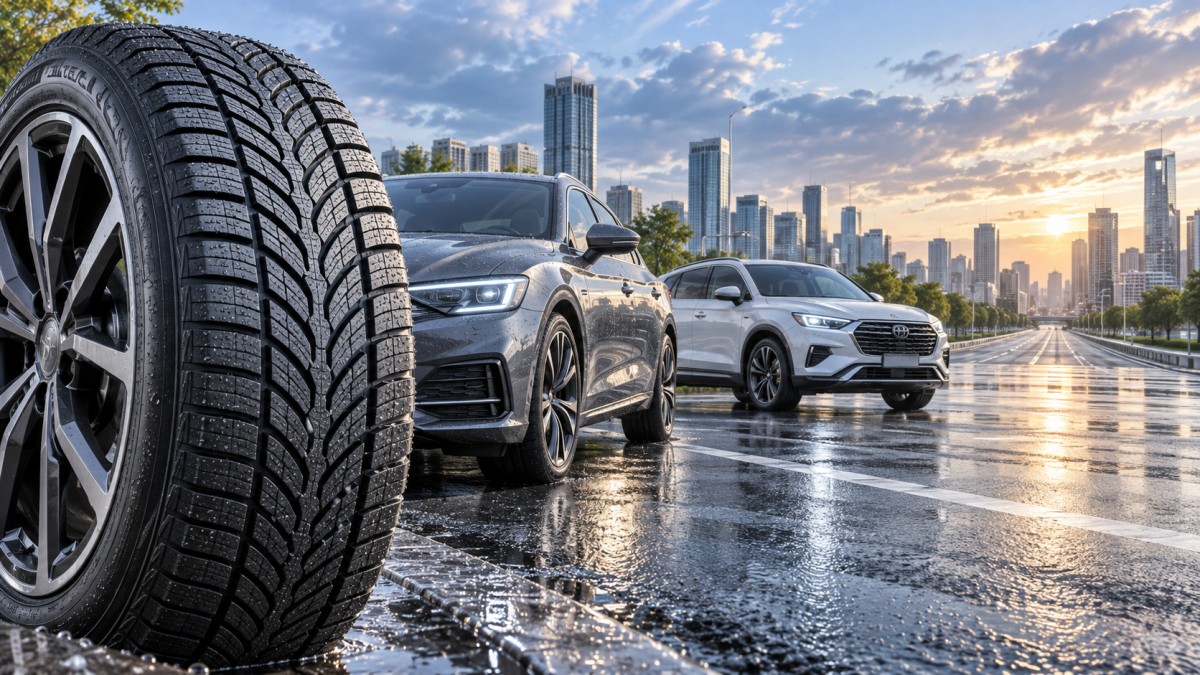
One example in the wider passenger-performance fitment range is AX688. Its listed sizes extend from 215/50R17 through wider 23-inch applications, with selected XL constructions and load capacities suited to larger or performance-oriented passenger vehicles. Its 3D cornering design, knife-groove pattern elements, optimized longitudinal grooves, and semi-closed shoulder structure are relevant where a buyer is comparing wet-road confidence, tread-block rigidity, handling support, and noise control. The final selection should still be checked against the vehicle’s required size, load index, speed symbol, and the climate classification needed for its market.
Inventory logic for mixed passenger fleets
All-season tires can simplify inventory, but only when standardization follows actual vehicle groups. Combining every passenger vehicle into one tire specification usually creates avoidable compromises. A more workable approach is to separate vehicles into a few fitment families: standard commuter cars, road-focused crossovers, and higher-load or higher-speed vehicles. Each group can then have compatible size and performance options without carrying separate summer and winter stock for every model.
Replacement timing also affects the result. Tires should be inspected for uneven shoulder wear, center wear, tread damage, vibration complaints, and pressure loss before ordering replacements. Uneven wear may point to alignment, suspension, wheel-balance, or inflation issues. Installing new all-season tires without addressing those causes can shorten service life and make the new product appear unsuitable when the underlying vehicle condition is responsible.
Making the final decision
All Season Passenger Tires provide the strongest value for road-based passenger cars, sedans, hatchbacks, crossovers, and many light-use SUVs operating through mild to moderate seasonal changes. They are especially practical where rain, cool temperatures, dry pavement, and occasional light winter conditions appear in the same annual cycle. The choice becomes less appropriate as deep snow, ice, aggressive off-road travel, repeated heavy loading, or sustained high-performance driving becomes a routine part of the vehicle’s work.
The most reliable procurement decision is therefore based on three checks: the climate the vehicle truly encounters, the load and speed requirements shown for that vehicle, and the operating priority that cannot be compromised. When those checks support a balanced year-round tire, an all-season passenger fitment can reduce changeover complexity while maintaining the everyday traction, comfort, and stability that most passenger vehicles need.
Chat Online