


Which truck tire tread patterns suit frequent highway driving?
Which truck tire tread patterns suit frequent highway driving?
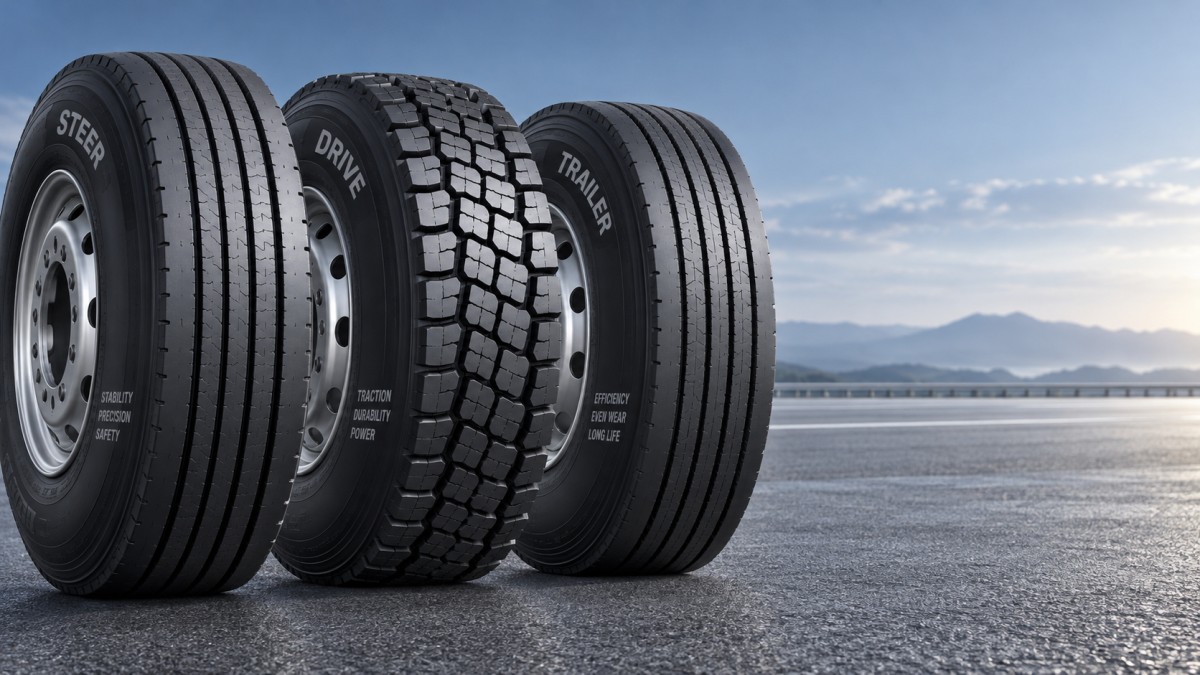
For trucks covering long highway distances, tread selection can influence fuel consumption, wet-road traction, noise, and tire service life. Evaluating Truck Tire Tread Patterns requires more than comparing groove layouts: axle position, operating loads, route conditions, and casing design all affect performance. Rib patterns are typically suited to steer and trailer applications, while highway-oriented drive patterns balance traction with rolling efficiency.
The practical answer is to choose an axle-specific highway design, not one pattern for the entire vehicle. Continuous ribs generally suit steering and free-rolling duties; closely spaced blocks or rib-block combinations suit drive axles. More aggressive, open tread usually needs a route-related justification, such as regular exposure to loose surfaces, snow, or muddy loading areas.
Start with the axle, then examine the grooves
On a steer axle, stable tracking and predictable wet braking matter more than an aggressive-looking tread. Continuous circumferential ribs provide relatively stable contact with the road, while longitudinal grooves provide paths for water evacuation. Shoulder design also deserves attention because irregular shoulder wear can shorten usable life even when substantial tread remains elsewhere.
Drive tires must transmit torque. Lateral edges and blocks provide traction that a predominantly straight-rib layout may not deliver under demanding starts, climbs, or slippery conditions. For frequent highway driving, compact blocks with controlled spacing can offer a useful compromise: traction edges without the large voids and pronounced block movement of an off-road-oriented pattern.
Trailer tires have different demands again. They need to tolerate free rolling, braking, and lateral scrub during turns. Highway trailer rib designs are a common starting point, but shoulder durability becomes especially relevant where motorway mileage is mixed with tight yard maneuvering. Always confirm the manufacturer's approved axle applications rather than assigning a tire by appearance.
A useful visual comparison looks at continuous ribs, lateral traction edges, shoulder openness, and groove connections—not simply the number of grooves.
How much traction does the route actually require?
A vehicle operating mainly on paved highways does not automatically need the least aggressive tread available. Repeated wet climbs, unpaved depot entrances, and seasonal snow can change the decision. Conversely, selecting deep, widely spaced lugs for occasional gravel exposure can introduce compromises throughout the much longer paved portion of the journey.
Open patterns help release loose material and provide biting edges, but greater block movement can contribute to heat generation, wear, and noise. The magnitude depends on the complete tire design. Where difficult access roads represent a small but unavoidable part of the route, a highway drive pattern with suitable traction features may be preferable to a dedicated mixed-service tire.
Wet performance cannot be established from groove width alone. Groove connectivity, tread compound, remaining depth, inflation pressure, speed, and water depth all matter. Sipes may add useful edges, but their presence is not proof of superior braking. Request applicable test results, and verify any winter-service markings required for the operating market.
Deeper tread is not automatically better highway value
Initial tread depth provides wear allowance, but it does not predict mileage by itself. Deeper tread can allow more deformation, while compound properties and casing construction influence rolling resistance and heat buildup. A tire that remains evenly worn may deliver better usable life than a deeper design removed early because of irregular wear.
Consider HD998 as a specification-review example. Its supplied TBR data lists a 12R22.5 size, 1,085 mm overall diameter, and 17.0 mm tread depth. The dimensional list identifies 300 mm as section width; although another supplied field calls it tread width, these measurements are not interchangeable and should be clarified before fitment assessment.
The product description specifies a wide tread with a high proportion of rubber contact area, a wear-resistant tread compound, and an “S” curve groove-bottom design intended to support self-cleaning. These are relevant design details, particularly where loose material is encountered. They do not independently establish low rolling resistance, wet braking performance, or suitability for a particular axle.
Before approving it for highway service, obtain the confirmed axle recommendation, load and speed ratings, approved rim information, and operating-pressure guidance. Any unclear rating notation in a commercial specification should be resolved against the manufacturer's technical documentation and tire sidewall, not interpreted by guesswork.
Compare performance evidence, not tread photographs
A credible shortlist should separate fitment requirements from performance preferences. Load capacity, speed capability, clearance, and approved rim compatibility are pass-or-fail checks. Fuel efficiency, wet grip, noise, wear behavior, and retread potential then determine which eligible tire fits the operation.
- Request rolling-resistance and wet-performance evidence under identified test conditions, where available.
- Compare wear at consistent inspection intervals, including shoulder wear and depth variation across the tread.
- Check casing inspection, repair, and retreading guidance if multiple tire lives are part of the fleet's cost model.
- Confirm local compliance documentation for the exact size and model, rather than accepting unrelated product certificates.
A fleet trial is useful only if operating differences are controlled. Compare tires on equivalent axle positions, with similar loads, routes, inflation practices, and alignment condition. Record removal reasons as well as mileage. Otherwise, a pattern may receive credit—or blame—for differences caused by maintenance or vehicle assignment.
Make the specification repeatable across deliveries
Replacement availability matters when a fleet needs to maintain consistent fitment. Confirm that repeat deliveries will match the approved size, rating, pattern, and construction. Also check lead times, batch traceability, and the process for handling specification changes before committing to a larger rollout.
Jinan Xinkunyu International Trading Co., Ltd., founded in 2001 and formerly known as Jinan Kunyu, reports a 360,000-square-meter operation with more than 1,000 employees, including 180 engineering and technical personnel. Its product range includes semi-steel radial tires, truck tires, and special tires. Its dedicated logistics lines serve China and most countries and regions in Europe and Asia; destination-specific availability and delivery schedules still require confirmation.
For frequent highway use, begin with rib patterns on approved steer and trailer applications and highway-oriented traction patterns on drive axles. Move toward more open designs only when route conditions warrant the trade-off. Then validate the exact specification with technical documentation and a controlled operating trial—the tread layout is a starting point, not the final decision.
Chat Online