


Which AX688 size fits your vehicle's approved wheel specifications?
The right AX688 size is one that matches your vehicle’s approved tire designation, fits the wheel’s permitted rim-width range, and meets the required load capacity and speed rating. Matching the wheel diameter alone is not enough. During a replacement review, two tires that both fit a 17-inch wheel can still differ in load capability, operating pressure, clearance, and suitability for the vehicle.
No verified AX688 size table is provided here, so a specific size cannot be approved from the available information. Start with the vehicle manufacturer’s specifications, then compare them with a current, model-specific supplier data sheet. This prevents a same-diameter substitution from becoming a clearance problem, an under-rated fitment, or an unsupported change in vehicle behavior.
Establish the approved fitment before reviewing stock
Use the tire placard, owner’s manual, and vehicle manufacturer’s technical fitment information to establish the baseline. Confirm the exact vehicle variant: axle ratings, wheel packages, and approved tire combinations may differ within the same model range. A tire already installed on the vehicle is useful evidence, but it is not proof that the installation is approved.
Record the front and rear requirements separately where the vehicle uses different sizes. For a vehicle with replacement wheels, also verify the wheel markings and supporting documentation rather than assuming the original wheel specification still applies.
Separate mandatory requirements from preferences. Tread appearance, availability, and expected use can help choose between compliant candidates, but they cannot compensate for an incorrect size, insufficient load capacity, or an incompatible rim.
Read the full designation, not just the last number
A tire designation identifies nominal width, aspect ratio, construction, and rim diameter. Its service description adds load index and speed symbol. Prefixes or suffixes such as LT and XL also matter because they identify categories or load characteristics that affect the evaluation.
The supplied listing for AX997, for example, includes 245/70R17LT-10PR119/116Q and 255/55R19 111T XL. These are specifications for a different product, not evidence of AX688 availability. The listed large tread blocks and stone-removal features may be relevant when evaluating an alternative for rough-road use, but neither those features nor its size list establishes compatibility for the requested pattern.
In the first designation, 245 indicates nominal section width in millimeters, 70 is the aspect ratio, R indicates radial construction, and 17 is the rim diameter in inches. The paired load indices identify single and dual applications respectively; they are not two interchangeable capacity choices. The speed symbol must be checked against the vehicle requirement.
A PR marking is a ply-rating designation, not a literal count of physical plies. Do not approve a tire simply because it carries a higher PR marking: use its load index and the applicable load/inflation data to establish capacity.
Resolve rim compatibility and installed clearance separately
The supplier’s measuring rim and approved rim-width range answer different questions. The measuring rim is the reference wheel used for published dimensions. The approved range identifies the rim widths on which that tire may be fitted. A wheel outside that range should not be accepted merely because the bead can be mounted.
Request the approved rim-width range for the exact AX688 size under consideration. Also obtain section width and overall diameter, noting their measurement conditions. Nominal tire width is not a guaranteed installed width, and tires with the same designation can have different physical envelopes.
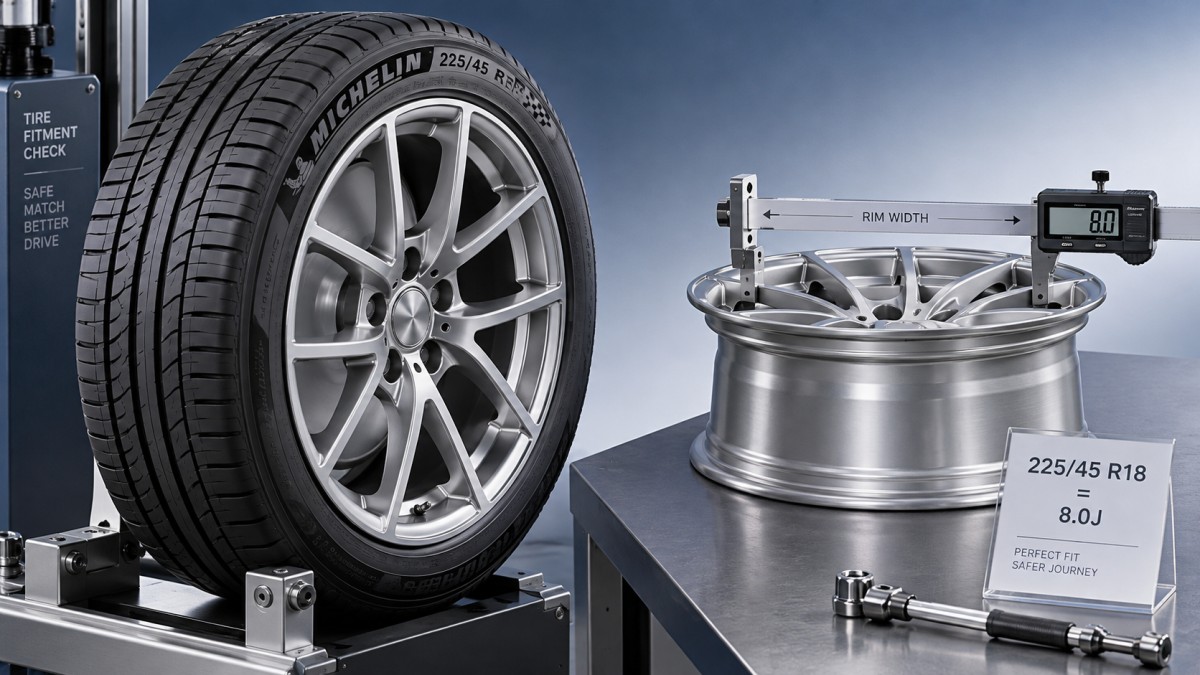
After checking tire-to-rim compatibility, assess the assembly on the vehicle. Offset positions the wheel relative to suspension and body components; it does not make an unsuitable rim width acceptable. Verify clearance to brake components, suspension parts, wheel-arch liners, and bodywork under the relevant operating conditions.
- Check steering clearance through the full steering range, not only with the wheels straight.
- Assess suspension compression and loaded operation, including towing where applicable.
- Account for required chain clearance if chains form part of the operating specification.
- Confirm that the wheel and valve pressure ratings suit the proposed application.
Static clearance in an unloaded workshop inspection cannot establish clearance throughout suspension travel. Where dimensions differ from the approved baseline, use the vehicle manufacturer’s acceptance criteria and a controlled fitment assessment before release.
Check load capacity at the pressure the vehicle will use
A load index describes capacity under specified conditions; it does not establish that capacity at every inflation pressure. Confirm the candidate’s load-carrying capability using the applicable table, tire category, and intended cold inflation pressure. The sidewall maximum pressure is not automatically the correct vehicle operating pressure.
For an initial screening, compare the relevant axle requirement with the capacity available from the tires serving that axle. Do not substitute total vehicle weight divided evenly among all tires: axle loading and side-to-side distribution may differ. Vehicles used for cargo or towing require particular attention to the loaded rear axle.
A move between passenger-type and LT tires deserves more than a size comparison. Inflation requirements and load assessment can change even when nominal dimensions appear similar. Retain the manufacturer-approved category unless there is documented support for the alternative.
The speed rating should meet the manufacturer’s requirement unless a documented exception applies. A lower expected driving speed, by itself, is not sufficient justification for reducing the rating.
When the original size is unavailable
The strongest starting point is the original approved size with the required service description and a compatible wheel. If that AX688 specification is unavailable, look for another size explicitly approved for the vehicle and its wheel package before considering an unlisted substitution.
A tire-size calculator can screen nominal diameter differences, but it cannot approve an alternative. Nominal overall diameter can be estimated from rim diameter plus twice the nominal sidewall height. Published dimensions remain necessary because actual geometry and rolling characteristics are not fully represented by that calculation.
There is no single diameter-difference percentage that proves suitability for every vehicle. An alternative may affect speed indication, gearing, electronic control systems, or drivetrain operation. All-wheel-drive vehicles can have specific rolling-circumference and tread-depth matching requirements. Use the vehicle manufacturer’s limits rather than a generic replacement rule.
Close the review with model-specific evidence
Ask the supplier for a current specification sheet that identifies the exact pattern and size, service description, approved rim range, measuring rim, physical dimensions, and applicable load/inflation information. A catalog containing headings for pressure or dimensions without populated values is not sufficient evidence.
Release a candidate only when its documentation satisfies the vehicle requirements and the installed assembly passes the necessary clearance checks. Record the accepted size, wheel specification, cold pressures, and supporting document revision. If a required value is missing—or the supplier provides data for another pattern—keep the selection pending rather than treating an apparently similar tire as an approved match.
Chat Online