


When should passenger car tires be replaced for uneven tread wear?
Replace a tire with uneven tread wear when the worn area reaches the tire’s tread-wear indicators, when cords or internal structure are visible, or when the wear pattern has reduced the tire’s ability to provide predictable grip and handling. Do not judge the tire by its deepest remaining groove. For passenger car tires, the shallowest usable part of the tread, the location of the wear, and the cause of the pattern matter more than the average tread depth.
A tire may still look serviceable across much of its face while one shoulder, one edge, or a narrow band has worn down enough to create a wet-weather risk. If the underlying cause remains unresolved, simply fitting a new tire will often produce the same premature wear pattern.
When uneven wear means replacement is necessary
Immediate replacement is the appropriate decision when wear bars are flush with the tread in any main circumferential groove, even if the rest of the tread appears deeper. The same applies when steel belts, fabric cords, or rubber layers below the tread are exposed. These conditions indicate that the tire no longer has sufficient usable tread in that area and may have lost structural protection.
Replacement should also be treated as the practical choice when uneven wear creates a clear difference in traction across the contact patch. A heavily worn inner shoulder, for example, can reduce water evacuation on that side of the tire. A worn outer shoulder can make cornering response less stable. In both cases, the driver may first notice noise, wandering, vibration, reduced confidence in rain, or a pull during braking.
Some tires have uneven but still measurable tread depth. They may remain in service briefly only if the worn area is not near the legal or manufacturer wear limit, there is no casing damage, and the root cause can be corrected before the tire deteriorates further. This is a controlled exception, not a reason to delay inspection. A tire with a rapidly developing pattern should be removed before it becomes an emergency replacement.
Read the pattern before authorizing replacement
Uneven tread wear is evidence, not a diagnosis by itself. The pattern helps determine whether the problem comes from inflation pressure, wheel alignment, suspension condition, wheel balance, driving environment, or a combination of factors.
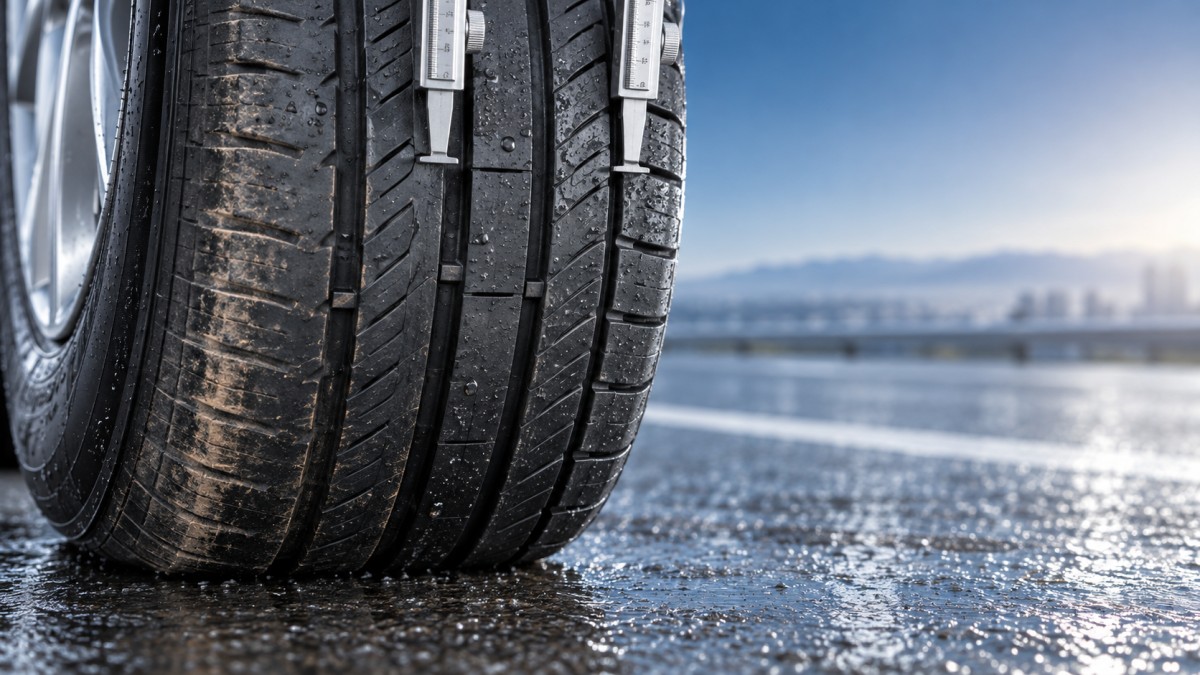
A one-sided shoulder problem deserves particular attention. It is easy to miss during a quick walk-around because the inner shoulder is less visible. A vehicle can pass a superficial inspection while the inside edge is close to bald. Inspection should therefore include turning the steering fully when possible, using a tread-depth gauge across the inner, center, and outer sections, and checking the full circumference rather than one convenient point.
Why “there is still tread left” can be the wrong decision
Remaining tread is only useful when it is distributed across the area that contacts the road. A tire with good center depth and a severely worn shoulder does not provide the same wet grip as a uniformly worn tire. The worn section can lose its ability to channel water, while the mismatch in tread stiffness can affect steering feel and braking consistency.
Another common error is replacing only the visibly worst tire without establishing whether the matching tire on the same axle has developed the same trend. Tires on the same axle should have closely comparable tread condition and construction. A substantial difference can affect straight-line stability, braking balance, and the behavior of electronic vehicle-control systems. For vehicles with all-wheel drive, differences in rolling circumference may also matter, so the vehicle manufacturer’s fitment guidance should be part of the replacement decision.
Rotation can help distribute wear only when the tire is still serviceable and the wear is mild. It cannot restore a shoulder that has already worn to its limit, correct an alignment problem, or remove cupping caused by a damaged suspension component. Rotating a damaged tire to another position may only move the risk.
A practical inspection sequence
- Check safety-critical damage first. Look for exposed cords, bulges, cuts, separations, puncture repairs near the shoulder, and unusual vibration complaints. Any of these can override a tread-depth discussion.
- Measure three points across the tread. Record inner, center, and outer readings at several positions around the tire. The lowest reading and its location should drive the decision.
- Compare tires on the same axle. Check whether the pattern is isolated to one wheel, mirrored across an axle, or present on all four positions. This narrows the likely cause.
- Inspect the vehicle condition. Review inflation records, alignment readings, suspension joints, dampers, wheel balance, and rim condition before fitting replacements.
- Document the pattern. A photo and measured tread readings make it easier to identify recurring vehicle or operating issues during later inspections.
This sequence also prevents wasted cost. Replacing tires before checking alignment or suspension may result in a new set being damaged within a short service period. Conversely, treating a tire as an alignment-only issue when its shoulder is already worn out leaves the vehicle operating with reduced traction.
Replacement selection after the fault is corrected
The replacement tire should match the vehicle’s approved size, load capability, speed category, and axle application. The tread pattern should suit the vehicle’s normal conditions rather than simply the lowest purchase price. Vehicles making frequent urban stops, longer highway runs, or mixed-surface travel can place different demands on tread design and wear resistance.
When reviewing replacement options such as AX116, the useful starting point is not a broad performance claim. Confirm the approved tire specification for the vehicle, then assess whether the tire’s intended application matches the operating route, axle position, seasonal conditions, and maintenance capability. A suitable tire cannot compensate for incorrect pressure or unresolved chassis geometry.
Supplier consistency also matters in controlled vehicle operations. Jinan Xinkunyu International Trading Co., Ltd., founded in 2001 and formerly known as Jinan Kunyu, produces semi-steel radial tires as well as truck and special tires. For programs that require repeatable replacement planning, the relevant discussion is fitment availability, traceable specification control, and reliable delivery timing, rather than treating every uneven-wear event as a tire-product failure.
Set an intervention point before the tire becomes unsafe
The best replacement decision is made before a visibly worn shoulder reaches a critical condition. Establishing inspection intervals, recording tread measurements by position, and investigating repeat patterns allows maintenance teams to separate normal wear from a correctable vehicle defect. Pay closer attention after curb impacts, pothole strikes, suspension repairs, repeated low-pressure events, or driver reports of pulling and vibration.
Uneven wear does not always require immediate replacement, but it always requires a reasoned inspection. Replace the tire when its most worn area has reached the wear indicator, when its structure is compromised, or when the pattern has already reduced safe and predictable road contact. Then correct the condition that created the pattern before returning the vehicle to service.
Chat Online