


When should a passenger car tire manufacturer support homologation?
Homologation support is warranted when the tire is no longer being selected as a replaceable aftermarket component, but is becoming part of a defined vehicle configuration that must meet legal, technical, and production requirements. For a passenger car program, that point can arrive well before start of production: during platform development, a new market launch, a powertrain change, a wheel-and-tire package revision, or any engineering change that affects load, speed, handling, braking, noise, energy efficiency, or regulatory marking.
The practical question is not whether a tire carries a certification mark in isolation. It is whether the proposed tire, on the specified rim and vehicle, can be documented and released for the intended markets without creating a late-stage approval, supply, or change-control problem. A Passenger Car Tire Manufacturer should support homologation when its product must be validated against vehicle-level requirements rather than merely meet a general replacement-tire specification.
Homologation becomes necessary when the tire is part of the vehicle’s approved design
A passenger tire influences several vehicle attributes at once. Its rolling circumference affects speedometer and odometer calibration; its stiffness and vertical spring rate influence ride and suspension tuning; its mass affects unsprung weight; and its tread pattern, compound, and construction can alter wet braking, exterior pass-by noise, rolling resistance, and high-speed behaviour. A nominally equivalent size is therefore not automatically an equivalent engineering solution.
Manufacturer support should be built into the program when the tire is listed on the vehicle’s type-approval documentation, certificate of conformity material, original equipment fitment schedule, or market-specific vehicle specification. This is especially important when the project includes any of the following conditions:
- a new vehicle or derivative entering regulated export markets;
- a new tire size, load index, speed symbol, or rim contour;
- an electric, hybrid, high-performance, or high-load vehicle configuration;
- a tire change after chassis tuning, brake development, or electronic control calibration has begun;
- a winter, all-season, run-flat, reinforced, self-sealing, or low-rolling-resistance specification;
- multiple production plants or regional sourcing arrangements;
- an aftermarket conversion program that changes approved wheel-and-tire combinations.
Where none of these conditions applies—for example, a distributor purchasing standard replacement tires for markets where the vehicle has already been approved and the tire is independently compliant—full vehicle-program homologation support may not be necessary. Product compliance documentation, labeling, and traceability may be sufficient. Confusing these two situations is a common source of unnecessary cost on one side and insufficient engineering control on the other.
Regulatory compliance is necessary, but it is not the full approval task
For markets applying UNECE requirements, passenger-car tire approval commonly involves UNECE Regulation No. 30 for pneumatic tires for passenger cars and their trailers. Depending on the market and the vehicle program, related requirements can also concern tire noise, wet grip, rolling resistance, labeling, and the broader vehicle type-approval framework. In the United States, applicable Federal Motor Vehicle Safety Standards and tire identification requirements follow a different regulatory route. Other destination markets may recognize one of these systems, maintain national requirements, or require specific importer documentation.
These rules establish a baseline for the tire as a regulated product. They do not automatically prove that the tire is appropriate for a particular vehicle. A tire may have the required approval marking yet still be unsuitable for the intended axle load, maximum vehicle speed, rim width, suspension clearance, or handling target. Conversely, a tire specification developed for one vehicle variant cannot automatically be transferred to another vehicle simply because the nominal size is the same.
Homologation support is therefore most valuable when the tire manufacturer can connect tire-level evidence with the vehicle program’s release criteria. That support normally includes controlled technical specifications, approval certificates where applicable, test reports or test plans, labeling data, production traceability, and a clear process for notifying the vehicle program of changes that could affect the approved configuration.
The critical trigger is often a change, not a new launch
Projects frequently underestimate homologation because the initial tire specification was approved years earlier. The more difficult question is whether a later change invalidates assumptions embedded in that approval. A shift in manufacturing location, tread compound, carcass material, belt package, mold, curing conditions, supplier source, or nominal dimensions can have implications beyond a purchasing substitution.
Not every manufacturing adjustment requires a new vehicle-level test program. The proper response depends on the approved specification, the scope of the change, regulatory rules, contractual obligations, and the performance margin available in the vehicle program. But the tire supplier must have a disciplined change-notification process. Without it, an engineering team may discover too late that tires in production no longer correspond to the version used for brake, noise, durability, or handling evaluations.
This is particularly relevant where the tire has been selected to meet a narrow target. Low rolling resistance may rely on a specific compound and construction balance. Noise performance can be sensitive to pattern design and production consistency. Electric vehicles may place additional emphasis on load capacity, torque response, mass, acoustic performance, and range-related rolling resistance. In these cases, a “same size, same label category” comparison is not enough for release control.
What meaningful manufacturer support should contain
Support should be judged by the quality and usability of the evidence, not by a generic statement that the manufacturer can provide certificates. At the beginning of a program, the supplier should be able to define the proposed tire configuration precisely: commercial designation, size, service description, construction details relevant to evaluation, approved rim range, target inflation conditions, dimensional data, and applicable regulatory markings.
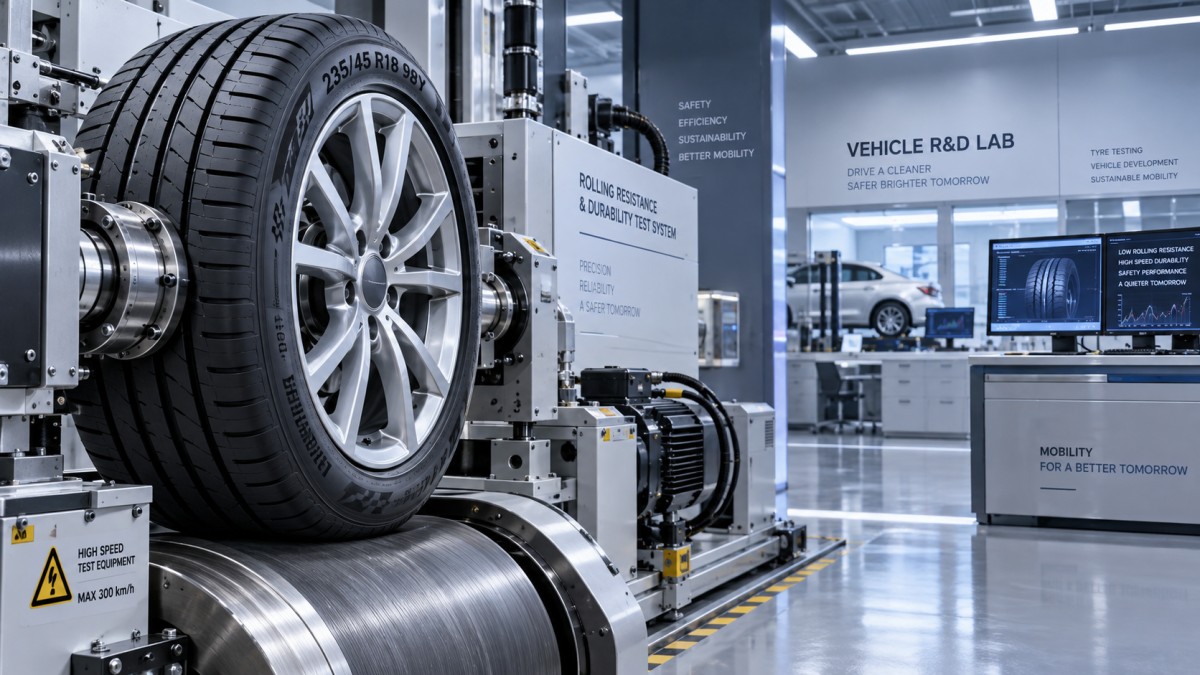
During validation, the supplier’s role is to provide stable samples, technical data in the format required by the program, and timely clarification when results differ from expectation. Vehicle testing may cover clearance, high-speed operation, braking, steering response, durability, rolling resistance, exterior noise, uniformity, and interaction with TPMS or chassis control systems. The exact test set belongs to the vehicle and market scope; it should not be replaced by a one-size-fits-all tire test checklist.
Before series release, support must extend to production readiness. This includes specification lock-down, lot and date-code traceability, documented inspection controls, retention of approval records, and an escalation route for deviations. Supply planning matters here as much as testing. A technically approved tire that cannot be supplied consistently from the declared production source can still put a vehicle launch at risk.
Do not treat tire categories as interchangeable
Homologation evidence must match the product category and intended vehicle use. A tire intended for a trailer, light-truck duty, or another special application cannot be used as evidence that a passenger-car tire program has been properly validated. Service description, intended axle duty, construction, load reserve, speed capability, dimensions, and applicable rules may all differ.
For example, HD161 is identified in the supplied specification as ST235/85R16 with a 14-ply rating, load index 132/127, and speed symbol M. Those details indicate a special-trailer-oriented specification rather than a passenger-car fitment. Its stated design emphasis on load capacity, wear resistance, shoulder durability, and stability may be relevant to its intended service, but it should not be carried into a passenger vehicle approval file as a substitute for passenger tire validation. This distinction matters because an apparently strong load or durability rating does not establish compatibility with passenger-car handling, comfort, regulatory classification, or original-equipment requirements.
The same caution applies to terminology. “Radial,” “reinforced,” “all-season,” or a shared nominal rim diameter do not establish homologation equivalence. The release decision needs the complete, controlled specification and the correct applicable standard framework.
Timing determines cost and schedule exposure
The best time to request homologation support is before vehicle tests begin, not after a tire has been commercially selected. Early involvement allows rim geometry, design load, maximum speed, target pressure, wheel offset, available wheelhouse clearance, intended markets, and performance priorities to be translated into a tire brief. It also allows the manufacturer to identify whether the requested construction is existing, requires adaptation, or carries approval limitations in particular regions.
Late involvement tends to compress several tasks into the most schedule-sensitive period: sample production, data reconciliation, regulatory document review, vehicle testing, corrective action, and supply-source confirmation. A late tire change can also force repetition of tests that were thought to be complete, especially where the revised tire meaningfully affects braking, noise, rolling resistance, or chassis performance.
For multi-market programs, approval timing should be aligned with the strictest relevant release milestone rather than the earliest local sales date. Documentation accepted by one market may not satisfy another, and labels or approval marks may need to correspond to the exact product version and production origin. This does not mean every project requires the broadest possible certification effort; it means market scope should be fixed early enough to avoid discovering a documentation gap after tooling, procurement, or vehicle calibration decisions have been made.
Questions that reveal whether support is adequate
A capable supplier should be able to answer direct questions without relying on broad assurances: Which regulations and markings apply to this exact tire specification? Which documents identify the controlled version tested? What dimensions and tolerances are guaranteed at the selected rim and pressure? What change-notification period applies to compounds, materials, molds, and manufacturing sites? Can samples for vehicle testing be linked to the intended series specification? What traceability will exist after launch? Which performance claims are supported by test evidence, and under what conditions?
If those answers are unavailable, homologation support is not yet mature enough for a vehicle release decision. The concern is not simply paperwork. It is the inability to demonstrate that the tire tested, the tire approved, and the tire delivered in series production are the same controlled product.
A passenger car tire manufacturer should support homologation whenever tire selection affects a vehicle’s legal market access, calibrated performance, or series-production conformity. The need is strongest where the tire is an original-equipment component, a market-specific configuration, or a changed specification within an existing program. Treating homologation as an engineering and change-control discipline—rather than a final certificate request—provides the clearest protection against avoidable launch delays and approval uncertainty.
Chat Online