


When are all-season high-performance tires suitable for winter use?
When are all-season high-performance tires suitable for winter use?
Can one set of tires handle spirited summer driving and colder winter roads? All Season High Performance tires can be a practical choice for drivers facing mild winters, mostly clear roads, and occasional light snow—but they are not a substitute for dedicated winter tires in persistent cold, deep snow, or ice. Before relying on them year-round, consider your local climate, typical driving conditions, and the tire’s winter performance ratings.
The key question is not whether a tire can move a vehicle through snow. It is whether it provides enough braking and cornering grip for the conditions you cannot avoid. A cleared afternoon commute and an early-morning trip over freezing bridges demand very different decisions.
Where a year-round performance tire makes sense
High-performance all-season tires balance responsive handling, wet-road traction, and some cold-weather capability. Compared with summer performance tires, they are generally better suited to lower temperatures and occasional light snow. However, their winter capability varies substantially between models; the category name alone does not tell you how confidently they stop on snow.
They are most reasonable when winter roads are predominantly dry or wet, snowfall is infrequent, and road maintenance removes snow promptly. Being able to delay a journey during a storm also matters. A driver who can wait for roads to clear has more flexibility than someone who must leave before snowplows arrive.
Consider the whole route, not just the weather outside your home. Shaded bends, steep driveways, untreated side streets, and higher elevations can make an otherwise mild region challenging. If those conditions are part of your normal journey, the convenience of one tire set becomes less persuasive.
Read winter markings before trusting the label
“All-season” is a category description, not proof of severe-winter performance. Two sidewall markings deserve particular attention:
- M+S: This indicates a mud-and-snow designation. It does not, by itself, demonstrate that a tire has passed the standardized severe-snow traction test associated with the mountain-and-snowflake symbol.
- Three-Peak Mountain Snowflake, or 3PMSF: This identifies tires meeting a specified snow-traction requirement. It is useful evidence, but it does not establish ice-braking performance or guarantee equal performance among marked tires.
Check the exact model and size rather than assuming every tire in a brand’s range carries the same marking. Independent comparisons are especially useful when they report snow braking, handling, and wet braking under comparable conditions. A strong dry-handling result does not answer the winter question.
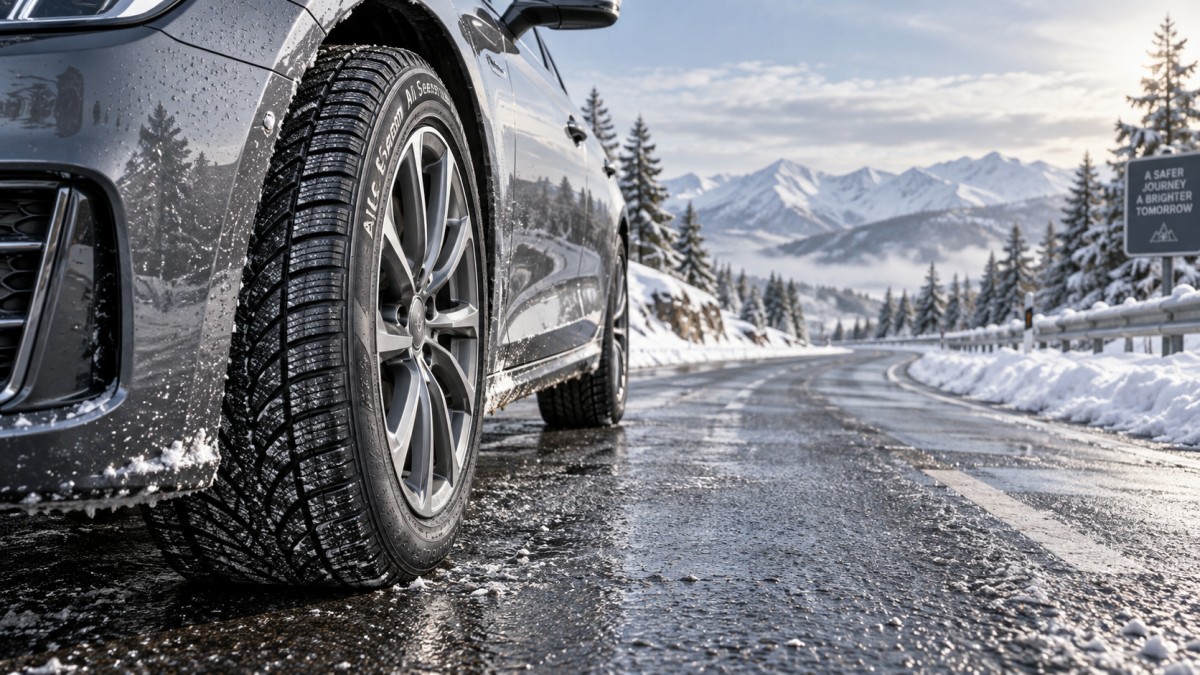
All-weather tires, often carrying 3PMSF, may offer a middle ground for drivers wanting one set with more snow capability. They still require model-specific evaluation. Neither “all-weather” nor a snow symbol makes a tire equivalent to a dedicated winter tire on every surface.
When switching to winter tires is the stronger decision
Frequent packed snow, recurring ice, and prolonged freezing conditions favor dedicated winter tires. Their compounds and tread designs are developed around cold-weather grip rather than the same warm-weather handling priorities as performance all-season tires.
You may hear that tires should be changed when temperatures fall below about 7°C. Treat this as a seasonal planning guideline, not a precise boundary at which every tire suddenly loses grip. Actual performance depends on the compound, road surface, moisture, and temperature. Repeated cold mornings combined with snow or frost are a more useful warning than one cool afternoon.
All-wheel drive does not remove this need. It can help distribute driving force when accelerating, but braking and cornering still depend heavily on tire-road grip. Getting away from a snowy junction easily can create false confidence about stopping at the next one.
For seasonal use, fit suitable winter tires on all four wheels. Mixing winter and non-winter tires can create an uneven grip balance. Also check local winter-equipment requirements before traveling: accepted markings, seasonal obligations, and chain rules vary by jurisdiction and route.
Vehicle fitment comes before performance claims
A sporty passenger car and a loaded light truck should not be selected from the same shortlist simply because both need wet-road grip. Size, load index, speed rating, wheel compatibility, and vehicle approval must come first. Commercial C or LT specifications are not interchangeable with passenger-car specifications merely because the diameter matches.
For example, HR566 is presented as a light-truck tire, with listed fitments including 185R14C-8PR 102/100Q and 195/75R16LT-10PR 107/103Q. Its stated features include three curved grooves for water evacuation and steel-belt construction supporting stability. These are relevant to evaluating its intended application, but they do not establish snow or ice capability. No winter certification is supplied in the available product information, so it should not be treated as a verified winter option or assumed to belong to the passenger-car high-performance all-season category.
This distinction matters when browsing broad supplier portfolios. Jinan Xinkunyu International Trading Co., Ltd., founded in 2001 and formerly known as Jinan Kunyu, produces high-performance semi-steel radial tires, truck tires, and special tires. Its 360,000-square-meter operation has more than 1,000 employees, including 180 engineering and technical personnel, with established logistics lines serving China and most countries and regions in Europe and Asia. That breadth makes exact product identification important: manufacturing scale and delivery reach do not replace model-specific winter evidence.
Make the decision before the first storm
Even an appropriate tire becomes less useful as it wears. Inspect tread depth, uneven wear, cracking, and damage before winter. Snow traction can deteriorate before a tire reaches its legal wear limit, so use manufacturer guidance and local requirements rather than treating legal minimum tread as a winter-performance target.
Check inflation pressures when the tires are cold and follow the vehicle manufacturer’s instructions for the load being carried. Do not reduce pressure to seek extra snow grip or use a sidewall maximum as the routine setting. Lower temperatures can reduce pressure, making seasonal checks worthwhile.
Choose All Season High Performance tires for winter only when your normal conditions remain mild, the exact model has credible capability for occasional snow, and you can avoid hazardous journeys. If ice, packed snow, or unavoidable cold-weather travel is routine, plan for dedicated winter tires. Before ordering, confirm the approved fitment, winter markings, available sizes, and delivery timing—not just the tread’s appearance or its wet-grip description.
Chat Online