


What wet-braking evidence should you request for an SL909 tire?
Before approving an SL909 tire, request a traceable wet-braking report for the specification you intend to buy. It should identify the tire, test method, road conditions, vehicle or test equipment, and results across repeated runs. A wet-grip claim or tread photograph cannot establish how consistently the tire will brake in your intended application.
The decision depends on two questions: does the evidence belong to the proposed tire, and do the test conditions support the intended use? A standardized wet-grip result can support comparison within its defined scope. Application-specific braking data helps judge whether that performance carries over to the vehicle, loading, and operating conditions that matter to your procurement decision.
Establish exactly which SL909 tire was tested
A model name alone is insufficient identification. Different sizes within a tire range can differ in construction, tread geometry, and load capability. Request the complete sidewall designation, including size, load index, speed symbol, and any commercial or reinforced marking. The report should also identify the manufacturer, production date or batch, sample quantity, and test date.
Match those details against the purchase specification. If the report covers another size, ask for the technical basis connecting the tested version to the proposed version. A representative-size test may be appropriate within a defined assessment scheme, but its scope should be documented. It does not automatically establish identical stopping performance across every size carrying the SL909 name.
Sample condition also matters. Record tread depth, whether the tires were new or worn, conditioning procedures, and storage history where relevant. Results from specially prepared samples offer less procurement confidence unless the supplier can show how those samples represent normal production.
Request the report behind the rating
A wet-grip label or certificate is useful evidence, but it answers a narrower question than a vehicle stopping test. Standardized assessments use prescribed conditions and may express performance relative to a reference tire. They do not promise a universal stopping distance on every wet road.
Ask for the underlying report, or sufficient supporting documentation to understand the result. It should name the laboratory, report identifier, method and revision, applicable tire category, and any departures from the procedure. Where laboratory accreditation is presented, check that its scope includes the relevant test.
If the method measures a braking-force coefficient or wet-grip index, request that result and its calculation basis. For a vehicle braking test, request measured braking distances and the defined speed interval. Converting an index into a claimed stopping distance requires a separate, defensible basis.
Read the conditions before comparing the distances
Two braking distances are comparable only when the main test conditions are sufficiently aligned. Starting speed, ending speed, pavement texture, water depth, temperature, loading, and inflation pressure all affect the outcome. A shorter distance on a different surface cannot, by itself, establish a better tire.
The report should describe the test surface and how its condition was monitored. “Wet asphalt” is too broad: a textured test track with controlled water application differs from polished pavement or standing water. Request water-depth records, measurement locations, and the procedure used to maintain conditions between runs.
Air and pavement temperatures help explain differences between sessions. Tire compounds respond to temperature, and repeated braking can change tire and brake temperatures. The procedure should describe warm-up, conditioning, and the interval between runs.
For vehicle tests, request the vehicle model, axle loads, ballast arrangement, wheel specification, tire fitment positions, and ABS or other braking-control configuration. Inflation pressure needs a stated measurement condition, such as cold pressure. On vehicles using dual tires, the fitment arrangement must also be clear.
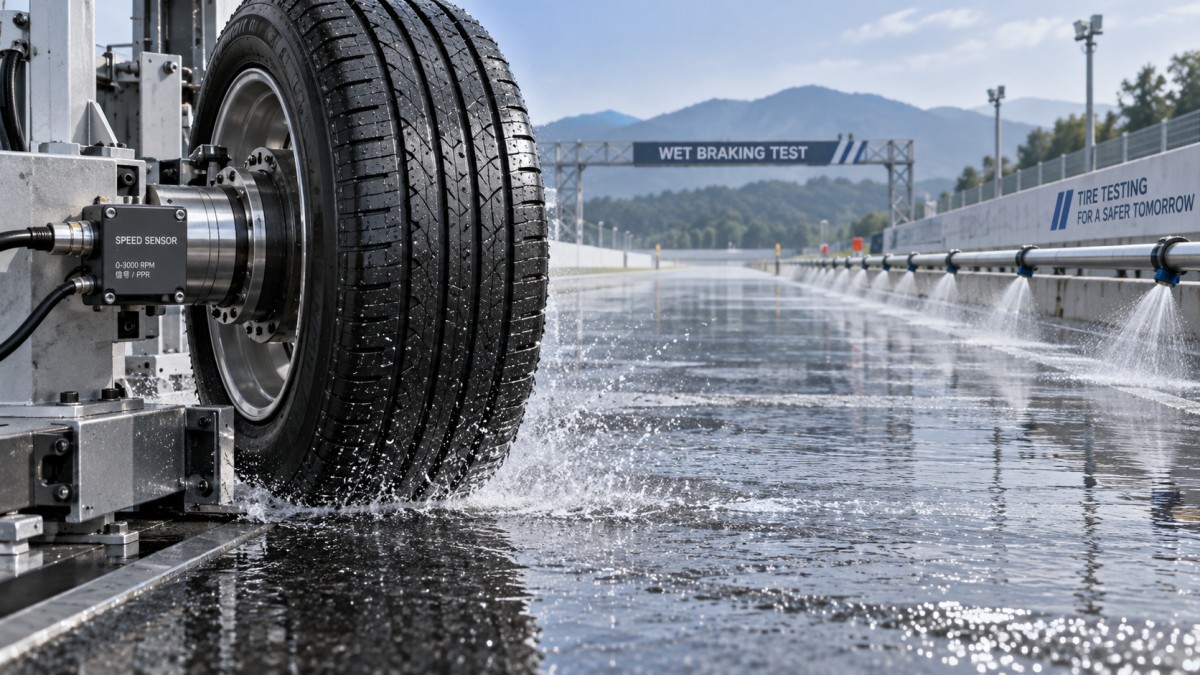
Check how braking begins and where distance measurement starts. A distance measured after a brake trigger differs from a total stopping distance that includes driver reaction. Likewise, a test between two defined speeds differs from a complete stop. Keep those distinctions visible when comparing supplier reports.
Look for repeatability and a meaningful reference
A single favorable stop is weak evidence. Request the individual valid runs, their average, a measure of spread, and the rules governing rejected runs. Exclusions should follow the procedure and include reasons. This makes it possible to distinguish a stable result from an average that conceals substantial variation.
Small differences deserve particular care. If the apparent advantage is similar to the variation between runs or the stated measurement uncertainty, the evidence may not justify ranking one tire above another. More decimal places do not make the distinction stronger.
For relative claims, identify the comparator precisely. A standardized reference tire serves a different purpose from a competing commercial tire. If the supplier claims improvement against another product, request its model, size, condition, inflation pressure, and test configuration.
Test sequencing matters because track conditions can change. Reference measurements taken around candidate runs, or another documented control procedure, help detect changes in surface grip. Comparing tires tested on unrelated days without suitable controls leaves the tire effect mixed with environmental differences.
Decide what additional evidence your application needs
A sound standardized report may support initial qualification while leaving operational questions open. For a delivery vehicle that frequently runs near its permitted load, an unladen test does not fully represent service conditions. Ask for a controlled assessment at representative axle loads and vehicle-specified pressures, within the tire’s operating limits.
Tread condition deserves separate attention. New-tire results establish new-tire performance. If procurement aims to manage braking throughout service life, request evidence at a defined worn condition, including how wear was produced and measured. Uneven wear and artificially reduced tread depth may affect interpretation.
Wet braking also should not stand in for aquaplaning resistance, wet cornering, or traction under acceleration. These behaviors involve different conditions and measurements. Where standing water is a significant exposure, include a separate assessment suited to that risk.
This distinction applies when reviewing alternatives. The commercial-van tire HR556 is described with four wide circumferential grooves intended to assist water evacuation. That design feature provides a reason to examine wet-performance evidence; it does not establish a braking distance or an advantage over SL909. Compare only application-compatible specifications supported by comparable records.
Turn the evidence into a procurement decision
Set acceptance criteria before reviewing the final results. Define the required tire specification, evidence method, operating conditions, comparator where appropriate, and treatment of variability. Otherwise, an attractive headline figure can end up determining the criteria after the fact.
Use the evidence to choose one of three actions:
- Approve within a defined scope: tire identity, test quality, and application coverage support the intended specification and use.
- Request targeted testing: the report is credible, but a material gap remains, such as representative loading, another size, or worn-condition performance.
- Withhold qualification: sample identity, method, repeatability, or comparison conditions are insufficient to support the claim.
Keep the accepted reports linked to the purchasing specification. Require notification of changes to compound, construction, manufacturing source, or other features that could affect the qualification basis. For SL909, the strongest approval is one supported by identifiable production tires, repeatable measurements, and conditions relevant to the job those tires will perform.
Chat Online