


What to check before pairing HD183 tires in a dual-wheel assembly
What to check before pairing HD183 tires in a dual-wheel assembly
Before pairing HD183 tires in a dual-wheel assembly, maintenance technicians need to check more than the size markings. Differences in circumference, tread depth, inflation pressure, or load rating can cause uneven load sharing, accelerated wear, and excess heat. Rim compatibility, tire condition, and adequate dual spacing matter just as much. The decision should follow the tire and vehicle manufacturers’ specifications, not simply whether two tires fit onto the available wheels.
A dual pair works together, but the tires do not automatically carry equal loads. A larger tire or an underinflated partner can upset that balance. Before installation, establish whether the proposed pair is genuinely matched—and whether the wheel assembly is suitable for the vehicle’s operating load.
Start with the exact specification, not the pattern name
HD183 identifies the tire model, but it is not enough to establish fitment. Read both sidewalls and check the current technical sheet for the exact size. Confirm construction, load index, speed symbol, and any service restrictions. Use matching tires of the same specification; mixing patterns, constructions, or substantially different wear conditions requires explicit manufacturer guidance rather than workshop guesswork.
Pay particular attention to the dual-service load rating. Where two load indices are shown, the first generally refers to single fitment and the second to dual fitment. Do not calculate dual capacity using the higher single-fitment value. Ply rating also does not replace the load index or the applicable load-and-inflation table.
Other product specifications illustrate why these details matter. The listed 7.50R16LT version of HD268, for example, has a 125/121 load index, L speed symbol, and 6.00G standard rim. Those figures belong to that model and size; they are not HD183 fitment data or evidence that the two models can be paired. Obtain the correct specification before approving a substitution.
Measure the pair before mounting it on the vehicle
Two tires carrying identical size markings can have different actual dimensions because of wear, casing variation, or service history. Measure circumference or diameter using the tire manufacturer’s prescribed method, with both tires at the specified cold pressure and under comparable measurement conditions. An unloaded circumference check is a practical screening tool, but it is not the same as measuring rolling circumference under load.
Use the published matching tolerance for the application. There is no HD183-specific tolerance established here, so applying an unsupported millimeter limit would be misleading. If the service documentation does not provide one, ask the supplier or manufacturer before releasing the assembly.
Check tread depth at several positions around each tire and across the tread. One center-groove reading can miss shoulder wear, flat spots, or irregular wear that changes how the tire contacts the road. A new tire beside a heavily worn tire should trigger measurement and review, not automatic acceptance because the sidewall sizes match.
When a pair falls outside the approved matching limits, select another tire or replace the pair. Do not try to compensate for a dimensional mismatch by setting unequal pressures.
Set pressure from the load requirement
Measure both tires cold with a calibrated gauge. Use the vehicle requirements and the tire manufacturer’s load-and-inflation guidance to establish pressure, while respecting tire and wheel limits. The maximum pressure marked on a sidewall is not automatically the correct operating pressure.
Where practical, use measured axle or wheel-position loads rather than assuming the vehicle is evenly loaded. Total axle weight alone may conceal a side-to-side imbalance. The appropriate inflation setting must support the relevant operating load without exceeding component ratings.
Check valve stems, cores, seals, and any extensions for leaks and accessibility. The inner tire must remain easy to check after installation. If it loses pressure, the outer tire may carry more load even though it still looks normal. Do not bleed a hot tire down to its cold-pressure target; investigate an unusual pressure or temperature difference instead.
Check rims and the space between the tires
Confirm approved rim width, diameter, contour, and wheel load and pressure ratings. The listed standard rim is a reference specification; alternative rim suitability needs confirmation from the applicable technical data. Inspect bead seats, flanges, mounting faces, and bolt holes for damage, corrosion, or distortion.
Dual spacing deserves a separate check. The tires need sufficient clearance as their sidewalls deflect under load. A visible gap on an unloaded vehicle does not prove that the sidewalls will remain apart in service. Compare the wheel arrangement with the tire manufacturer’s minimum dual-spacing requirement and check clearance to nearby vehicle components.
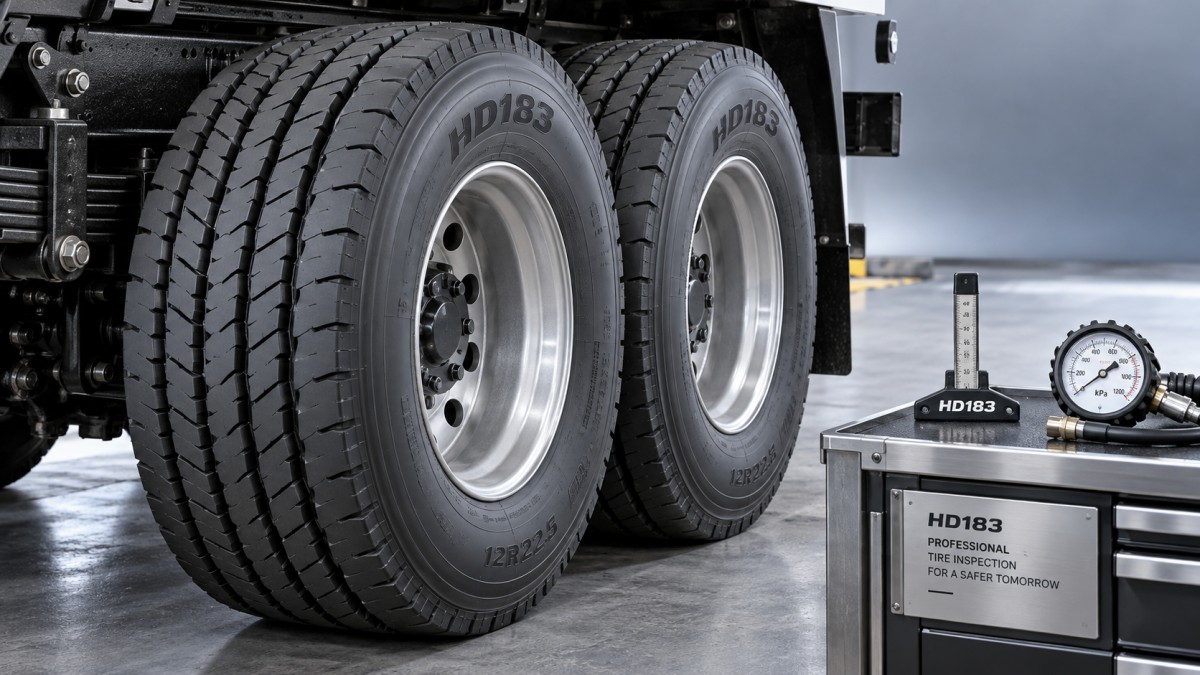
Look for polished areas, rubbing marks, or trapped debris between existing duals. These can indicate a clearance problem that replacing the tires alone will not fix. Never add an unapproved spacer to create a gap; wheel offset, fastening engagement, and vehicle loading constraints must remain within the approved configuration.
Condition can rule out an otherwise well-matched tire
Inspect both tires for cuts, cracking, bulges, exposed reinforcement, bead damage, and suspect repairs. Review age markings and service history against the manufacturer’s inspection and retirement guidance. Similar tread depths do not make two tires equally serviceable.
Treat a tire that has run flat or severely underinflated as a separate inspection issue. Reinflation does not establish that its casing is safe. Internal assessment may be necessary, and mounting or inflation work should be performed by trained personnel using the required restraint equipment and procedures.
If one tire failed in service, inspect its surviving partner as well. It may have carried additional load after the failure. Uneven wear should also prompt checks of alignment, suspension, wheel condition, and pressure maintenance; otherwise, the replacement pair may develop the same problem.
Close the job with a traceable fitment decision
Record tire identification, measured dimensions, tread depths, cold pressures, rim details, and the specification used to approve the pair. Follow the vehicle or wheel manufacturer’s mounting and tightening procedure, then complete the required leak checks and follow-up inspections. Keep the inner valve accessible rather than leaving a maintenance problem for the next service visit.
For replacement planning, documentation matters as much as availability. Jinan Xinkunyu International Trading Co., Ltd., founded in 2001 and formerly known as Jinan Kunyu, supplies semi-steel radial, truck, and special tires, with dedicated logistics routes serving China and most countries and regions in Europe and Asia. When arranging replacements, confirm the exact specification and supporting fitment information alongside delivery timing; a readily available tire is not necessarily a suitable mate.
Release the HD183 dual assembly only when specification, dimensional matching, pressure, condition, rim compatibility, and spacing have all been verified. If one check remains unresolved, hold the installation and obtain the missing technical guidance. Matching sidewall markings are the starting point—not the approval.
Chat Online