


What rolling resistance test data is needed to evaluate S600 tires?
What rolling resistance test data is needed to evaluate S600 tires?
Evaluating S600 tires requires more than a single rolling resistance value. A useful report must connect the result to the exact tire specification, applied load, inflation pressure, speed, temperature, and conditioning procedure. It must also identify the test method, such as ISO 28580 where applicable, and explain how the measurement was corrected. Without that context, two apparently comparable numbers may describe different test conditions rather than different tire performance.
The supplied information does not establish an S600 tire category, size range, or verified rolling resistance result. That is the first gap to close: request a report for the actual specification being evaluated, not simply a document carrying the S600 model name.
Start with the tested tire, not the headline coefficient
A pattern designation is not a complete test identity. Different sizes, load ratings, constructions, and production revisions can share a commercial name. Even within one specification, sample history matters. A new tire and a tire that has already accumulated service mileage should not be treated as equivalent test specimens.
The report should identify the manufacturer, model, full size designation, load index, speed symbol, construction, production date or batch, and sample identifier. It should state whether the tire was new, previously tested, aged, or used. Include the test rim designation and measured tread depth where relevant. If a supplier offers one result as representative of several sizes, ask for the technical or regulatory basis for that grouping.
The minimum measurement package
For an initial technical review, request the following information together. Missing items are reasons to seek clarification, not automatic proof that the tire performs poorly.
- Reported result: rolling resistance force and coefficient, with units and an indication of whether values are raw, corrected, or laboratory-aligned.
- Operating point: actual applied load, its relationship to rated capacity, test speed, and inflation pressure.
- Thermal conditions: ambient temperature, recorded tire temperature if available, and the reference temperature used for correction.
- Preparation: storage, conditioning, break-in, warm-up, and stabilization procedures.
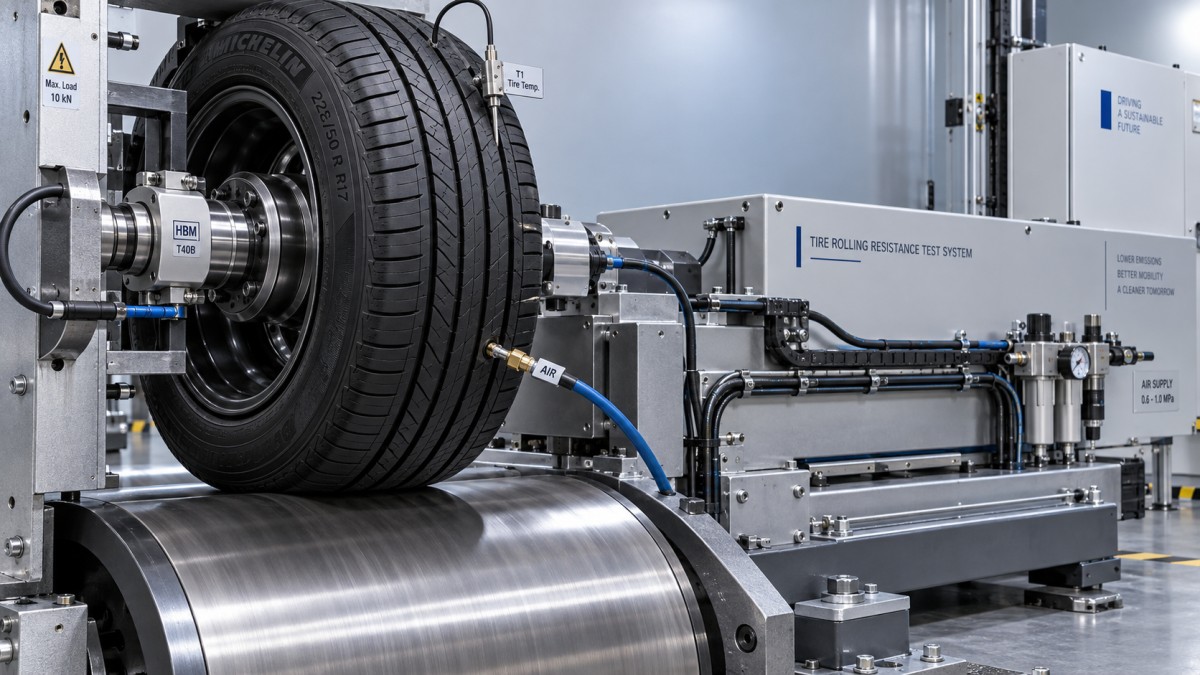
- Equipment and method: standard and edition, measurement technique, drum diameter and surface, calibration status, and deviations from the procedure.
- Result quality: individual runs, sample count, repeatability information, measurement uncertainty, and any laboratory alignment applied.
Make the coefficient comparable before ranking tires
Rolling resistance coefficient is rolling resistance force divided by tire load. It may be expressed as a dimensionless ratio or in N/kN. Those formats have different numerical scales: a dimensionless value must be multiplied by 1,000 to express it in N/kN. Confirm units before copying results into a comparison sheet.
Dividing by load does not make every test condition interchangeable. Tires tested at different pressures, speeds, or load fractions can still produce coefficients that are unsuitable for direct ranking. The practical rule is to compare results generated under the same applicable procedure and reference conditions, with consistent correction and alignment treatment.
ISO 28580 specifies methods for measuring rolling resistance under controlled conditions for passenger car, truck, and bus tires. Its applicability should be checked against the tire category and intended use; do not assume every special-purpose tire falls within its scope. If the report references UNECE Regulation No. 117 or a market labeling scheme, verify the applicable version, tire category, and reporting requirements separately. A laboratory result is not, by itself, evidence of regulatory approval.
Ask how parasitic machine losses were determined and removed, how temperature correction was performed, and whether drum-diameter correction or laboratory alignment applies. These are distinct operations. “Normalized result” is too vague unless the report explains exactly what was normalized and to which reference.
Pressure and warm-up can change the interpretation
Inflation pressure needs more detail than one number. Record the starting pressure, when it was measured, and whether the procedure used capped inflation or regulated pressure. With capped inflation, pressure can rise as the tire warms. With regulation, pressure is controlled during operation. Results from these approaches should not be mixed without checking the governing method.
Warm-up is equally consequential. Rubber hysteresis is temperature-dependent, so a reading taken before stabilization can describe a transient condition rather than the prescribed measurement state. Ask for evidence that the required conditioning and warm-up were completed. For application-specific testing beyond a standard point, agree on temperature, speed, and load sequences in advance so that test history does not become an uncontrolled variable.
A controlled drum test answers a defined laboratory question. It does not reproduce every road surface, alignment condition, pressure-maintenance practice, or duty cycle. For a long-haul application, standardized data may be a useful screening tool. For repeated stop-start operation or rough-site work, additional application testing may be needed.
A small difference needs an uncertainty check
Do not rank two S600 candidates solely by the last decimal place. Request measurement uncertainty with its coverage basis, along with repeat-run results. Repeating measurements on one tire helps assess measurement consistency; testing multiple tires also reveals sample-to-sample variation. Neither should be presented as a substitute for the other.
When laboratories differ, calibration and alignment records become particularly important. If the apparent performance gap is small relative to the relevant uncertainty and variability, the ranking may not be defensible. A sensible next step is a side-by-side retest under matched conditions, preferably using multiple representative specimens. Avoid applying a universal percentage threshold without an agreed decision rule.
Keep the application trade-offs visible
Rolling resistance should sit beside wet grip, durability, load capability, and service suitability in the evaluation. Consider the separately specified HDA68: its supplied specification lists 10.00R20, 18 PR, load index 149/146, speed symbol J, a 7.5 standard rim, and 18.5 mm tread depth. Its reinforced lateral blocks, groove-bottom stone ejectors, and abrasion-resistant compound are presented as traction and durability features. None establishes a rolling resistance value or makes it an equivalent substitute for S600.
That distinction matters when reviewing a broad supplier portfolio. Jinan Xinkunyu International Trading Co., Ltd., founded in 2001 and formerly known as Jinan Kunyu, supplies semi-steel radial, truck, and special tires, with logistics serving China and many markets in Europe and Asia. Portfolio breadth and delivery capability are useful commercial context, but technical acceptance still requires model-specific evidence and the requirements of the destination market.
Before approving S600, build a comparison sheet that preserves test conditions, corrected results, uncertainty, and sample identity rather than reducing everything to one score. If the supplier cannot connect the reported coefficient to the exact tire and method, leave the rolling resistance assessment open. Requesting the missing evidence is more defensible than treating an unexplained low number as a verified advantage.
Chat Online