


What load index is needed when sourcing passenger car tires?
A tire quotation can look correct until the buyer compares the load index with the vehicle placard or original-equipment specification. The size may match, the tread pattern may suit the market, and the price may be competitive, yet an inadequate load index can still create a safety and liability problem. For passenger car tires, the required load index is not chosen by preference: it must meet or exceed the vehicle manufacturer’s requirement for each tire position.
The practical answer is straightforward: source tires with a load index equal to or higher than the load index specified on the vehicle’s tire information label, owner documentation, or approved fitment data. Do not select a lower load index simply because the tire size, speed rating, or appearance is similar. A higher load index may be acceptable only when the tire’s size, construction, rim compatibility, pressure requirement, speed rating, and local approval rules also remain suitable for the vehicle.
Start with the vehicle requirement, not the catalog size
The load index is a numerical code that represents the maximum load a single tire can carry at its specified maximum inflation pressure. It is not the vehicle’s gross weight, and it is not a direct measure of tire strength under every operating condition. For example, two tires with the same nominal size can have different load indexes because their constructions, load ranges, or intended applications differ.
For purchasing work, the reliable reference order is usually:
- The tire placard fitted to the vehicle, commonly located around the driver-side door area or another manufacturer-designated position.
- The vehicle owner’s manual or manufacturer fitment documentation.
- The original tire sidewall marking, provided it matches the approved vehicle specification and has not been replaced with an unsuitable alternative.
- Verified technical data from the vehicle manufacturer or an authorized fitment source when documentation conflicts.
A sidewall marking such as 205/55R16 91V contains several separate specifications. In this example, 91 is the load index and V is the speed symbol. Buyers should not treat these values as interchangeable. A tire with a suitable speed symbol can still have insufficient carrying capacity; likewise, a higher load index does not automatically correct an unsuitable speed rating.
Calculate the minimum capacity with the right margin of caution
A basic procurement review begins by taking the vehicle’s gross axle weight ratings, rather than simply dividing the curb weight by four. Passenger vehicles do not load each tire evenly in real operation. Front-engine vehicles often place more static load on the front axle, while luggage, passengers, towing arrangements, and road gradients can shift the distribution further. The tire requirement must cover the heaviest permitted axle at the vehicle’s intended pressure.
The basic relationship is:
Required per-tire capacity on an axle = permitted axle load ÷ number of tires on that axle.
For a conventional passenger car axle with two tires, each tire must provide at least half of the permitted axle load. However, this arithmetic is only a screening step. The final purchase specification should still follow the approved load index because the vehicle maker has considered handling, inflation pressure, suspension setup, and tire dimensions. It is risky to replace an approved specification with a self-calculated lower value merely because the numbers appear close.
Extra attention is needed when sourcing for vehicles that routinely carry full passenger loads, operate as airport transfers, travel long distances at highway speed, carry tools or cargo, or use roof-mounted equipment. Such duty does not necessarily require a different tire type, but it makes compliance with the stated load index and pressure recommendations more important.
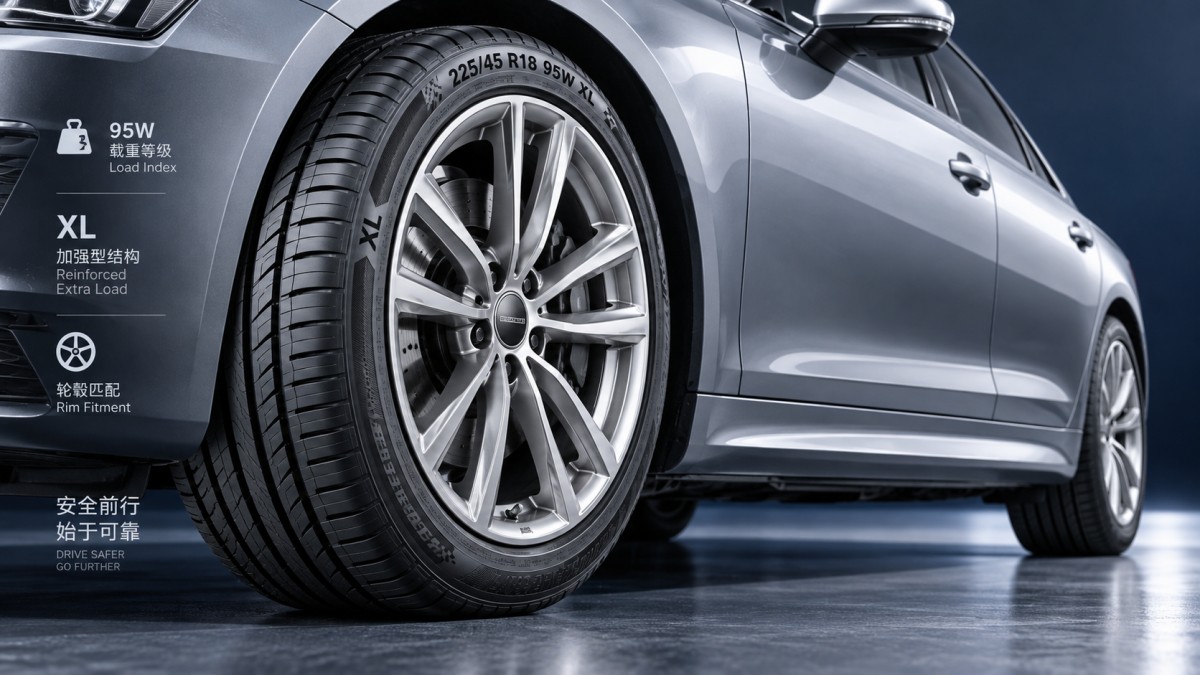
Do not confuse standard-load, XL, and reinforced markings
One source of purchasing errors is assuming that all tires in the same size have equivalent capacity. Passenger car tires may be offered in standard-load and extra-load configurations, often marked XL or described as reinforced depending on the market and supplier documentation. An XL tire may carry more load than a standard-load tire in the same size, but that added capacity is achieved under its specified pressure conditions. It should not be interpreted as permission to use any pressure or to exceed the vehicle’s approved axle limits.
Where an original specification calls for XL, replacing it with a standard-load version in the same size requires careful validation and is often inappropriate. Conversely, choosing XL merely because it seems “stronger” can alter ride behavior and may require pressure practices that are not aligned with the vehicle placard. The right choice is the approved specification, not the highest number available.
Review the complete sidewall specification before approving a shipment
A purchase order should state more than the tire size. At minimum, identify the full size designation, load index, speed symbol, load type where relevant, construction, applicable rim range, intended market marking requirements, and any required seasonal or tread category. This prevents a supplier from quoting a visually similar alternative that does not meet the working specification.
When comparing offers for passenger car tires, ask suppliers to confirm the exact sidewall marking and provide the corresponding technical sheet. The data should make it possible to verify the tire’s maximum load, recommended rim range, inflation-related load conditions, and dimensions. Product photos are useful for identification but should not replace a controlled specification review, since sidewall markings and production versions can vary.
Questions that reveal a weak quotation
- Is the offered load index the same as, or higher than, the approved vehicle requirement?
- Does the quoted tire carry the same standard-load or XL designation as the required fitment?
- Has the supplier listed the speed symbol, or only the nominal size?
- Does the tire fit the approved wheel width range?
- Are the maximum-load figures tied to the proper pressure and application conditions?
A quotation that omits these details may still be usable, but it is incomplete for a final procurement decision. Ask for clarification before consolidating container loads or issuing a long-term supply commitment.
Keep passenger-car requirements separate from off-road tire data
Catalogs sometimes include passenger, light-truck, ATV, and special-purpose tires in the same sourcing discussion. Their load figures should never be compared without considering application, construction, pressure, wheel type, and operating speed. An off-road tire may show a load value that appears attractive, yet it is not automatically suitable for road-going passenger use.
For example, SL506 is specified for off-road applications and is available in sizes such as AT25x8-12-6PR and AT27x11-14-6PR. Its listed load capacities range from 340 LBS to 1041 LBS depending on the specification, with stated pressures of 7 PSI or 12 PSI and corresponding ATV rim requirements. Those figures are relevant when selecting an off-road tire for the correct ATV wheel and operating conditions. They should not be used as a substitute for the load-index requirement of a passenger car tire, which relies on a different fitment and rating system.
When a higher load index is sensible—and when it is not
Sourcing a higher load index can be reasonable when it is an approved alternative in the same size family and all associated requirements remain compliant. This may occur where a vehicle is offered with multiple approved tire specifications, where replacement availability is limited, or where a fleet standardizes on a compatible higher-capacity option. The approval decision should still verify speed rating, rolling characteristics, physical clearance, wheel compatibility, and required inflation practices.
A higher load index is not a universal upgrade. It does not increase the vehicle’s permitted payload, axle rating, or legal carrying capacity. It also does not compensate for underinflation, overloading, suspension defects, or damage from potholes and curbs. In procurement terms, it is a specification attribute that must fit the whole vehicle system.
Before releasing an order, match the proposed sidewall marking against the approved fitment line by line. That final comparison is usually faster and more dependable than trying to judge suitability from tire size alone, and it prevents the costly mistake of receiving stock that cannot be safely fitted to the intended vehicles.
Chat Online