


What drives OTR tire price differences for the same rim size?
Two tires that fit the same rim can carry very different prices because rim diameter is only one compatibility point. It does not define the tire's required load, casing strength, tread volume, heat resistance, cut resistance, or expected operating life. A low quotation may describe a tire built for firm, short-haul conditions, while a higher quotation for the same rim size may include a stronger carcass and deeper tread intended for abrasive haul roads or repeated heavy cycles.
Comparing OTR tire price by rim size alone therefore creates a false comparison. The useful question is whether each quotation represents the same working specification: the same machine position, axle load, travel distance, surface, inflation target, speed, and damage exposure. When these conditions differ, the price difference often has a physical reason inside the tire.
The carcass carries much of the cost difference
The carcass is the load-bearing structure beneath the tread. It includes body plies, steel belts where applicable, bead components, sidewall reinforcement, and the compounds that bind these parts together. Two tires with the same nominal rim diameter may have different ply ratings, load indexes, or construction details. Those differences affect the amount and type of reinforcement used, as well as the tire's response to flexing and impact.
A tire assigned to a loader, dumper, or industrial vehicle that sees repeated heavy loads needs a casing suited to that duty. Under-specifying this area can lead to excessive deflection, heat buildup, bead movement, or separation risk. Paying for a heavier construction where the machine runs light and slowly on smooth ground can also be unnecessary. The proper comparison begins with the tire's load-and-speed capability rather than its outside dimensions.
Sidewall design deserves separate attention. A more protected sidewall can add material and manufacturing complexity, but it may be justified where rocks, curbs, debris, or loading-zone impacts are common. Conversely, a tire optimized for heat control may use a sidewall design that differs from a cut-resistant version. Both may mount on the same rim, yet their intended failure modes are not the same.
Tread depth, pattern volume, and compound are not interchangeable
Tread depth is visible and easy to compare, but it should not be treated as a standalone measure of value. A deeper tread contains more rubber and can provide more wearable volume, which commonly raises the initial price. On loose or abrasive surfaces, that additional depth may support a longer removal interval. On long, fast hauls over hard surfaces, however, a very deep pattern can retain more heat and may not suit the duty cycle as well as a shallower, cooler-running design.
Pattern geometry also changes both cost and performance. Large blocks and wider voids improve traction and can resist chunking or impact damage in demanding ground conditions. Anti-stone features help reduce stone retention, while stepped elements can protect vulnerable areas of the tread. These features require a different mold design and often use more tread material. They should be evaluated against the actual surface: a pattern intended to clear loose material can wear differently on compacted pavement.
Rubber compound is another source of price separation that cannot be reliably judged from a product photograph. Cut-resistant compounds, heat-resistant compounds, and compounds balanced for lower rolling resistance use different formulations and curing controls. A hard compound may resist abrasion but offer different grip and ride behavior. A softer compound may provide traction but wear faster under severe abrasion. The right compound follows the dominant operating condition rather than a general assumption that harder rubber is always better.
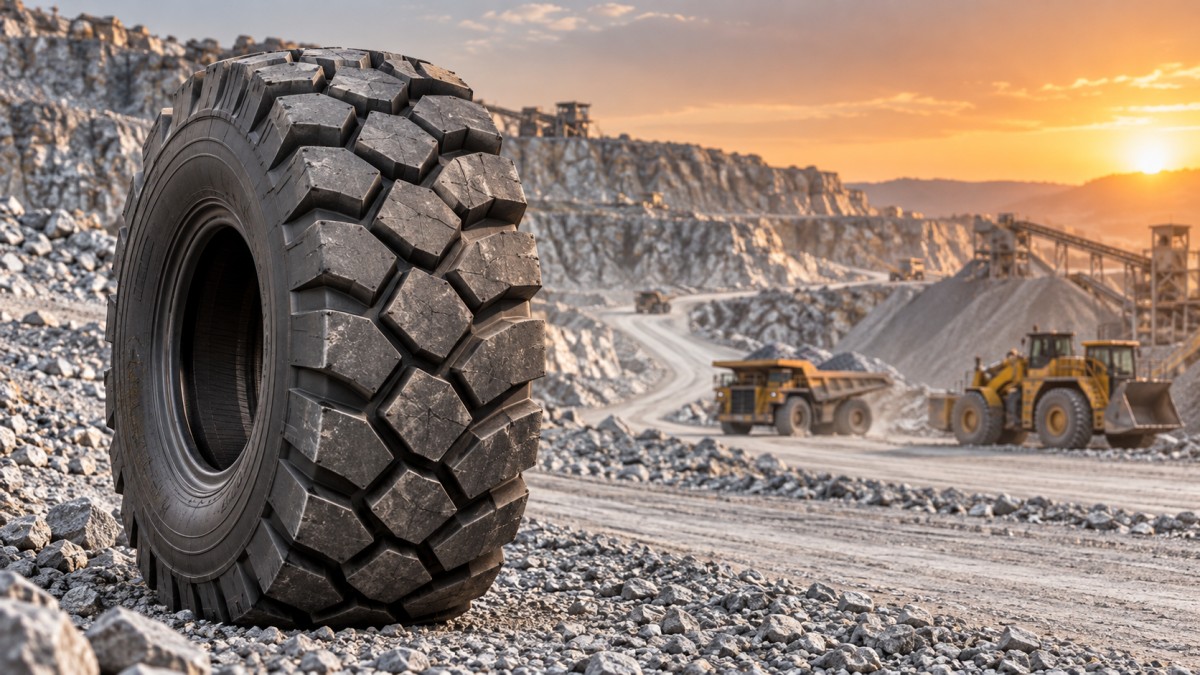
Same rim size does not mean the same working envelope
Quotation sheets should be compared line by line for the parameters that define usable capacity. The designation may be similar, while the load index, ply rating, standard rim, section width, overall diameter, and speed category differ. Even small dimensional changes can affect clearance, dual spacing, rolling circumference, and machine gearing behavior. A tire that technically mounts on the rim may still be unsuitable for the vehicle configuration.
A practical example is a 12.00R20(K) tire specification. The HD779 listing identifies a 22-ply construction, load index 158/155, speed symbol D, 8.5 standard rim, 311 mm section width, 1126 mm overall diameter, and 26 mm tread depth. Its wide, deep block pattern and anti-stone features indicate that the comparison should include puncture and impact exposure, not simply whether another 12.00R20 tire has a lower unit price. A tire of the same size with a different ply rating, depth, or pattern purpose is not an equivalent cost option.
Production controls affect consistency, not just specification labels
Two quotations can list similar headline parameters while differing in consistency of materials and manufacturing controls. Casing durability depends on cord placement, belt alignment, bead construction, compound mixing, curing conditions, and inspection discipline. These are difficult to verify from a short quotation, yet they influence balance, uniformity, heat distribution, and the probability of early structural issues.
The relevant commercial question is not whether every tire will perform identically in every environment. It is whether the offered specification is supported by clear, traceable product data and whether replacement handling is defined if a construction issue appears. Ambiguous descriptions such as “heavy duty” or “premium pattern” should be translated into measurable details: ply rating, load index, tread depth, tire weight where available, dimensions, approved rim, and intended service category.
Retread potential may also matter where tire management programs use casings after the first tread life. A lower initial price does not automatically represent lower whole-life cost if the casing is less suitable for the operating cycle or has limited retread value. At the same time, retreadability should not be assumed from size or appearance; it depends on casing condition, repair history, heat exposure, and the available retreading process.
Freight can distort the apparent OTR tire price
Large tires consume shipment volume quickly, and their shape makes container utilization less straightforward than for many industrial goods. Freight may be quoted separately, embedded in the tire price, or calculated using a different delivery basis. A lower ex-works figure can become less attractive once inland transport, port handling, insurance, packaging, and destination charges are included.
Delivery timing has a cost dimension as well. A tire specified for a critical machine position may carry a higher landed cost when supply must meet a narrow maintenance window. That premium should be kept separate from the tire's technical value; otherwise, a rush-delivery charge can be mistaken for a product-quality difference. Comparing delivered cost under the same terms prevents this confusion.
Storage deserves attention before delivery is finalized. Tires kept outdoors, exposed to direct sunlight, ozone sources, petroleum products, or standing water can deteriorate before entering service. A quotation that includes long storage or multiple handling stages should be assessed alongside packaging condition and stock age information where available.
Where quotations commonly go wrong
The most frequent error is treating a size designation as a complete specification. A second error is comparing nominal tread depth without considering tread width, compound, pattern shape, and duty cycle. A deep tire used in an unsuitable heat environment can lose value despite its larger rubber volume.
Another problem appears when machine data are incomplete. Tire selection may be based on the vehicle's rated capacity while ignoring attachment weight, material density, load distribution, grade resistance, or travel speed. Axle loads should reflect the heaviest realistic condition rather than an unloaded machine weight. Inflation pressure and rim condition must align with that load assessment, because both influence casing fatigue and bead security.
Price comparisons become clearer when every offer is normalized into the same technical and commercial basis. Match the exact application, required capacity, tread purpose, dimensions, delivery point, and included terms. Then assess expected removal causes: tread wear, cuts, heat, impact, or casing damage. The lowest OTR tire price is meaningful only after these conditions have been made equivalent.
Chat Online