


Should you pay a deposit before inspecting a wholesale tire order?
Paying a deposit before inspecting a wholesale tire order can be reasonable when the tires still need to be manufactured and the supplier has been independently verified. It is harder to justify when the supplier claims the entire order is already in stock but will not allow inspection before payment. The deciding issue is not the deposit percentage alone: it is how much money becomes exposed, what evidence supports the order, and whether the buyer can stop further payment if the goods fail inspection.
A deposit should fund a defined commercial commitment, not substitute for supplier verification. Before releasing it, the buyer should have an agreed specification schedule, a credible delivery plan, enforceable inspection rights, and written remedies for shortages or nonconforming tires. Without those protections, even a relatively small advance can become an unrecoverable loss.
Existing stock and new production require different payment decisions
For an existing-stock order, the goods can potentially be checked before substantial funds change hands. Request a stock list showing quantities by size, load index, speed rating, and manufacturing date range, together with the warehouse location. An independent inspector should be able to access the actual stock allocated to the purchase—not merely samples or a showroom display.
A supplier may request a reservation payment to hold inventory. That request is not automatically unreasonable, but the agreement should identify the reserved goods, the reservation period, and what happens if inspection fails. Paying to reserve unspecified inventory gives the buyer little assurance that suitable tires will remain available.
For a made-to-order purchase, finished-goods inspection cannot occur before production. The initial decision therefore rests on verification of the contracting supplier, its access to manufacturing capacity, approved specifications, and the payment structure. A factory audit or sample assessment can support that decision, but neither proves that the eventual production batch will conform.
The distinction matters: approving an advance to start production is different from accepting the finished order. The contract and internal approval record should keep those decisions separate.
Verify who receives the money and who must deliver
The legal seller, manufacturer, exporter, and bank beneficiary may be different entities. A trading company is not inherently an unsuitable counterparty, but its role must be clear. Establish which entity owes the delivery obligation, which entity handles claims, and whether it can secure access to the factory and shipment inventory.
Check business registration through an appropriate official source where available, confirm the operating address, and independently verify bank instructions. A changed beneficiary or payment to an unrelated company needs a documented explanation and additional checks. Do not rely solely on an email containing replacement bank details; confirm changes through a previously established contact channel.
A company presentation, production-capacity statement, or certification image does not establish that the specific order exists or meets its destination requirements. Supporting evidence should match the transaction: the relevant manufacturer, tire range, order specifications, and applicable approval scope. A low price should not reduce the verification standard.
Define what a passing tire inspection actually means
“Inspection before shipment” is too vague to protect an advance payment. The purchase agreement needs measurable acceptance criteria and a clear process for determining whether they have been met.
The specification schedule should identify the brand and pattern, tire size, load index, speed rating, reinforced or XL designation where required, quantities per specification, and permitted substitutions—preferably none without written consent. Specify required labeling, packaging, and destination-market compliance evidence as well.
For example, an order for AX266 should not be approved simply as a purchase of that pattern. Its listed specifications include 215/50R17 95V XL and 255/40ZR20 101W XL. Those are separate stock-keeping units with different fitment and service characteristics. The invoice, inspection instructions, and packing list must preserve the exact specification and quantity for each line.
Manufacturing dates also need an explicit agreement. Define the permitted production-date window at shipment, any allowed variation between batches, and the evidence used to check it. Older stock is not automatically defective, but age and storage conditions can affect resale suitability, customer acceptance, and warranty exposure. A discount on aged stock is meaningful only when those conditions are disclosed and accepted.
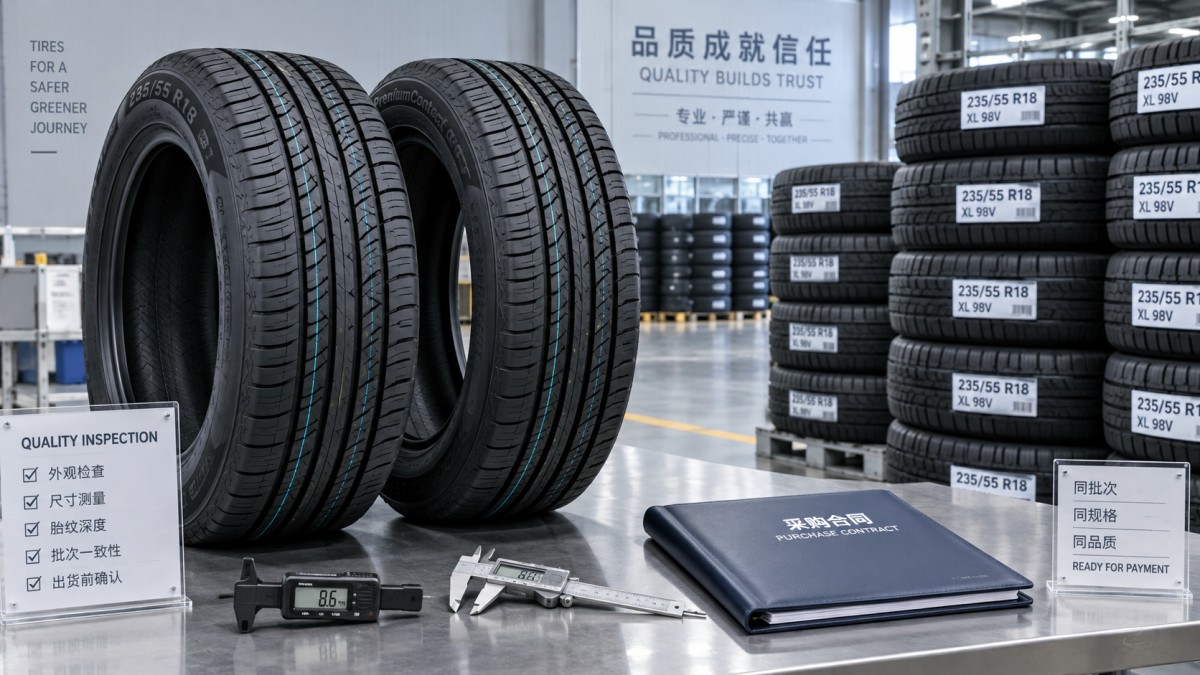
The inspection plan should cover quantity verification, sidewall markings, accessible manufacturing-date codes, visible damage, deformation, and packing condition. It should state the sampling method, defect classifications, acceptance thresholds, and who appoints the inspector. Random selection from the allocated shipment is more useful than examining tires chosen in advance by the seller.
Visual inspection cannot establish wet grip, braking performance, endurance, or every internal manufacturing characteristic. Relevant approval documentation and test evidence must be assessed separately where required. A clean visual inspection report is not a substitute for product compliance.
Make payment milestones preserve leverage
There is no deposit percentage that is safe regardless of circumstances. A modest advance to an unverified seller can carry more risk than a larger advance supported by credible security and a proven transaction history. Negotiate the amount against the supplier’s stated production or reservation needs, while keeping unsecured exposure within an acceptable loss limit.
A workable structure separates the initial production commitment from later acceptance. The advance follows supplier verification and contract execution; another payment, if necessary, follows a defined production milestone; the principal balance becomes payable only after the agreed inspection and documentary conditions are satisfied. Each milestone should require evidence, not merely the passage of time.
For an illustrative $100,000 order, a $20,000 deposit leaves $20,000 exposed before finished-goods acceptance. If another $60,000 is released before inspection, the exposure rises to $80,000. Calling the second transfer a “progress payment” does not make it safer unless it buys a meaningful, independently verified reduction in risk.
Check the sequence between inspection, balance payment, loading, and dispatch. Goods can be substituted or damaged after inspection. Identification of inspected lots, loading supervision, and container-seal records can reduce that gap. Also clarify control of shipping documents and cargo release: passing inspection does not by itself establish ownership or guarantee possession of the shipment.
Where justified by the order value and counterparty risk, consider escrow, an advance-payment guarantee, or a documentary letter of credit. These mechanisms have costs and limitations. Banks under a documentary credit examine documents rather than physically inspecting tires; any inspection requirement must be reflected in suitable documentary conditions. A guarantee requires careful review of the issuer, expiry, claim conditions, and coverage.
Write the failure outcome before sending the deposit
The contract should explain what happens if inspection identifies the wrong specifications, excessive defects, shortages, unacceptable dates, or missing compliance evidence. Without agreed consequences, the buyer may have a report documenting failure but no practical route to correction or repayment.
Specify whether the supplier must replace, rework, or remove rejected goods; who pays for reinspection; and how the delivery deadline changes. State when the buyer may cancel and whether the deposit must be refunded, including the repayment deadline. Do not allow substitution or a price reduction to become the automatic remedy for tires that cannot legally or commercially serve the intended market.
Contract language alone does not ensure recovery. Its value depends on the counterparty’s assets, the chosen dispute mechanism, and the practical cost of enforcement. Where recovery would be difficult, reducing the unsecured advance or obtaining credible payment security matters more than adding stronger-sounding promises.
Approve the exposure, not just the purchase price
The financial comparison should include inspection, payment-security fees, bank charges, and the cost of capital tied up before usable inventory arrives. For illustration, a $20,000 advance outstanding for 60 days at a 10% annual financing rate costs about $329 in financing alone. Delay, rejected stock, and recovery expenses create additional exposure.
A supplier discount therefore needs to be weighed against both funding cost and the downside if the transaction fails. The maximum tolerable unsecured advance should reflect a loss the business can absorb, not an assumed ability to recover money overseas.
Approve a pre-inspection deposit when the reason for it is credible, the counterparty and beneficiary are verified, the order is precisely defined, and later payments remain conditional on acceptance. Defer or decline it when inspection access is refused without a sound explanation, specifications remain unresolved, payment instructions cannot be verified, or rejection leaves the buyer funding goods it cannot use. The essential safeguard is keeping enough money unpaid—and enough evidence independently obtainable—to make acceptance a real decision.
Chat Online