


Wet grip should outweigh tread life whenever a tire cannot meet the fleet’s minimum wet braking and handling requirements throughout its planned service interval.
Which matters more for fleet high-performance tires: wet grip or tread life? For technical evaluators, the answer starts with operating conditions and minimum safety requirements.
Wet braking performance influences collision risk, while tread durability affects replacement frequency, downtime, and cost per kilometer. Selection therefore requires more than comparing advertised mileage.
The challenge is to compare both using relevant test data, including wet-road performance as tires wear, under representative vehicle loads, temperatures, and maintenance conditions.
This article explains how to establish defensible performance thresholds, evaluate competing evidence, and compare operating costs among tires that satisfy the fleet’s safety requirements.
Set a wet-performance threshold before comparing mileage
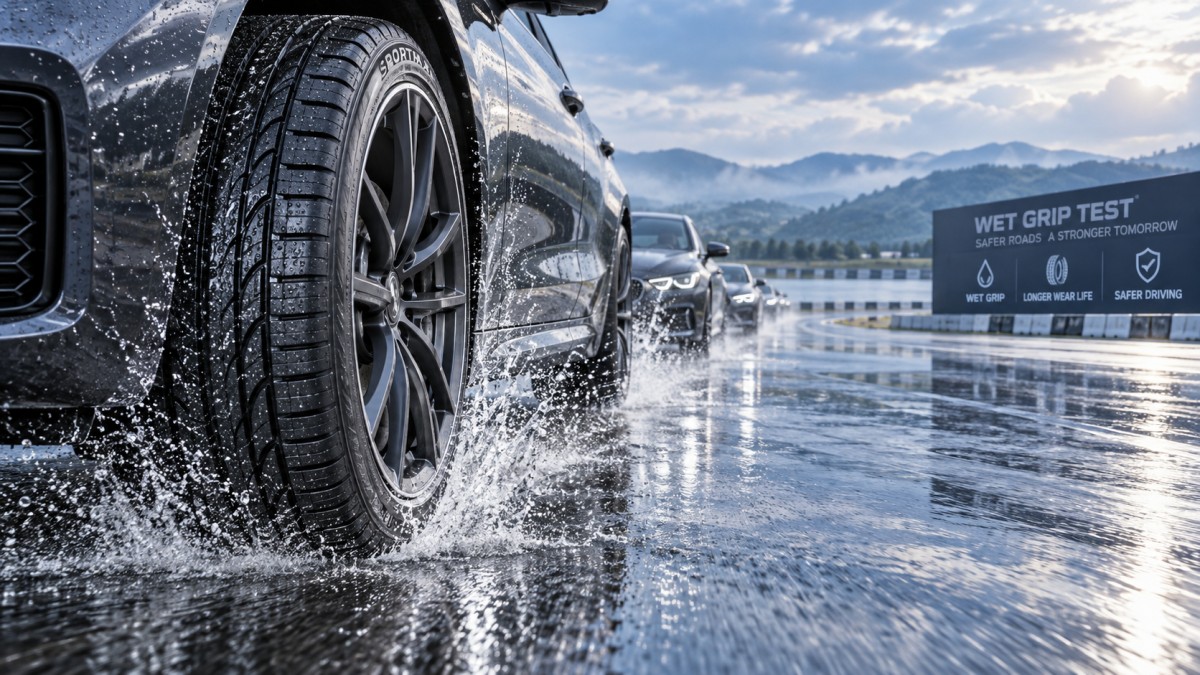
Wet grip and tread life should enter the decision differently. Wet performance establishes eligibility; expected service life helps rank the candidates that remain eligible.
A longer-lasting tire offers limited operational value if its wet braking performance becomes unacceptable before reaching the fleet’s intended replacement depth or inspection interval.
Define acceptance criteria around representative wet braking, predictable handling, and relevant standing-water exposure. Specify the vehicle configuration, load, speed, temperature range, and evaluation method.
A single stopping-distance limit cannot cover every fleet. Passenger cars, delivery vans, and heavier vehicles require criteria appropriate to their approved fitments and operating conditions.
Use applicable legal and vehicle requirements as the baseline, then establish internal criteria reflecting route hazards. Legal compliance alone does not resolve every operational concern.
Once candidates satisfy those criteria, tread life becomes a legitimate differentiator. The objective is durable, acceptable performance across service life, supported by comparable evidence.
Which operating conditions make wet grip the stronger priority?
Rainfall frequency matters, but exposure matters more. Record how often vehicles operate on wet roads, their typical speeds, and whether routes include persistent standing water.
Highway travel, frequent emergency braking exposure, steep descents, and changing vehicle loads can strengthen the case for prioritizing wet performance over incremental mileage gains.
Urban fleets also need careful assessment. Repeated junction approaches, pedestrian activity, and short following distances can make reliable wet braking important even at lower speeds.
Separate ordinary wet-road adhesion from aquaplaning resistance. Water depth, speed, tread condition, inflation, and tire geometry influence aquaplaning; a wet braking result cannot characterize everything.
For predominantly dry routes with limited wet exposure, greater weight on durability may be reasonable after candidates demonstrate acceptable performance during foreseeable rain events.
Segment the fleet when duty cycles differ substantially. One specification may suit motorway vehicles, while another better serves urban routes with frequent braking and turning.
What test evidence can technical evaluators actually compare?
Request results for the exact tire model, size, load index, and speed rating wherever possible. Similar product names do not establish equivalent performance across fitments.
Compare tests conducted under sufficiently similar conditions. Surface characteristics, water depth, temperature, vehicle setup, inflation pressure, and test procedure can materially change the reported result.
Where a regulated tire label applies, use its wet-grip classification for initial screening. It does not describe every aspect of wet handling or aquaplaning resistance.
For European procurement, check the applicable labeling and approval requirements for the tire category. Avoid transferring passenger-car assumptions to commercial or specialist equipment tires.
Ask suppliers for repeatability information, test conditions, and the comparison baseline. A percentage improvement without an identified reference tire provides weak support for procurement decisions.
Independent testing can strengthen confidence, but relevance remains essential. A credible result from a different size or vehicle class may have limited direct applicability.
Does the tire remain acceptable as the tread wears?
New-tire performance is only the starting point. Reduced groove depth can limit water evacuation, while aging and service conditions may also influence available grip.
Request wet-performance evidence at intermediate wear levels and near the fleet’s planned removal depth. Clearly distinguish naturally worn tires from artificially prepared test samples.
Artificially worn samples can help isolate tread-depth effects, but they may not reproduce the compound changes or irregular wear experienced during actual fleet service.
Define usable mileage as distance traveled before any removal criterion is reached. Those criteria include tread depth, unacceptable wet performance, damage, and irregular wear.
Check minimum tread depth across relevant positions, rather than relying on an average. Localized wear can trigger removal while other areas retain substantial tread.
Set inspection frequency around wear rate and operating severity. Seasonal rainfall may justify earlier assessment, particularly when tires are approaching the fleet’s replacement threshold.
If comparable worn-tire data are unavailable, record that uncertainty explicitly. A conservative replacement policy and monitored trial can support decisions while evidence is developed.
Compare cost per usable kilometer, not purchase price alone
Calculate tire-related cost per usable kilometer by dividing purchase, fitting, planned servicing, and attributable downtime costs by mileage achieved before the applicable removal criteria.
Include disposal costs and any supportable residual value consistently. For tires eligible for further approved service processes, apply equivalent assumptions across every candidate being compared.
Consider fuel consumption separately when reliable rolling-resistance evidence exists. Wet grip, wear, and rolling resistance can involve tradeoffs, but compound and construction also matter.
Suppose one fitted tire costs $240 and delivers 40,000 usable kilometers. Its purchase-and-fitting contribution is $0.006 per kilometer, before other operating costs are included.
A $280 alternative delivering 50,000 usable kilometers contributes $0.0056 per kilometer. That apparent advantage matters only if both candidates satisfy the same wet-performance criteria.
Do not convert modest laboratory braking differences into precise crash-cost savings without supporting evidence. Treat minimum safety performance as a constraint, then examine cost sensitivity.
Keep industrial equipment tires within their own evaluation framework
Mixed fleets may include specialist equipment alongside road vehicles. Their tires require separate assessment because operating speeds, surfaces, loading patterns, and approval requirements differ.
The M-600 Industrial Implement,Dumper,Telehandler,etc. Tubeless is presented for dumpers, telehandlers, and tough industrial applications, making it relevant to equipment procurement within a mixed fleet.
The supplied 18-19.5 specification lists a 1,090 mm outside diameter, 457 mm section width, and 28 mm tread depth; the construction is identified as tubeless.
It also lists 450 kPa pressure and a maximum load of 4,000 kg at 40 km/h. Confirm applicable loading and inflation instructions before selection.
Verify the approved rim specification and machine compatibility with the supplier. These dimensional and load details do not establish wet braking performance or service mileage.
Jinan Xinkunyu International Trading Co., Ltd. supplies high-performance semi-steel radial tires, truck tires, and special tires. Request evidence specific to each proposed product and application.
Use a controlled fleet trial to make the final choice
Shortlist compliant candidates, then trial them on comparable vehicles and routes. Control inflation, alignment, loading, rotation practices, and driver allocation as far as practical.
Record distance, tread-depth progression, uneven wear, damage, downtime, and removal reasons. Use qualified testing for braking comparisons; ordinary driver impressions cannot establish measured stopping performance.
Predefine acceptance criteria and review points before installation. This prevents an attractive mileage result from overshadowing a wet-performance weakness discovered during the evaluation period.
Document the final decision with its operating assumptions and evidence gaps. Reassess when routes, vehicle loads, tire specifications, or seasonal exposure change materially over time.
Wet grip should outweigh tread life when safety thresholds are unmet or wet exposure demands stronger performance. Among qualifying tires, prioritize the lowest defensible operating cost.
The strongest specification combines acceptable wet performance through planned removal, predictable usable mileage, and consistent maintenance. That gives technical evaluators a clear, auditable procurement rationale.