


PCR Tire Types: Summer, Winter & All-Season
PCR tires—passenger car radial tires—are not interchangeable seasonal variants of the same product. Summer, winter, and all-season tires use different tread designs and rubber compounds because dry heat, cold pavement, standing water, slush, and packed snow demand conflicting performance characteristics. The practical choice should begin with the lowest temperatures and most hazardous road conditions a vehicle will regularly encounter, not with the assumption that one tire category is universally “best.”
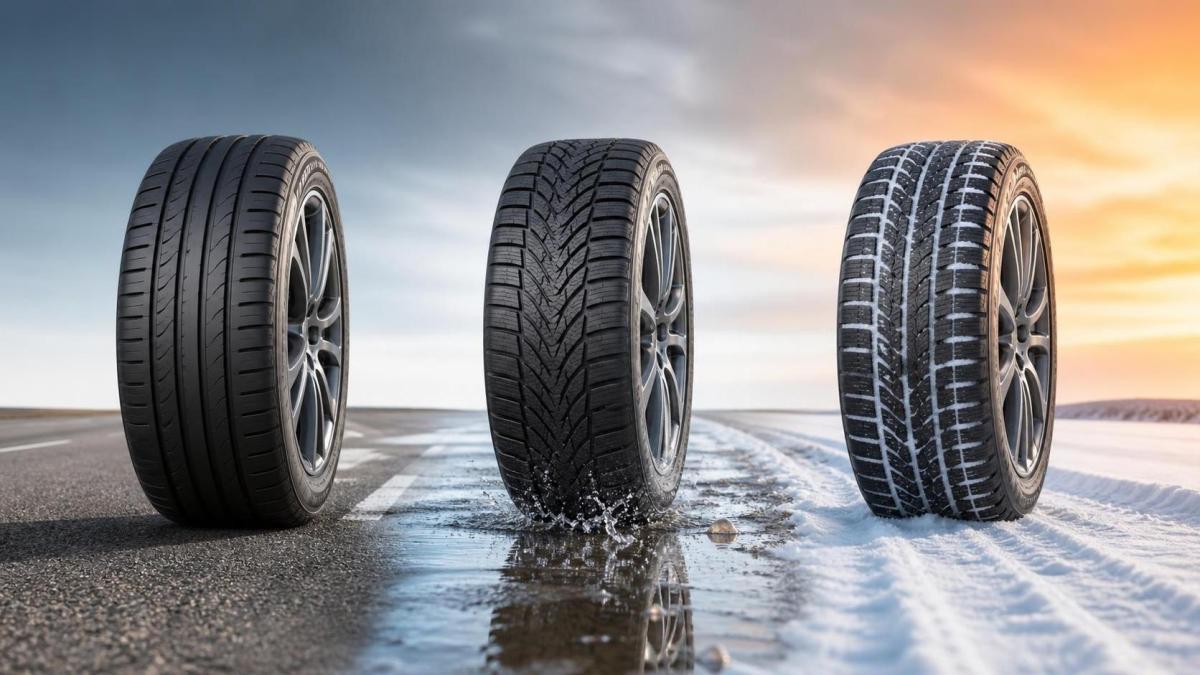
A summer tire can offer sharper steering and shorter braking on warm, dry roads, yet lose flexibility when temperatures fall. A winter tire can maintain grip in freezing conditions, but its softer compound wears more quickly in hot weather. An all-season tire reduces the need for seasonal changeovers, but it is a compromise rather than a replacement for a dedicated winter tire in severe snow and ice conditions.
Summer PCR tires: built for warm pavement and wet-road control
Summer tires are engineered for use in mild to hot conditions. Their tread blocks are generally more stable than those on winter tires, and their rubber compounds are formulated to retain road contact and handling precision at higher operating temperatures. Many designs use wide circumferential grooves to evacuate water and reduce hydroplaning risk, while solid outer shoulder areas support cornering stability.
The main advantage is not simply speed capability. A properly matched summer tire can provide more direct steering response, predictable braking, and better resistance to tread movement on dry asphalt. These characteristics matter on passenger cars that spend most of their time on paved urban, highway, or intercity routes in consistently warm climates.
The limitation appears when temperatures approach freezing. Rubber that performs well on warm pavement can become less compliant in cold conditions. The tire may then lose grip, particularly during braking and cornering on cold, wet surfaces. This is why a summer tire with deep remaining tread should not automatically be regarded as suitable for winter use.
For procurement and distribution, the relevant specification is more than tire size. Load index, speed symbol, approved rim width, vehicle fitment, and regional labeling requirements all need to match the intended market. A high-performance summer tire selected only on appearance or speed rating can be unsuitable where road quality, rainfall patterns, or vehicle loading differ from the original application assumptions.
Winter tires: cold-weather grip depends on compound as much as tread
Winter tires are designed to remain flexible at low temperatures. Their tread patterns contain many fine cuts, commonly called sipes, which create additional biting edges. These edges help the tire interact with snow-covered and icy surfaces, while the tread channels move snow and water away from the contact patch.
The widespread mistake is to judge winter capability by tread depth alone. Tread depth matters because worn grooves cannot clear water, snow, and slush effectively, but the compound is equally important. A tire with an aggressive-looking pattern cannot deliver true winter behavior if its rubber stiffens excessively in cold weather.
Where roads are regularly covered by snow, compacted snow, or ice, dedicated winter tires should be treated as a safety decision rather than a convenience item. Their benefit is most noticeable during braking, starting from rest, and directional control on low-grip surfaces. Those are also the moments when the limitations of an all-season tire become most apparent.
Winter tires should normally be fitted as a complete set. Mixing winter tires on one axle with summer tires on the other can create an imbalance between front and rear grip. Depending on the vehicle layout and maneuver, that imbalance can increase understeer or oversteer risk. Replacing only the visibly worn pair may appear economical, but it can undermine the predictable handling that seasonal fitment is intended to provide.
All-season tires: a practical category with clear boundaries
All-season PCR tires aim to provide usable performance through a broad range of normal road conditions. Their compounds and patterns sit between summer and winter designs. They generally offer better cold-weather flexibility and light-snow traction than summer tires, while retaining better warm-weather durability and handling than many dedicated winter tires.
This makes them a rational choice where winter conditions are occasional, temperatures are moderate for most of the year, and seasonal tire storage or changeover is impractical. They are also commonly considered for vehicles with predictable urban and highway duty cycles rather than frequent travel through mountain routes or regions with prolonged snow cover.
However, “all-season” should not be interpreted as “all-weather under every condition.” The category includes products with substantially different winter capabilities. In markets where winter markings are relevant, buyers should distinguish between a basic M+S designation and tires carrying the Three-Peak Mountain Snowflake symbol. The latter marking indicates that the tire has met a defined snow-traction performance requirement, whereas M+S alone is primarily a tread-design classification and should not be read as proof of severe-snow performance.
Even a snow-rated all-season tire remains a compromise. It can be well suited to variable weather and occasional snowfall, but it may not match a dedicated winter tire on sustained ice, deep snow, or repeated sub-freezing operation. The correct question is not whether an all-season tire can handle winter at all; it is whether its margin of safety fits the actual route, weather exposure, and vehicle use pattern.
The operating environment should decide the tire category
Climate maps can be misleading because tires operate on road surfaces, not average annual temperatures. A coastal city may have mild averages but frequent cold rain. A region with limited snowfall may still experience early-morning frost on bridges, shaded roads, and elevated routes. Conversely, an area with cold nights may have dry roads and stable daytime temperatures that do not justify a dedicated winter inventory.
Useful selection questions are operational:
- What are the lowest recurring temperatures during normal driving hours?
- Are roads commonly wet, slushy, snow-covered, or icy when the vehicle must operate?
- Does the vehicle travel on high-speed highways, urban streets, steep grades, or unpaved access roads?
- Will the driver be able to postpone travel during severe weather?
- Is the vehicle lightly used for private mobility, or does it support time-sensitive business activity?
A passenger vehicle that can remain parked during a rare snow event has a different requirement from a service car that must complete daily routes regardless of weather. Similarly, a performance-oriented vehicle used in a warm climate has different priorities from a family vehicle operating through wet winters and occasional mountain travel.
Performance labels help, but they do not replace application judgment
Where applicable, tire labels can support comparison of fuel efficiency, wet grip, external rolling noise, and in some jurisdictions snow or ice-related information. These indicators are valuable, but they should be compared within the same tire category and size. A winter tire should not be rejected merely because it has higher rolling resistance than a summer tire; the two products are optimized for different conditions.
Wet grip ratings also deserve careful interpretation. Wet braking performance under the applicable test conditions is important, but it does not fully describe behavior in cold rain, standing water, slush, or snow. Tread wear, inflation pressure, vehicle weight distribution, suspension condition, and road texture all affect real-world results.
For fleet and trade decisions, a consistent specification policy is often more valuable than choosing the highest-rated product in isolation. The policy should define approved tire categories by vehicle type, route conditions, seasonal exposure, replacement threshold, and permitted mixing rules. That reduces the risk of fitting visually similar tires with incompatible performance characteristics across a vehicle group.
Do not confuse PCR selection with industrial tire selection
The seasonal classification discussed here applies to passenger car radial tires. It should not be transferred directly to industrial, construction, agricultural, or material-handling equipment. Those applications are governed more heavily by load capacity, ply rating or construction, casing protection, tread depth, ground conditions, cycle speed, and heat buildup.
For example, an M-600 Industrial Implement,Dumper,Telehandler,etc. Tubeless tire in size 18-19.5 is specified for dumper, telehandler, and other demanding industrial applications, with a listed maximum load of 4,000 kg at 40 km/h and a 28 mm tread depth. That specification addresses an entirely different operating problem from choosing summer, winter, or all-season PCR tires for a passenger vehicle. Treating these product groups as interchangeable because both are radial or tubeless tires can lead to serious fitment and safety errors.
Replacement timing can change seasonal performance
A tire’s original category does not guarantee its remaining performance. As tread wears, water evacuation declines, snow traction weakens, and the tire becomes more sensitive to standing water and uneven road surfaces. Uneven wear may also point to incorrect alignment, inadequate inflation control, suspension wear, or excessive loading. Replacing tires without correcting the cause can repeat the problem on the new set.
Pressure management remains central across all PCR tire types. Underinflation increases heat generation, can accelerate shoulder wear, and may impair handling response. Overinflation can reduce the effective contact area and contribute to harsher ride behavior and center wear. The vehicle manufacturer’s recommended pressures, adjusted only where the vehicle documentation permits for load and operating conditions, should govern routine maintenance.
The most reliable seasonal choice is therefore a match between tire design and actual exposure: summer tires for sustained warm-road use, winter tires for recurring freezing and snow conditions, and all-season tires for moderate climates where their compromises remain within an acceptable safety margin. Size and price matter, but neither can substitute for this basic fit between tire category and road reality.
Chat Online