


How to verify production capacity at a China OTR tire manufacturer
How to verify production capacity at a China OTR tire manufacturer
Choosing a China OTR Tire Manufacturer requires more than comparing prices and reviewing factory photos. The real question is whether the supplier can deliver your tire sizes, quantities, and quality within the agreed lead time—not whether it operates a large facility. Reliable verification means examining production records, compatible equipment, curing capacity, quality controls, and existing order commitments. A factory may have substantial annual output but little available capacity for the particular tires you need.
Define the order before asking about capacity
“How many tires can you make per month?” is too broad to support a purchasing decision. OTR tires differ in construction, dimensions, compound requirements, and curing time. Output from passenger or truck tire lines cannot automatically be treated as available OTR capacity.
Send a size-by-size requirement covering construction, tread pattern, ply rating or load specification, tube-type or tubeless configuration, quantities, and required shipment dates. Separate the opening order from expected repeat demand. A supplier may fulfill a trial order from stock while having no confirmed production slot for replenishment.
For example, the E-1 range lists industrial and off-road sizes including 16.00-20 and 14.00-20. The listed 16.00-20 specification has a 16-ply rating, a 10.00W rim, a 1,370 mm outside diameter, and a 420 mm section width. The 14.00-20 version lists an 18-ply rating and a 1,200 mm outside diameter. These differences matter when checking mold availability and press compatibility. Confirm the approved technical sheet before ordering, particularly where pressure units or load-and-speed conditions are unclear.
Establish who actually controls production
Before scheduling an audit, identify the contracting company, production site, and entity responsible for quality release. Buying through a trading company is not inherently a problem. Unclear responsibility is. You need to know who can reserve equipment, authorize specification changes, and resolve a rejected batch.
Jinan Xinkunyu International Trading Co., Ltd.’s business profile states that it was founded in 2001, formerly known as Jinan Kunyu, and describes a 360,000-square-meter operation with more than 1,000 employees, including 180 engineering and technical personnel. Its stated portfolio includes high-performance semi-steel radial tires, truck tires, and special tires. These are useful background details, but they do not establish available capacity for a specific OTR order. Verify which site and production resources support the quoted products.
Request the factory address, relevant business documentation, and a production-flow explanation. If another plant performs mixing, tire building, or curing, include that arrangement in the assessment. Your delivery plan depends on the whole chain, not just the company signing the quotation.
Follow the tire through the bottleneck
A useful factory visit follows material preparation, component production, tire building, curing, inspection, and finished-goods release. Ask the production manager to show how your requested sizes move through those stages. A general tour can demonstrate activity without demonstrating capability.
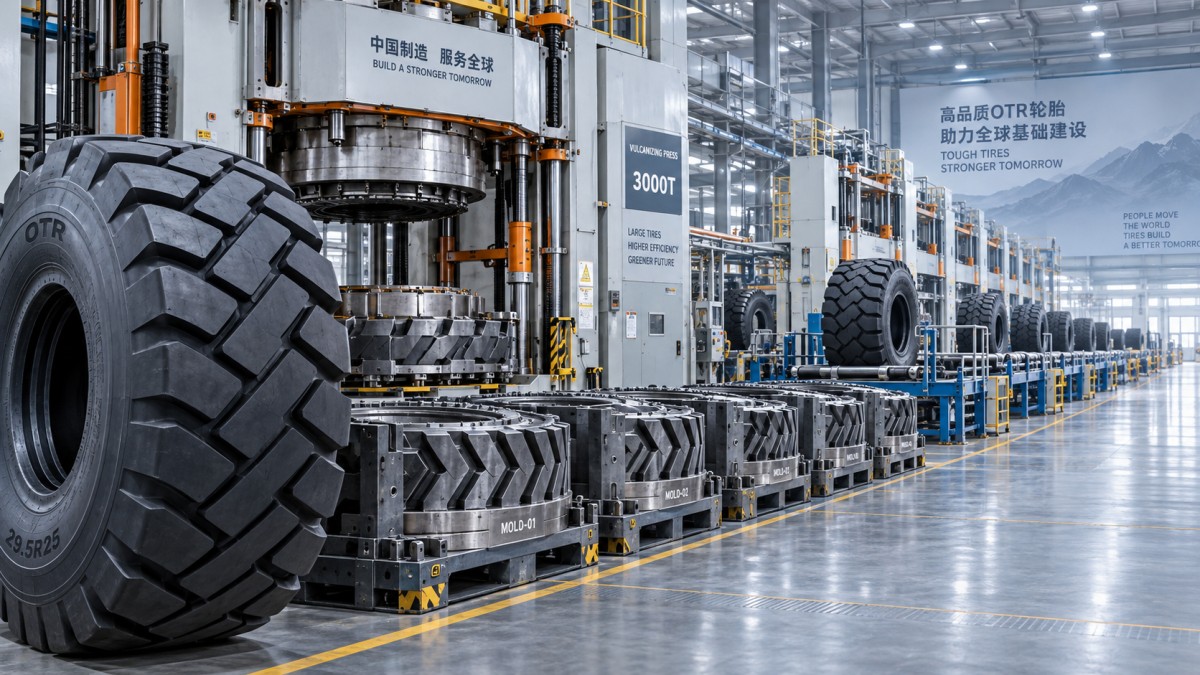
Curing deserves close attention because compatible presses, molds, and cycle times can constrain output. However, do not assume it is always the bottleneck. Building equipment, component supply, maintenance, or inspection backlogs may be the actual limitation.
For each requested size, check:
- How many compatible presses and serviceable molds are available, and whether they serve other products.
- The approved curing cycle, scheduled operating hours, and recent downtime records.
- Whether building and component-preparation output can support the proposed curing schedule.
- When mold changes, maintenance, and already-booked orders occupy the same equipment.
A basic capacity check starts with compatible curing positions multiplied by available operating minutes, divided by the approved cycle time. That produces theoretical output—not saleable tires. Reconcile it with actual downtime, changeovers, quality losses, and committed orders. Avoid deducting the same loss twice if the supplier’s operating-time figures already exclude it.
Use records to test what the tour suggests
Ask for recent production records for the same sizes or a technically comparable product family. Exact customer names and prices are unnecessary; redacted records should still show dates, specifications, quantities, equipment references, and release status. Aggregate annual output is much less useful than evidence of repeatable production on the relevant line.
Cross-check production logs against inspection releases, warehouse receipts, and dispatch records. These quantities may differ because tires remain under inspection or in inventory, but the differences should be explainable. A production report alone cannot prove that the factory shipped acceptable tires on time.
During an on-site or independent audit, select a batch from the floor and trace it through the applicable records. Review material identification, process-control records, and finished-tire checks. Where internal inspection or performance testing is claimed, verify its scope and frequency rather than assuming every tire receives every test.
Repeated unexplained gaps, unavailable batch records, or equipment that does not match the proposed production route deserve more attention than a polished presentation. Confidentiality is reasonable; an inability to provide any redacted evidence leaves the capacity claim unverified.
Separate production time from delivery time
Ask for a dated schedule covering material readiness, building, curing, inspection, packing, and dispatch. Clarify whether the quoted lead time begins after deposit, technical approval, or another milestone. “Available capacity” means little if the required materials or molds will not be ready.
Xinkunyu’s profile also describes established dedicated logistics lines serving China and most countries and regions in Europe and Asia. Logistics arrangements can help dispatch, but they cannot compensate for an unreserved production slot. Check inland transport, container availability, loading plans, and the agreed delivery term separately from manufacturing capability.
Mixed-size orders need particular care. One delayed size may hold up a complete shipment. Decide in advance whether partial dispatch is acceptable and who pays additional freight or handling costs. The cheapest unit quotation may become the more expensive purchase if it creates emergency replenishment or prolonged equipment downtime.
Approve a production commitment, not a headline figure
Before committing to recurring volume, place a controlled initial order with agreed specifications, inspection requirements, traceability, and shipment milestones. If the purpose is to validate manufacturing capacity, confirm that the order comes from scheduled production rather than existing stock. Successful stock delivery verifies fulfillment, not necessarily replenishment capability.
The strongest basis for approval is a consistent chain of evidence: compatible equipment, demonstrated output, released quality, and an available slot for your order. If one link remains uncertain, reduce the initial commitment or keep an alternative source open. A credible supplier should be able to explain its constraints as clearly as its capacity.
Chat Online