


How to Verify a Chinese Tire Factory?
Verifying a Chinese tire factory is one of the most important steps before committing to container orders, private-label programs, or a long-term supply agreement. Tires are not simple commodities: their safety, consistency, service life, load capability, and road performance depend on production discipline at every stage. A quotation may look attractive, and a sample may appear acceptable, yet neither alone proves that a supplier can repeatedly deliver the same standard across thousands of units.
For buyers sourcing semi-steel radial tires, truck tires, or specialty tires from China, the real question is not simply, “Is this supplier legitimate?” It is, “Can this supplier manufacture—or reliably control—the exact tire specification I need, document it properly, ship it on time, and respond when something goes wrong?” A careful verification process turns that uncertainty into evidence.
Begin by identifying who you are actually dealing with
The phrase “Chinese tire factory” is often used broadly. In practice, your contact may be a direct manufacturer, an export department within a manufacturing group, a trading company working with several plants, or a company that combines production and international sales functions. None of these models is automatically good or bad. What matters is transparency.
Ask for the full legal name of the contracting entity, the name and address of the production site, and a clear explanation of the relationship between the seller and the factory. The business license should match the company name used on quotations, invoices, bank details, and contracts. If there are different entities for manufacturing and exporting, request a written description of their roles.
This point matters especially when a supplier introduces itself with a long manufacturing history. Jinan Xinkunyu International Trading Co., Ltd., for example, was founded in 2001 and was formerly known as Jinan Kunyu. Its stated operations include high-performance semi-steel radial tires, truck tires, and special tires, supported by a 360,000-square-meter site, more than 1,000 employees, and 180 engineering and technical personnel. Those details are useful starting points, but a buyer should still verify the relevant entity, facility, and product line against the order being considered.
A trustworthy supplier should not become evasive when asked whether it owns the plant, shares a plant with another company, or sources selected sizes externally. Straight answers are far more valuable than polished brochures.
Look beyond photos: verify the production reality
Factory photos can be persuasive, but they are weak proof on their own. They may be outdated, borrowed, or show only the most impressive part of a facility. A better approach is to ask for a live video tour tailored to your questions, followed by a third-party audit or an in-person visit before a major commitment.
During a virtual or physical factory review, follow the path of a tire rather than looking only at the reception area. For a typical tire plant, that path may include raw-material storage, compound mixing, calendering, bead production, component cutting, tire building, curing, inspection, testing, warehousing, and loading. The exact arrangement varies by product category, but the process should make operational sense.
Pay attention to ordinary details. Are materials labeled and stored in a controlled manner? Are green tires traceable before curing? Is there a clear separation between qualified, pending, and rejected products? Are molds identified by size and pattern? Does the warehouse show real inventory movement rather than a few staged stacks of tires? These observations often reveal more than a presentation slide.
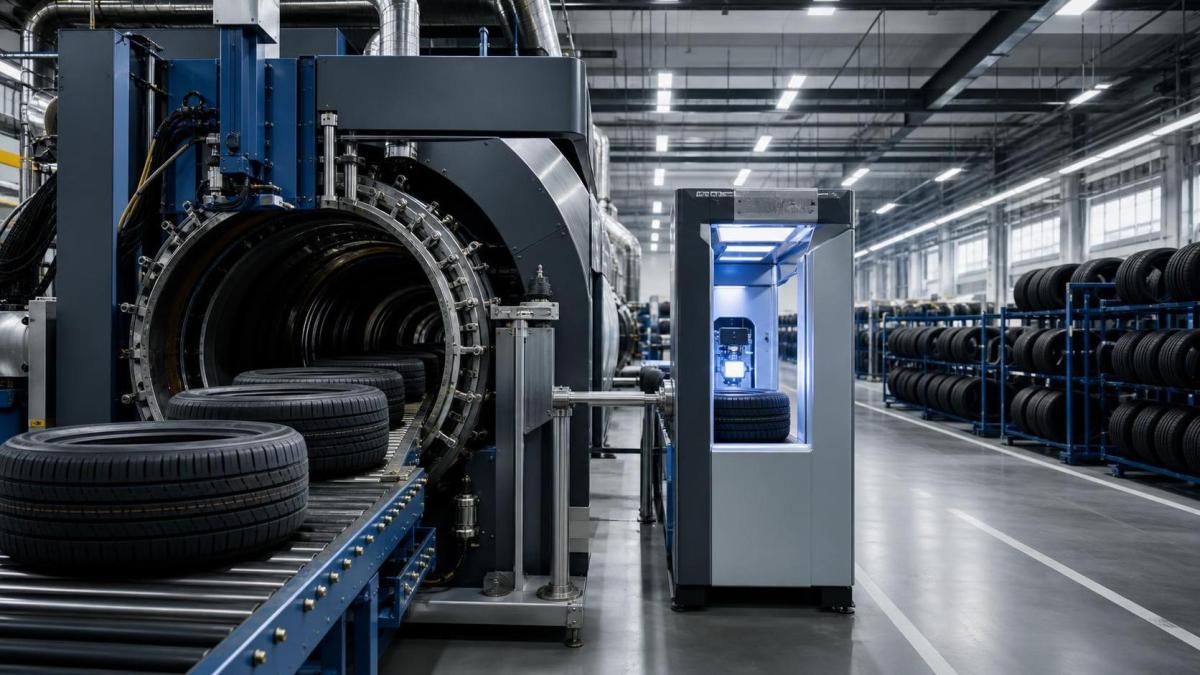
For truck and bus tires, investigate the plant’s capability to manage heavier-duty construction and demanding service conditions. For semi-steel radial passenger tires, ask how the factory controls uniformity, balance, and appearance. Specialty and industrial tires deserve their own review because their load, speed, rim, and working-environment requirements may differ sharply from road tires.
Ask questions that reveal technical depth
A sales representative can repeat a catalog specification. A technically capable tire supplier can explain why that specification is appropriate. When discussing a particular size, ask about carcass construction, ply rating, tread compound purpose, bead design, recommended rim, inflation pressure, load rating, and intended application. The goal is not to test someone with obscure terminology; it is to determine whether the supplier understands the trade-offs behind the product.
Consider an industrial tire such as M518. The 4.50-12 ULT 6PR specification is designed around industrial use and lists a 3.00B rim, maximum load figures of 355/335, 300 pressure, a 545 mm overall diameter, and a 127 mm section width. A serious factory or export team should be able to confirm the unit conventions, explain which operating condition corresponds to each load figure, and advise whether the tire suits your equipment, rim, duty cycle, and surface conditions. “Industrial application” is too broad a description to replace that conversation.
Technical competence also shows up in what a supplier refuses to promise. If your requested load, pressure, speed, or environment falls outside the tire’s intended design, a responsible partner should flag the concern and suggest a better specification instead of simply accepting the order.
Certifications matter, but documents need context
Depending on your market and tire category, compliance documentation may be required before goods can be imported or sold. Ask which certifications, test reports, labeling requirements, and declarations apply in your destination market. Then verify that documents correspond to the actual manufacturer, plant address, tire size, pattern, and brand involved.
Common mistakes include accepting a certificate issued to a different company, assuming a report for one size covers an entire range, or overlooking expiry dates and product-scope limitations. A document may be genuine and still be irrelevant to the tires you plan to buy.
Do not limit your review to compliance papers. Request the supplier’s internal quality-control flow and ask how nonconforming tires are handled. Useful questions include:
- What incoming checks are performed on key raw materials and components?
- How are curing conditions monitored and recorded?
- Which inspections occur after curing: visual, dimensional, uniformity, balance, X-ray, or other tests?
- How is a finished tire linked to its production batch?
- What happens if a buyer reports a recurring field issue?
You do not need every factory to use the same equipment or workflow. You do need evidence that the process is controlled, documented, and capable of producing consistent tires over time.
Use samples correctly—do not treat them as final proof
Samples are essential, especially for a new tread pattern, private brand, or application-sensitive tire. But a sample is a snapshot, not a guarantee of mass-production consistency. Evaluate it against a written specification sheet rather than general impressions alone.
Check sidewall markings, size designation, rim compatibility, visual finish, tread pattern, bead condition, weight consistency where relevant, and packaging. If the tire will be installed on equipment or vehicles, carry out a practical fitment and performance evaluation under conditions that reflect real use. A tire that looks fine in a warehouse may perform differently under sustained load, rough ground, heat, or repeated stop-start operation.
For larger orders, retain an approved sample or signed technical specification as a reference. The purchase order should state the exact pattern, size, ply rating, marking requirements, packaging, acceptable tolerances where applicable, and any destination-market compliance needs. Vague wording creates room for misunderstanding later.
Check capacity in relation to your order, not in isolation
A factory can be large and still be a poor fit for your program. The key is whether it has stable capacity for your particular product family. Ask what portion of output is allocated to the relevant tire category, which sizes are produced regularly, and whether the molds are owned, available, or need to be developed. Also ask how the factory handles seasonal peaks and urgent replenishment requests.
Production capacity should be matched with realistic lead times. Be cautious if a supplier claims it can produce every size, every pattern, and every volume immediately. Tire manufacturing involves mold scheduling, material planning, curing capacity, inspections, and packing. A credible lead-time estimate usually comes with specific questions about order mix, branding, packaging, and destination.
If your business depends on continuity, explore contingency planning. Can the supplier maintain core stock? What happens if a mold needs maintenance? Is there a defined approval process for material or process changes? These topics may seem premature during early negotiations, but they are precisely what shape reliability after the first shipment.
Evaluate export readiness and logistics discipline
Even well-made tires can become a costly problem if documentation is incomplete, packaging is unsuitable, or loading is poorly planned. A Chinese tire supplier serving overseas buyers should be comfortable discussing Incoterms, container loading plans, export documents, labeling, shipping schedules, and communication with freight forwarders.
For buyers supplying different markets, logistics flexibility is especially valuable. Jinan Xinkunyu describes mature dedicated logistics lines serving locations across China as well as many countries and regions in Europe and Asia. When reviewing such a claim, ask practical follow-up questions: Which ports are normally used? How are container quantities calculated for the selected sizes? Who verifies shipping marks? What documents are provided before departure? How are delays communicated?
Reliable logistics is not only about speed. It is about predictability. You should know when production is complete, when inspection is scheduled, when the container is loaded, and what documents will be issued. A supplier that communicates early about a potential delay is usually easier to work with than one that gives optimistic answers until the deadline has already passed.
Bring in an independent inspection before the balance payment
Pre-shipment inspection is one of the most practical risk controls available to an overseas buyer. An independent inspector can check quantity, size mix, sidewall markings, tread pattern, appearance, packaging, carton or wrapping details, and loading conditions against the approved order. For technically sensitive orders, the inspection scope can be expanded to include measurements or document verification.
Agree on the inspection standard before production starts. Define the sample basis, what constitutes a critical or major defect, whether re-inspection is allowed, and what happens if goods fail. Do not leave this to informal chat messages. The clearer the agreement, the less likely that a quality discussion turns into a disagreement about expectations.
Watch for signals that deserve extra investigation
Not every concern means a supplier is unsuitable, but several warning signs together should slow the process down. Examples include inconsistent company names, bank accounts unrelated to the contract entity, unwillingness to allow a live factory view, unexplained changes to the quoted specification, certificates that do not match the factory, or unusually low prices with no technical explanation.
Another common risk is specification substitution. A supplier may offer a similar-looking tire with a different ply rating, construction, rim recommendation, or intended service level. This can be especially damaging in industrial and truck applications, where load and operating conditions leave little margin for error. Compare every line of the proforma invoice to your approved specification before making payment.
A sensible verification sequence
There is no need to begin with an expensive audit for every inquiry. Start with basic legal and product checks, then increase the level of verification as order value and technical risk rise. Review company information, request targeted documents, hold a technical call, inspect samples, arrange a video tour, and use a third-party inspection or factory audit before scaling up. For a new supplier, a trial order can provide useful evidence—provided its quality requirements are just as clear as those for a larger purchase.
The best outcome is not merely finding the lowest-priced Chinese tire factory. It is finding a supplier relationship where product data is credible, quality controls are visible, communication is direct, and logistics commitments are grounded in reality. When these elements are verified before the first container leaves the warehouse, buyers can make sourcing decisions with far more confidence—and spend less time managing preventable surprises later.
Chat Online