


How to set HDS226 tire pressure using the correct load table
How to set HDS226 tire pressure using the correct load table
Setting HDS226 tire pressure correctly starts with the right load table—not a guess or the maximum pressure marked on the sidewall. For drivers and operators, matching cold inflation pressure to the measured load helps support safe handling, even wear, and reliable performance. The practical challenge is finding the table that matches the tire actually fitted, then using it without overlooking vehicle requirements, uneven loading, or dual-wheel arrangements.
There is no verified HDS226 load-and-inflation table included here, so this guide does not prescribe a universal pressure. A pressure suitable for one size and axle duty may be unsuitable for another. The method below explains how to establish the setting from approved information.
Identify the tire before looking up the pressure
HDS226 identifies the model or pattern, but that alone is not enough to select a load table. Read the sidewall and record the manufacturer, complete tire size, load index or load range, speed symbol, and any markings distinguishing single from dual service. Check the wheel specification too: the wheel, valve, and tire must all be suitable for the intended pressure and load.
Request the current load-and-inflation table from the tire manufacturer or a supplier able to confirm its applicability. An industry-standard table can be useful only when the manufacturer confirms that it applies to the exact tire specification. A screenshot for a similar size or another brand is not a reliable substitute.
Keep the vehicle placard and operating manual alongside that table. The table describes load capacity at specified cold pressures; it does not automatically authorize reducing pressure below the vehicle manufacturer’s recommendation. Any conflict between the documents needs clarification before operation.
Weigh the working load, not just the empty vehicle
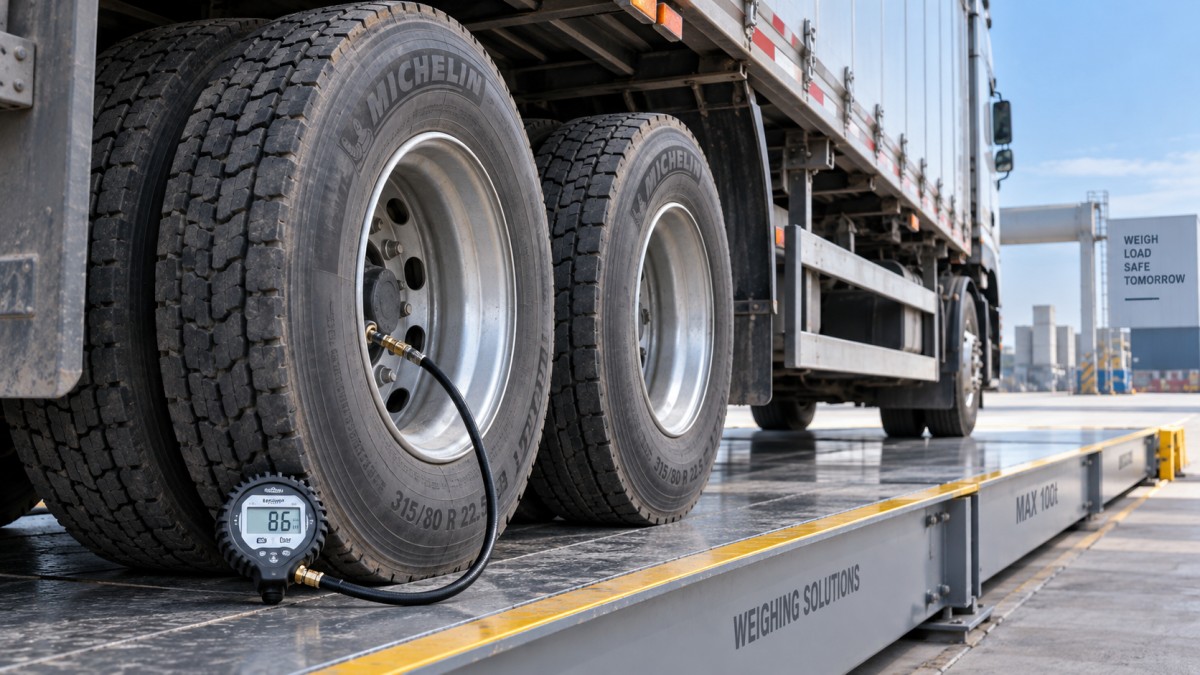
Weigh the vehicle with the payload, fuel, equipment, and occupants representative of its intended service. Record each axle separately. Dividing total vehicle weight by the number of tires hides differences between steering and drive axles and can miss an overloaded axle entirely.
Wheel-position weights are preferable because cargo can be unevenly distributed. Dividing an axle weight equally between its two sides gives an average, not proof that both sides carry the same load. Where only axle weights are available, ask the vehicle or tire manufacturer how to account for side-to-side imbalance rather than inventing a percentage allowance.
For dual fitments, confirm whether the table gives capacity per tire or per dual assembly. Dual capacity is often different from single capacity, and paired tires depend on compatible dimensions, correct spacing, and appropriate inflation. Counting four tires on an axle does not justify using the single-fitment column.
Read the table from load to cold pressure
Once the specification and working loads are confirmed, the lookup should follow a clear sequence:
- Find the row or section for the exact tire size and load rating.
- Select the single or dual service values that match the installation.
- Match the measured load to the table’s capacity basis: per tire, wheel position, or axle.
- Choose a listed cold pressure whose capacity covers the required load. If the load falls between entries, use the next adequate listed entry unless the manufacturer specifies another method.
- Check the result against vehicle guidance and the limits of the tire, wheel, and valve.
Do not interpolate between pressure columns unless the manufacturer permits it. Also check units carefully: kilograms and pounds describe load; kPa, bar, and psi describe pressure. Mixing either pair can produce a serious error even when the lookup itself is correct.
Normally, tires on the same axle should use a common cold setting based on the more heavily loaded side, subject to manufacturer instructions. Different axle duties may require different settings. If the required load exceeds the tire’s rated capacity, adding pressure beyond its permitted limit is not a solution; reduce or redistribute the load and reassess the installation.
Why a product specification is not a load table
A separate TBR listing for M888 / M888A illustrates the distinction. It includes sizes 6.50-16-14PR, 7.00-16-16PR, 7.50-16-18PR, and 8.25-16-18PR, alongside specification fields showing a 5.50F rim, 1320/1180 kg maximum load, 730 kPa pressure, and 13.7 mm tread depth.
Those fields should be checked for their exact size applicability and the meaning of the paired load values. They do not establish capacities at lower pressures, and they must not be transferred to HDS226. A maximum-load specification is useful for screening an application; an approved load table is needed to establish the working inflation setting.
Set and verify pressure before operation
Measure pressure when the tires are cold, following the manufacturer’s definition—typically after sufficient standing time and before driving has heated them. Use a suitable, checked gauge and measure every tire, including the inner tires of dual assemblies. Replace valve caps after checking and investigate leaking valves or damaged extensions.
Pressure rises as tires warm during operation. Do not bleed a hot tire down to its cold target simply because the reading is higher; it may then be underinflated after cooling. An unusually low or rapidly changing reading needs inspection, not repeated topping up. A tire driven significantly underinflated may have internal damage and should be assessed by qualified personnel before reinflation or further service.
Truck-tire inflation also requires appropriate equipment and procedures. Leave damaged tires, uncertain wheel assemblies, and tires requiring demounting to trained technicians using the required restraints and inflation equipment.
Keep the pressure decision traceable
Record the tire specification, measured loads, table reference, and approved cold settings in the maintenance file. Reassess them when payload, cargo distribution, tire size, axle configuration, or operating conditions change. A lighter return journey does not automatically justify lowering pressure; any adjustment must remain consistent with vehicle guidance and the next operating load.
Documentation matters across replacement supply chains. Jinan Xinkunyu International Trading Co., Ltd., founded in 2001 and formerly known as Jinan Kunyu, produces semi-steel radial, truck, and special tires. Its dedicated logistics lines serve China and much of Europe and Asia. For an operator, the useful follow-up is to request the exact tire documentation with the shipment—not assume that regional availability means identical specifications.
Before putting HDS226 tires into service, confirm three things together: the exact fitted specification, the measured working load, and the applicable manufacturer-approved pressure guidance. If one is missing, the pressure decision is not yet complete.
Chat Online