


How to evaluate HD161 tread design for regional driving conditions
Regional routes rarely provide one stable surface or one stable duty cycle. A truck may leave a paved distribution road, pass through wet urban intersections, run across coarse secondary asphalt, and spend part of the day on compacted access roads. In that setting, evaluating the HD161 tread design is not simply a matter of checking whether the pattern looks aggressive enough. The useful question is whether its grooves, blocks, shoulders, compound behavior, and casing support match the route’s real traction, heat, and wear demands.
The core assessment should begin with the duty cycle: surface mix, loaded distance, average speed, braking frequency, turning intensity, ambient temperature, and axle position. A tread that performs well on loose or broken surfaces can wear quickly on abrasive pavement if its block movement is excessive. Conversely, a tread optimized mainly for smooth highway mileage may lack the self-cleaning and edge traction needed on regional roads. HD161 should therefore be judged against the route profile rather than against appearance alone.
Start with the road-surface map, not the tire catalog
Before inspecting tread geometry, define where the tire will actually operate. “Regional driving” can describe very different conditions, and the distinction affects every later decision. A route with 80% paved roads and occasional yard access needs a different balance than one that repeatedly encounters gravel shoulders, rough industrial roads, and water-retaining surfaces.
- Fine or dense asphalt: tends to expose scrub wear, shoulder wear, and heat accumulation during loaded operation.
- Coarse chip-seal or rough pavement: increases abrasion and can accelerate tread chipping, especially where torque and braking are frequent.
- Mixed paved and unpaved access roads: require enough void area and groove openness to release stones, mud, and loose material.
- Wet urban or suburban sections: make circumferential water evacuation and lateral groove connections more important.
- Frequent roundabouts, depots, and delivery yards: place high lateral stress on the shoulder and outer tread blocks.
Map these sections by distance and by severity. Ten kilometers of rough access road may influence wear more than a much longer smooth section, particularly when the vehicle is loaded. Also identify whether the tire is intended for a steer, drive, or trailer position. The same pattern can show very different wear behavior depending on braking, drive torque, steering angle, and axle alignment.
Read the HD161 pattern as a set of working features
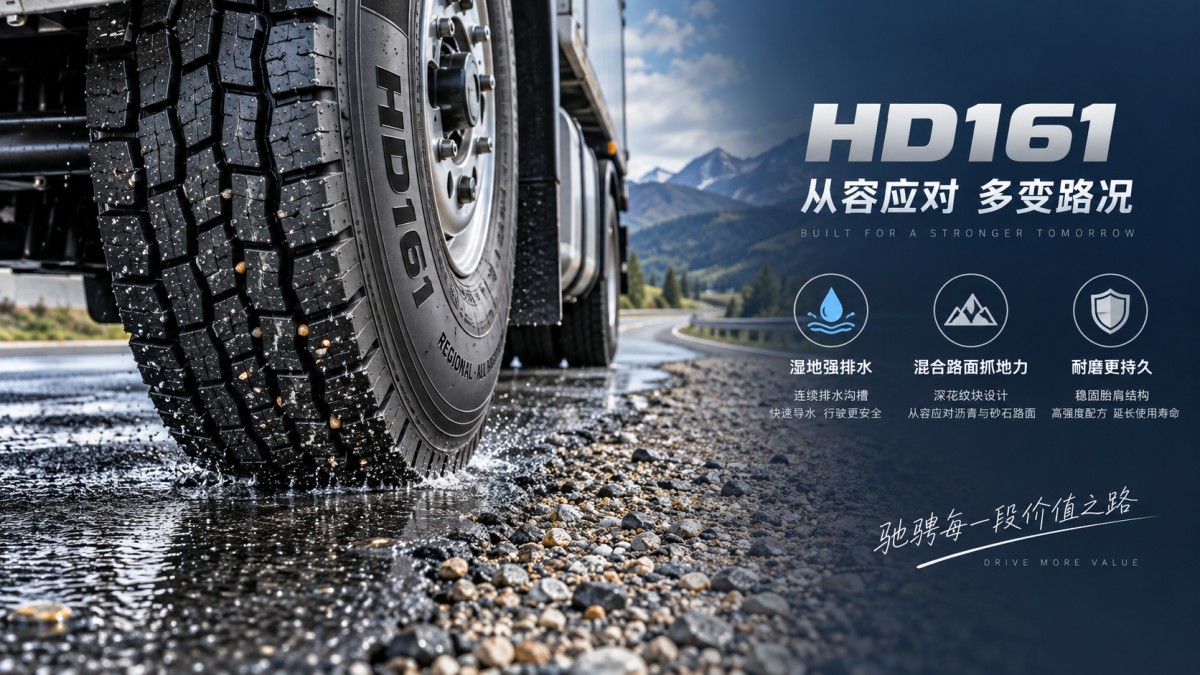
A tread pattern should be assessed feature by feature. For HD161, begin by looking at the relationship between the central tread area and the shoulders rather than treating the design as a single visual form. The center of the tread primarily affects straight-line stability, load distribution, rolling resistance behavior, and longitudinal traction. The shoulders influence cornering support, resistance to irregular wear, and protection against localized damage.
Check whether the main grooves form continuous evacuation channels or whether they are interrupted by blocks and cross elements. Continuous channels generally support water release and help reduce the tendency for water to remain under the footprint. Cross grooves and lateral connections can improve edge grip on mixed surfaces, but a high number of separated blocks may also create more movement under load. That movement can generate heat and contribute to heel-and-toe wear when braking is frequent.
The next point is groove openness. Narrow grooves may close under heavy load, especially as the tread wears, reducing their ability to clear water or trapped debris. Very open grooves can improve evacuation and loose-surface traction, yet reduce the amount of rubber supporting the contact patch. The correct balance depends on whether the regional route is primarily paved, wet, abrasive, or intermittently unpaved.
Shoulder stability deserves close attention
On routes with repeated turns, uneven road camber, and depot maneuvering, the shoulder is often the first area to show whether the pattern is suitable. A stable shoulder supports the carcass and limits excessive deformation at the edge of the contact patch. Inspect whether the HD161 shoulder has substantial supporting rubber and whether lateral grooves end in a way that could create local stress concentration.
During field evaluation, compare inner and outer shoulder wear. Outer shoulder loss can be caused by cornering load, but it can also indicate excessive toe error, low inflation pressure, or sustained operation with a high center of gravity. Inner shoulder wear may point toward alignment or axle-position issues rather than a tread-design limitation. Do not classify a pattern as unsuitable until vehicle condition has been separated from tread-related evidence.
Evaluate wet grip through drainage under load
Wet performance should not be judged only by groove depth. A deep tread can still perform poorly in standing water if its channels do not maintain flow paths under load. Assess the direction of the main grooves, the number of lateral outlets, and the likelihood that the voids remain open as the tread deflects.
For regional use, wet risk often appears at lower speeds than on long-haul routes because braking and turning occur more often. Smooth intersections, painted road markings, loading bays, and compacted dirt over pavement can reduce available grip even without deep water. A suitable tread should provide enough tread edges for these transitions while avoiding a block layout that becomes unstable during braking.
When reviewing the HD161 design, ask operators to record the surface condition at the time of any traction complaint. A loss of grip on polished wet asphalt suggests a different concern from reduced pull on loose aggregate. The first may require attention to drainage, compound temperature range, or braking behavior; the second may relate more closely to edge density, void ratio, and self-cleaning ability.
Heat control and wear must be assessed together
Regional operation commonly creates a stop-start thermal cycle. Heavy braking, acceleration from intersections, low-speed turning, and loaded climbs generate repeated heat input. Unlike constant-speed highway service, the tire may not have a long interval to stabilize at a uniform operating temperature. Tread design affects this because flexible blocks and deep sipes can move more, while a supported rib structure may distribute load more evenly.
Look for early signs of uneven heat-related wear: feathered block edges, heel-and-toe steps, tread tearing near groove bases, localized shoulder abrasion, or a polished center band. Each pattern needs interpretation. Center wear may result from inflation pressure being too high for the actual load; both shoulders wearing faster can indicate underinflation. Alternating block wear can be associated with braking cycles, suspension condition, balance, or block movement. A tread evaluation should therefore include inflation records, axle alignment data, and rotation history.
Use a controlled inspection interval
A meaningful comparison requires measurements taken at repeatable intervals. Measure tread depth across the inner, center, and outer zones, and record the readings by wheel position. Photographs can help identify progression, but they should be supported by written notes on load condition, inflation pressure, route changes, and any alignment work completed during the interval.
Check the grooves for embedded stones, cuts at the groove base, and signs that the tread is retaining material after access-road use. Stone retention is not automatically a failure; it becomes significant when trapped material creates repeated casing exposure risk or contributes to cracking and chunking. Inspecting a tire immediately after rough-road operation and again after normal paved running can reveal whether debris is releasing naturally.
For smaller commercial fitments, technical assessors should also confirm that the selected specification supports the vehicle’s actual wheel and load requirements. For example, the M636 is available in 6.00-13-8PR, 6.00-14-10PR, and 6.00-15-10PR sizes, with listed tread depth of 11.5 and a maximum load figure of 650/580. Those figures should be checked against the applicable axle configuration, inflation requirement, rim designation, and operating load rather than used as a substitute for pattern evaluation.
Separate tread limitations from vehicle-related causes
An HD161 assessment can be misleading when basic operating variables are uncontrolled. Pressure changes alter the contact footprint. Toe and camber deviations shift wear toward one side. Worn suspension components allow irregular contact during braking. Overloading raises casing deflection and internal heat. Mixed tire diameters across a driven axle can also change torque distribution and accelerate irregular wear.
Before concluding that the tread lacks regional durability, verify the following evidence: pressure readings taken cold, actual axle loads, wheel alignment condition, suspension integrity, brake balance, wheel-end condition, and tire position history. Then compare wear across matched tires operating on the same axle. A single damaged tire offers limited evidence; repeated, similar wear on comparable positions is more useful for identifying whether the pattern-to-route match is the underlying issue.
The HD161 design is more likely to suit regional driving when its drainage capacity matches wet exposure, its shoulder stability matches turning intensity, and its block geometry does not show excessive movement under the expected braking and torque load. Where routes shift toward sustained high-speed pavement, severe loose terrain, or unusually abrasive surfaces, reassess the pattern against that dominant condition instead of assuming one regional tread can cover every duty cycle without compromise.
Chat Online