


How to compare automotive tires by rolling resistance ratings
When a fleet specification, vehicle program, or replacement-tire review reaches the rolling-resistance section, the lowest visible rating can appear to be the obvious choice. It rarely is. A tire may show an attractive fuel-efficiency class yet be unsuitable for the required axle position, payload, operating speed, climate, or duty cycle. Conversely, a tire with a less favorable rating may deliver a lower whole-life operating cost where cut resistance, traction retention, or casing durability matter more.
To compare automotive tires by rolling resistance ratings correctly, first compare only tires tested under the same rating system, tire category, and test basis. Then treat the rating as one input in a controlled technical comparison, alongside load capability, inflation pressure, tread design, heat behavior, wet grip, noise, wear expectation, and intended application. A label grade is useful for screening candidates; it is not a complete performance verdict.
Start by identifying what the rating actually represents
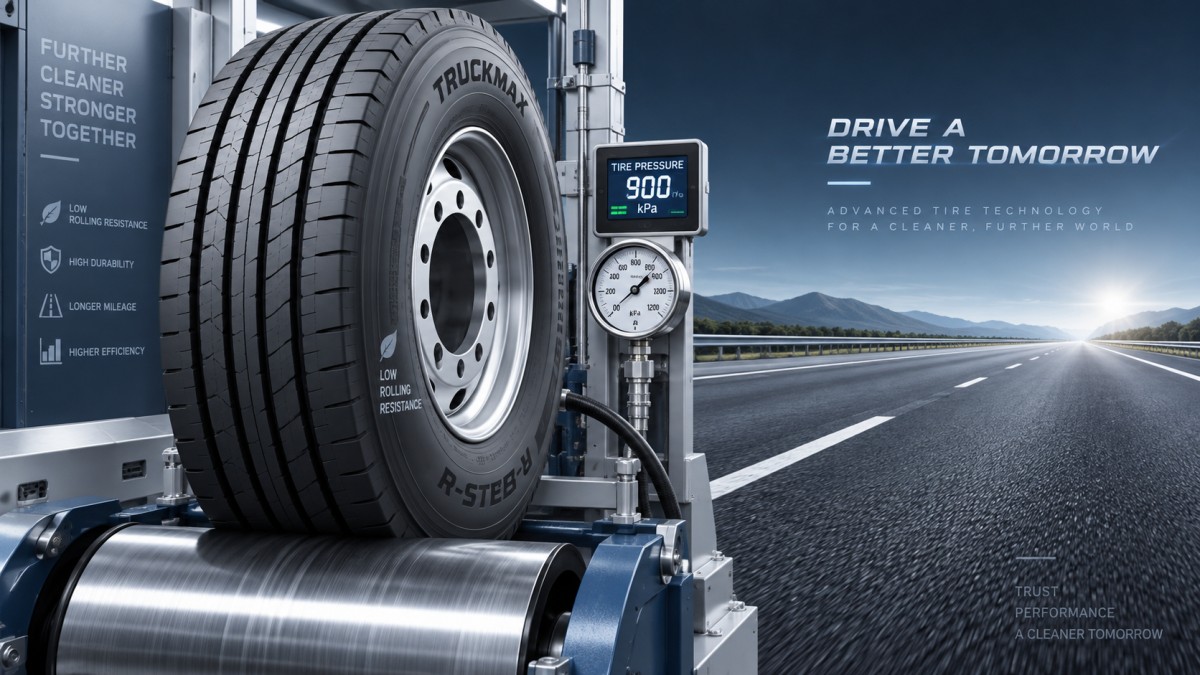
Rolling resistance is the energy a tire consumes as it rolls under load. Much of that energy is lost as heat when the tire deforms and recovers through the contact patch. Lower rolling resistance generally supports lower fuel or energy consumption, provided the comparison conditions are equivalent.
Rating labels simplify this property into classes or grades. The label may be based on a rolling-resistance coefficient (RRC), often measured in controlled laboratory conditions using a defined load, speed, inflation pressure, and test machine. The rating does not directly state fuel consumption in a particular truck, car, or specialty vehicle. It shows the tire’s relative performance within the label framework.
This distinction matters in practical evaluation. A highway tire running at its specified pressure on a well-maintained vehicle may express its rolling-resistance advantage more consistently than the same tire used in stop-start service, on abrasive roads, or at chronically low inflation. The label remains valid for its test condition; the vehicle’s actual energy use depends on the entire operating system.
Do not compare grades before normalizing the candidates
The first task is to remove false comparisons. Two tires should not be ranked solely by a rolling-resistance grade unless their application boundaries are substantially alike. A passenger-car tire, a regional truck tire, and a construction-service tire are designed around different compromises. Their labels may use related concepts but should not be read as interchangeable evidence.
A useful internal rule is to form a comparison group before looking at the grade: same vehicle class, same nominal size family, compatible load and speed requirements, and the same intended position. Only then should the rolling-resistance result influence ranking.
Read the rating as a trade-off, not an isolated target
Reducing hysteresis in the tread compound and casing can reduce rolling resistance, but tire design has multiple constraints. Wet braking, snow or loose-surface traction, abrasion resistance, retreadability, handling stability, and resistance to stone retention may require different materials or tread geometry. The technically sound question is not “Which tire has the lowest resistance?” but “What level of resistance is acceptable after all mandatory service functions are met?”
For example, an open-shoulder drive or mixed-service pattern can improve cooling and debris release. Those features may be essential in a severe operating environment even when a closed-rib, long-haul design could potentially prioritize low resistance. Comparing the two only by a label grade ignores the reason each pattern exists.
Rolling resistance also changes over the tire’s life. Tread depth decreases, compound properties evolve with heat cycles, alignment affects scrub, and inflation deviations alter carcass deflection. Label values should therefore be treated as standardized new-tire data, not a guarantee of a fixed in-service result.
A practical sequence for reviewing tire data
- Set non-negotiable requirements first. Record the required size, load index, speed symbol, axle position, rim, legal marking requirements, and operating surface. Exclude any tire that fails these conditions, regardless of its efficiency grade.
- Collect like-for-like rating documents. Ask for the label or technical document corresponding to the exact SKU, rather than a general product-family statement. Confirm that the document applies to the reviewed size and construction.
- Capture the underlying RRC where available. A class is convenient, but the measured coefficient and the named test method provide more resolution. Do not calculate a fuel-saving percentage from RRC alone unless a validated vehicle model and duty-cycle assumptions are available.
- Review companion performance properties. For on-road use, examine wet-grip information where applicable. For commercial applications, examine durability-related design features, tread depth, heat management, casing suitability, and service-position guidance.
- Map the tire to operating severity. Separate long, steady highway operation from urban delivery, regional routes, high ambient temperatures, gravel exposure, and high-torque drive positions. The same vehicle can require different priorities across axle positions.
- Document the decision basis. Record why one candidate was selected: rating-system equivalence, duty-cycle fit, capacity margin, and any operational trade-off accepted. This prevents a later rating comparison from being detached from the original application.
Inflation control can outweigh small label differences
A narrow difference between two eligible ratings may be less important than maintaining correct cold inflation pressure in service. Underinflation increases deflection and heat, which can raise rolling losses and accelerate structural fatigue. Overinflation may change contact pressure and wear behavior. Pressure should be set according to the tire manufacturer’s load-and-inflation guidance and checked with a disciplined process, not adjusted merely to chase an efficiency metric.
Alignment, wheel-end condition, brake drag, vehicle loading, and route conditions can also mask the advantage of a lower-resistance tire. When field fuel consumption does not align with the tire label, investigate these contributors before concluding that the rating is inaccurate. A controlled evaluation compares similar vehicles, loads, routes, drivers, maintenance status, and tire positions over a sufficient operating period; uncontrolled observations are best used as signals for further review.
Applying the method to commercial and specialty tires
Commercial tire selection often requires a stricter separation between energy efficiency and service capability. A candidate such as HD158A should first be checked against its stated 285/70R19.5 specification, 18-ply construction, 150/148 load index, K speed rating, and 8.25 standard rim requirement. Its block pattern, connecting ribs in the grooves, and open-shoulder design indicate that driving performance, groove protection, self-cleaning, and heat dissipation are relevant design considerations.
Those characteristics do not establish a rolling-resistance rating by themselves. For a valid efficiency comparison, obtain the applicable rating declaration or RRC test information for that exact specification, then compare it only with tires serving the same vehicle position and operating conditions. This avoids the common mistake of comparing a more service-oriented pattern against a highway-focused alternative as if both were intended to solve the same problem.
Questions that reveal an unreliable comparison
Be cautious when a proposal presents only a grade without naming the tire size, test basis, or application. The same concern applies when a fuel-efficiency label is used to imply superior mileage, safety, or total cost without supporting operating assumptions. Ask whether the cited value belongs to the exact tire, whether all candidates have equivalent load capacity, and whether the intended route creates traction, temperature, or debris requirements that the label does not capture.
The most defensible selection is usually the tire that meets the operating constraints first and has the best verified rolling-resistance result within that qualified group. That approach preserves the value of standardized ratings without allowing a single laboratory metric to override the functional requirements of the vehicle.
Chat Online