


How to choose truck tire load ratings from fully loaded axle weights
Choose truck tire load ratings by measuring the vehicle at its heaviest intended operating condition, determining the load at each wheel position, and matching that load to the tire manufacturer’s load-and-inflation table. The selected tire must carry the required weight in its actual single or dual fitment, at the intended speed, within the pressure limits of the tire and wheel assembly. Axle averages provide a starting point; the heavier side determines whether the selection is adequate.
A load-range letter alone cannot establish suitability. Tire size, load index, service description, inflation pressure, and installation all affect usable capacity. A higher-rated tire also cannot increase the vehicle’s permitted axle weight or compensate for an overloaded wheel.
Measure the condition the tires must actually carry
Fully loaded weight should include the intended payload, fuel, occupants, tools, mounted equipment, and other loads carried during operation. Use a loading arrangement that represents the heaviest expected duty. If cargo position varies, assess the arrangements that create the highest load on each axle rather than assuming one weighing captures every condition.
Record individual axle weights on a suitable scale. Gross vehicle weight alone leaves an important gap: a vehicle can remain within its total weight limit while one axle carries too much. Likewise, a combined tandem-axle reading does not establish the load on each axle. Suspension behavior, load placement, and vehicle configuration affect how that total is shared.
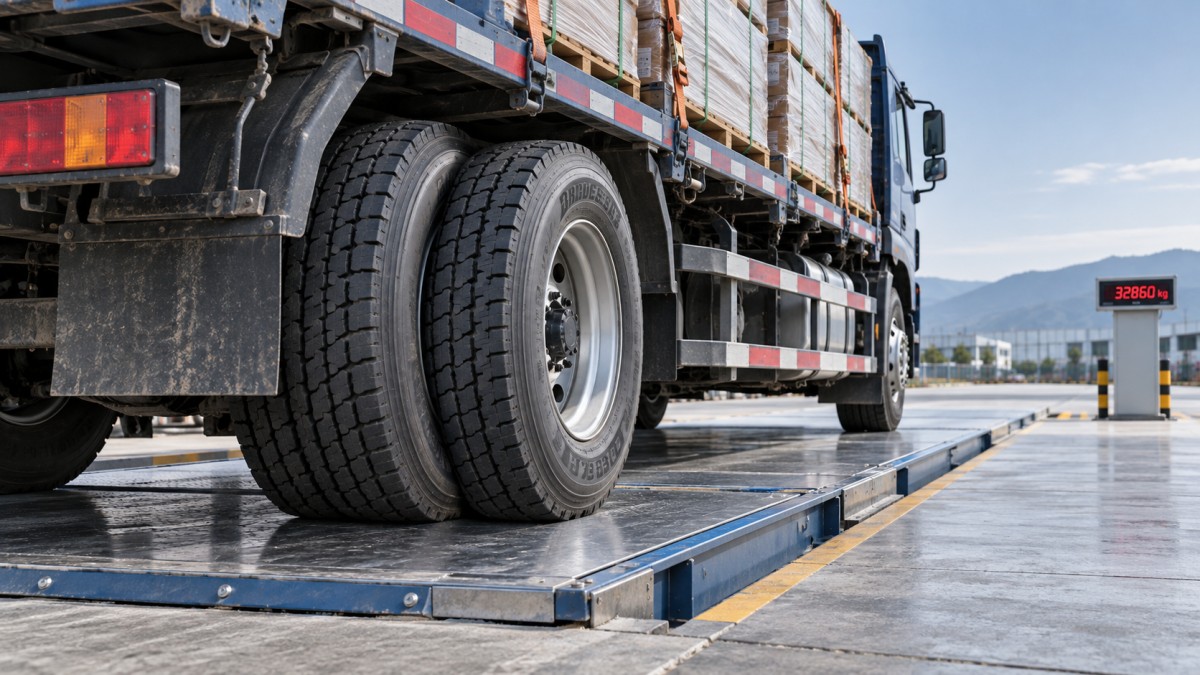
Where possible, obtain individual wheel-position weights using suitable equipment on a level surface. For a dual assembly, the wheel-position reading represents the combined load carried by the two tires on that side. Consistent scale height and the specified suspension condition matter because uneven support can distort the measured distribution.
If only axle weights are available, dividing by the number of tires gives an average requirement. Treat that result as preliminary. It does not establish the load on the heavier side, and an arbitrary allowance cannot reliably replace a wheel-position measurement.
Translate wheel-position weight into tire capacity
For an axle fitted with singles, each tire must support the measured load at its wheel position. For an axle fitted with duals, divide each side’s wheel-position load by two to establish the nominal requirement per tire, then use the manufacturer’s dual-service rating. This calculation assumes a properly matched, correctly inflated dual assembly.
Single and dual capacities are not interchangeable. When the service description contains two load indices, they identify single and dual capacity respectively. The dual value is generally lower, so multiplying a tire’s single rating by the number of tires can overstate axle capacity.
On an axle with unequal side loads, establish the required capacity from the heavier wheel position. Follow the vehicle and tire manufacturers’ inflation instructions; where a common pressure is specified across the axle, base that pressure on the heavier side. Setting each side independently from its measured weight can produce different deflection and handling behavior.
Allow for documented operating variation, such as additional equipment or a known change in payload distribution. There is no universal reserve percentage that makes every selection acceptable. When the expected variation exceeds available capacity, choose a compatible higher-capacity specification, change the loading arrangement, or reduce the load.
Read the rating together with its pressure and speed conditions
The sidewall maximum load describes capacity under stated conditions. It does not show the capacity available at every inflation pressure. Use the table applicable to the exact tire size, construction, load designation, and service conditions. A table for a visually similar tire can lead to an incorrect pressure or capacity decision.
Locate the required per-tire load in the correct single or dual column. Select a listed cold pressure that provides at least that capacity, following the table’s instructions. Avoid estimating a pressure between entries unless the manufacturer permits that method. If the required load exceeds the table’s maximum, additional inflation beyond the approved limit cannot make the tire suitable.
Load range indicates a tire’s load and inflation capability within its specification. It is not a universal weight rating across sizes. Similarly, a load index identifies rated capacity but must be read alongside the speed symbol and applicable service information.
Record the intended operating speed before approving a selection. Use only manufacturer-authorized load or inflation adjustments for the service involved. A reduced-speed capacity allowance must not be carried into faster operation, and a short journey does not justify exceeding a rating.
A dimensionally suitable tire still needs load documentation
A tire that fits the available space can still lack the required capacity. During specification review, keep dimensional suitability separate from load approval. Available sizes, tread depth, and pattern features help assess fit and traction, but none establishes the allowable axle load.
For example, HD762 is listed in 295/80R22.5, 13R22.5, and 12.00R20, with block-pattern features intended to improve traction and abrasion resistance. Those details do not supply the load indices, speed symbols, or load-and-inflation tables needed to approve a fully loaded application. Obtain the service information for the exact size and version under consideration.
Confirm the approved rim width, wheel load rating, pressure limit, and valve suitability. The required operating pressure must remain within every applicable component limit. The vehicle’s axle rating remains binding even when the combined tire capacities are higher.
For dual fitment, verify the specified minimum spacing and acceptable tire matching. Insufficient spacing allows loaded sidewalls to contact. Differences in rolling circumference, wear, or inflation can also make one tire carry more than its calculated share. Dividing the assembly load by two is valid only when the installation supports proper load sharing.
Set cold pressure and preserve the approved loading condition
Establish the cold inflation target from the approved load table and vehicle instructions. Cold pressure means pressure measured before driving has appreciably heated the tires. A hot reading cannot be compared directly with a cold target, and bleeding pressure from a normally warmed tire leaves it underinflated after cooling.
Use a suitable gauge and reach both valves in each dual assembly. Similar appearance does not confirm equal pressure. When one dual tire loses pressure, its partner takes additional load; the assembly’s original capacity calculation no longer represents its condition. Restore pressure and assess any tire operated underinflated according to the manufacturer’s service procedures.
Keep the approval record tied to the measured configuration: wheel-position weights, loading arrangement, tire specification, fitment, applicable table, cold pressure target, and component limits. A payload change, body modification, axle adjustment, or move to a different operating speed calls for reassessment when it changes those conditions.
If measured demand exceeds tire, wheel, or axle limits, resolve the mismatch before release. Load redistribution is acceptable only when subsequent weighing confirms that every affected axle and wheel position remains within its limits.
Chat Online