


How tire age limits affect passenger car tires in warehouse stock
An unused tire is not a new tire forever. For quality and safety teams, the production date on passenger car tires in warehouse stock is a release-control input, not merely a traceability record. Age alone does not prove that a tire is unsafe, and a tire stored for several years in controlled conditions may remain suitable for sale or service. But time increases uncertainty: rubber compounds continue to change, protective additives migrate and react, and storage failures can compound effects that are not visible during a quick inspection.
The practical question is therefore not, “How old is too old?” in isolation. It is whether a specific tire, with a known date code and documented storage history, still meets the organization’s safety, customer, and destination-market requirements. A defensible answer requires more than counting months in stock.
Age limits are usually a policy and compliance issue before they become a physical failure threshold
There is no single universal age limit that applies to every unused passenger car tire in every market. Requirements can differ among vehicle manufacturers, tire makers, distributors, fleet operators, insurers, public-sector buyers, and local regulations. Some customers may reject tires beyond a defined production-date window even when the tires have never been mounted. Other markets may focus on the condition of the tire and the manufacturer’s service guidance rather than impose a fixed warehouse-age limit.
That distinction matters when stock is allocated internationally. A tire that is technically acceptable under one organization’s internal release process can still be commercially unacceptable to a customer whose purchase specification requires a more recent DOT or production-date code. Quality teams should avoid treating a general rule of thumb as a substitute for contract review.
A practical stock policy should separate at least three decisions:
- Whether the tire may remain in warehouse inventory.
- Whether it may be released for sale into a particular market or customer program.
- Whether it requires additional inspection, technical review, discounting, reassignment, or disposal.
These decisions may have different age triggers. A warehouse review threshold can be earlier than a hard release limit, allowing time to inspect and reallocate inventory before it becomes difficult to sell.
Why unused tires still change in storage
Tires are engineered from rubber compounds, reinforcing materials, steel components, textiles, and bonding systems. Storage slows degradation; it does not stop it. Oxygen, ozone, heat, ultraviolet light, moisture, chemical contamination, and mechanical deformation can affect the material over time. The rate depends heavily on the environment.
Heat is especially important because it accelerates chemical aging. Tires held near heat sources, under roof areas with large temperature swings, or in poorly ventilated containers face a different risk profile from tires held in a clean, cool, dry indoor warehouse. Direct sunlight can damage exposed rubber surfaces. Ozone-producing equipment and electrical sources may contribute to surface cracking. Contact with oils, solvents, fuels, or incompatible packaging materials can create localized damage that is not resolved by simply cleaning the tire.
Long-term compression and poor stacking also matter. A tire can retain distortion if stored under excessive load, pinched between pallets, or forced into an unsuitable rack. Bead areas, sidewalls, and tread blocks should all be assessed during inspection, because storage damage is not limited to the visible tread face.
For this reason, a production date should be interpreted alongside the storage record. A five-year-old tire kept in a properly controlled warehouse may warrant a different disposition from a much younger tire exposed to sunlight, high heat, or sustained deformation. Neither should be released without the inspection and documentation appropriate to the company’s control plan.
Build release decisions around traceability, condition, and intended use
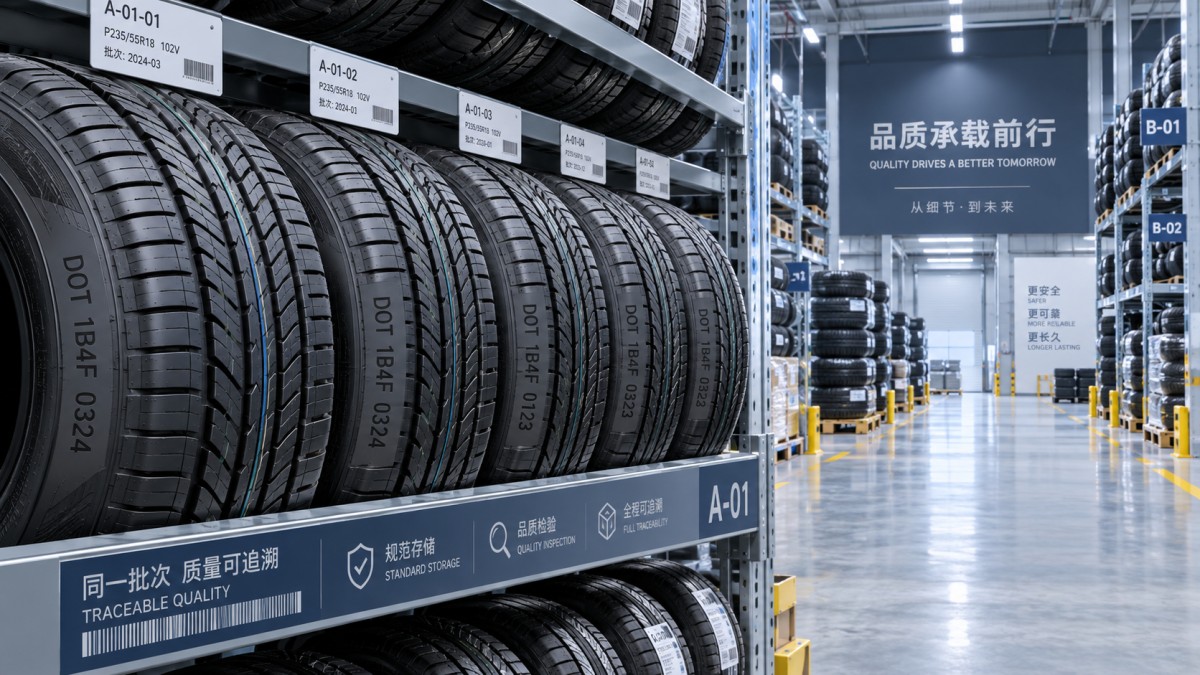
The date code provides the starting point. Warehouse teams should be able to identify the production period of each lot and preserve the link between physical stock, inbound records, storage location, and outbound shipment. Mixing lots without clear identification makes first-in, first-out rotation difficult and weakens the ability to respond to a customer query or quality hold.
Before releasing older stock, a structured inspection is more useful than a visual glance at the tread. The reviewer should check for abnormal surface cracking, cuts, abrasions, discoloration, contamination, flat spots, bead deformation, evidence of water exposure, and improper repairs or handling damage. The inspection should also confirm that labels, markings, and product specification remain consistent with the order. A tire may be physically sound but still unsuitable for release if its marking or certification configuration does not match the destination requirement.
The intended service should influence the escalation path. Passenger car tires intended for normal retail replacement may be subject to customer date expectations that are stricter than those applied to a controlled internal-use program. Tires intended for higher-load, high-speed, emergency-service, or safety-sensitive vehicles deserve particular care in interpreting storage history and manufacturer guidance. Quality personnel should not infer fitness for a demanding application solely from unused tread depth or an undamaged appearance.
A useful review sequence for aging stock
- Confirm the production date, product identity, and lot traceability.
- Check the customer order, destination-market conditions, and any contractual maximum-age requirement.
- Review storage location history, including heat, sunlight, contamination, water, and handling incidents.
- Inspect representative tires using a documented acceptance checklist; expand the sample or quarantine the lot when abnormalities appear.
- Refer borderline lots to the tire manufacturer’s technical guidance rather than creating an unsupported local exception.
- Record the release decision and the basis for it, including any restriction on destination or application.
Rotation discipline prevents the problem from becoming a last-minute quality issue
First-in, first-out rotation is the baseline, but it only works when warehouse layout and system data reflect physical reality. Fast-moving sizes may rotate naturally. Slow-moving fitments, seasonal patterns, special sidewall markings, and fragmented regional demand can leave particular lots untouched for long periods. Those items need active aging reports rather than passive FIFO labels.
Aged-stock dashboarding should group tires by production period, SKU, storage location, destination eligibility, and days since receipt. The goal is not to force every old tire out of the warehouse. It is to identify inventory early enough to transfer it to an eligible market, use it in an appropriate approved channel, obtain a technical disposition, or stop further purchasing before the stock profile worsens.
Physical practices support that system. Tires should be protected from direct sunlight and weather, kept away from oils and solvents, stored away from ozone sources where possible, and arranged to avoid excessive loading or distortion. Regular location audits are important because the warehouse may meet its written standard while a temporary overflow area, dock zone, or container does not.
Do not confuse different tire categories in an age-control program
Age-control logic must follow the actual product and service category. Passenger car tires, light-trailer tires, truck and bus tires, and special-purpose tires can have different constructions, load profiles, customer expectations, and storage priorities. A common inventory system can use the same traceability principles, but it should not apply one blanket release rule without reviewing the relevant technical and commercial requirements.
For example, an ST225/75R15 or ST235/80R16 trailer-oriented product such as HD182 should be governed by its own approved application and load-related controls. Its broader tread and shoulder design, reinforced bead construction, and load-oriented framework may be relevant to its intended duty, but they do not establish suitability for a passenger-car application. Inventory age management begins with correctly classifying the tire before evaluating how long it has been stored.
What a defensible policy looks like
A strong tire-age policy does not rely on a single calendar number printed on a warehouse notice. It defines ownership between warehouse, quality, sales, and technical functions; assigns review points before inventory reaches customer-sensitive age bands; and documents how market requirements override general stock practices.
For passenger car tires, the most reliable release decision combines date code, verified storage conditions, physical inspection, intended application, and the manufacturer’s current guidance. That approach protects against two costly errors: rejecting sound inventory simply because it is old, and releasing aged inventory because it still looks new.
Chat Online