


How Many Tires Fit in a 40ft Container?
How Many Tires Fit in a 40ft Container?
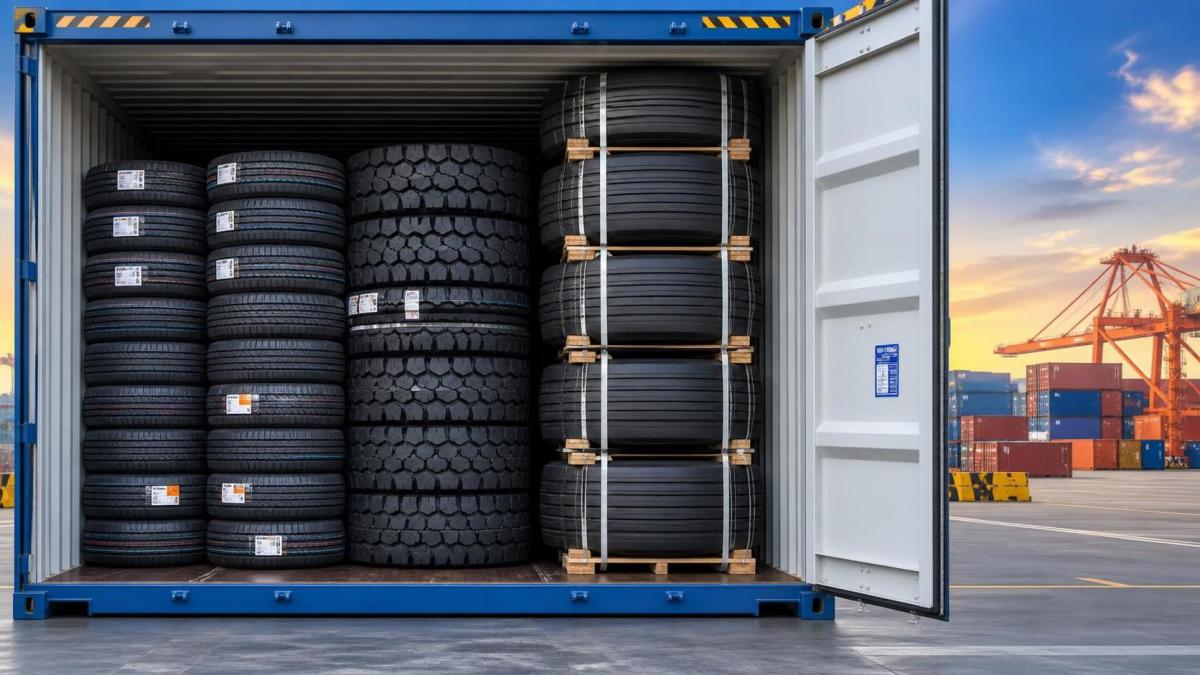
How many tires fit in a 40ft container? There is no single number. Capacity changes significantly with tire dimensions, loading configuration, packaging, and the available internal container space.
For buyers, the useful question is not simply how many units fit. It is how to achieve the lowest delivered cost while protecting tire quality and meeting inventory requirements.
A 40ft high-cube container commonly carries more tires than a standard 40ft container because it provides additional internal height. This difference matters especially for passenger and light truck tire shipments.
Truck and bus radial tires occupy much more volume than passenger car tires. Specialty tires may require even more space because of wider section widths, larger diameters, or handling restrictions.
Importers should therefore request a loading plan based on the exact tire sizes, quantities, container type, and destination requirements before confirming a purchase order.
Typical 40ft Container Tire Capacity by Tire Category
A standard 40ft container has roughly 67 cubic meters of usable internal volume. A 40ft high-cube container usually offers approximately 76 cubic meters, depending on its construction.
However, cubic volume alone does not determine how many tires fit in a 40ft container. Tire shapes create empty areas, and loading practices influence whether those spaces are effectively used.
Passenger car radial tires are often loaded in the highest quantities. Depending on the size and nesting method, a 40ft high-cube container may hold roughly 1,000 to 1,800 units.
Compact passenger tire sizes, such as common 13-inch through 16-inch products, can achieve higher loading quantities. Larger SUV tires and performance tires normally reduce total container capacity.
Light truck tires generally require more space than passenger tires. A 40ft high-cube container may carry approximately 600 to 1,000 light truck tires, depending on the profile and packaging.
For TBR tires, a 40ft container commonly holds around 250 to 450 units. The final figure depends heavily on whether tires are stacked upright, laid flat, nested, or mixed.
Popular truck tire dimensions such as 11R22.5, 12R22.5, 315/80R22.5, and 385/65R22.5 have materially different outer diameters and widths. They should never be estimated as identical cargo.
Large agricultural, industrial, OTR, and specialty tires may only allow dozens or low hundreds of units per container. Their loading must also consider securing methods and permitted container weight.
These ranges are planning references, not shipping guarantees. A supplier should provide a size-specific loading calculation before issuing the final proforma invoice or booking request.
Why Tire Size Has the Greatest Effect on Container Quantity
The outside diameter, section width, rim diameter, and sidewall profile all influence cargo volume. A seemingly small dimensional difference can reduce the number of tires per container by many units.
For example, two 22.5-inch truck tires may use different amounts of space. A wider low-profile tire can restrict nesting opportunities even when its overall diameter appears similar.
The tire's hollow center is important in container loading. Smaller tires can sometimes be placed inside larger tires, helping use otherwise unused space and improving the freight cost per tire.
This nested loading approach is common when a shipment contains compatible tire sizes. It requires careful planning to prevent deformation, maintain safe unloading conditions, and preserve product identification.
Mixed-size orders are often commercially necessary for distributors. Yet they may reduce loading efficiency unless the largest tires form a stable outer structure and smaller tires fill selected gaps.
Buyers should give suppliers a complete size breakdown instead of asking for capacity based only on total quantity. Accurate data allows logistics teams to calculate a realistic loading pattern.
The same principle applies to tire brands, tread patterns, and market specifications. Different products can have different weights or dimensions even when their nominal size designation appears comparable.
Where container utilization is critical, request the actual overall diameter and section-width information for every SKU. Nominal tire labels alone are not always sufficient for precise planning.
Standard 40ft vs. 40ft High-Cube: Which Is Better?
For many tire importers, the 40ft high-cube container is the preferred option. Its additional height can improve loading capacity, particularly for vertically stacked passenger or light truck tires.
The extra space may permit another loading layer for certain sizes. Even when it does not add a complete layer, it can improve arrangement flexibility and reduce unusable overhead space.
A high-cube container is not automatically the best choice in every trade lane. Freight rates, availability, inland transport limitations, and destination handling charges must also be compared.
In some markets, high-cube equipment is less readily available or may carry a higher ocean freight rate. The correct decision should be based on total landed cost per tire.
For bulky TBR tires, high-cube space can still be valuable. The additional height may improve stacking options, although large truck tires are often limited by geometry before volume is fully used.
Weight restrictions also matter. Heavy tire shipments can approach payload limits before the container is physically full, especially when using reinforced casings or high load-rated commercial tire designs.
Ask the freight forwarder for the container's permitted payload for the selected route. Port, road, rail, and country regulations may impose different practical weight limits.
A proper comparison should calculate units per container, freight per tire, handling cost, customs value, inventory turnover, and the risk of excess stock after arrival.
Loading Methods That Change the Number of Tires Per Container
Tires can be loaded upright, flat, stacked, interlocked, nested, or through a combination of these methods. The best method depends on tire type and unloading conditions.
Upright loading is often easier to count and unload. It may also help protect sidewalls, but it can leave more unfilled space than a carefully planned nesting arrangement.
Flat stacking can improve stability for some tire sizes. It may be preferred when tires are bundled, wrapped, or loaded in rows with controlled stack heights.
Interlocking uses the contours of adjacent tires to reduce voids. This method can increase loading efficiency, but workers must follow a consistent plan to avoid unstable cargo layers.
Nesting smaller tires inside larger tires can meaningfully improve utilization for mixed orders. The method must not compromise labeling, traceability, or the ability to inspect goods during unloading.
Some buyers request strapped bundles or protective wrapping. These measures may simplify warehouse receiving, but packaging dimensions can reduce the total number of tires that fit.
Loose loading usually provides the highest quantity per container. Bundled or palletized loading provides greater handling convenience, though it typically lowers space efficiency and increases material costs.
The correct method depends on the buyer's warehouse capability. A distributor without suitable unloading labor or equipment may benefit from lower-density loading that saves time and reduces damage risk.
Packaging, Documentation, and Cargo Protection Considerations
Tires are durable products, but they still require proper handling during international transport. Poor loading can lead to shifted cargo, distorted packaging, scuffed sidewalls, or difficult unloading.
Container floors should be clean, dry, and free from sharp objects. Moisture management is also important because long sea voyages can create condensation inside the container.
Desiccants, moisture barriers, and appropriate ventilation planning may be useful for sensitive packaging materials. Their need depends on the route, season, transit time, and destination climate.
Clear product labels help receivers identify tire sizes, patterns, production dates, and quantities. Good labeling is especially important when a single container contains multiple tire specifications.
Loading records should align with the packing list, commercial invoice, bill of lading, and any country-specific compliance documents. Mismatched quantities can delay customs clearance and warehouse receiving.
For regulated markets, confirm marking, certification, and labeling requirements before shipment. A low freight cost offers little value if goods face clearance problems at the destination port.
Buyers should also agree on inspection standards before loading. Photos, loading videos, seal records, and final quantity confirmation provide useful evidence if questions arise later.
Professional logistics support is not simply about securing a container booking. It connects product accuracy, cargo protection, documentation, and delivery reliability into one operating process.
How to Estimate Freight Cost Per Tire Before Ordering
Freight cost per tire is calculated by dividing the total shipment cost by the quantity loaded. This makes container utilization a direct purchasing and pricing issue.
For example, a container with 350 truck tires may have a substantially different freight cost per unit than one carrying 300 tires, even when the ocean freight charge is unchanged.
Importers should include more than ocean freight in their estimate. Inland trucking, terminal handling, documentation, insurance, customs clearance, and destination charges can affect final unit economics.
It is also important to consider working capital. Maximizing container quantity is not always financially efficient when the shipment creates inventory levels that cannot be sold within a reasonable period.
A distributor with fast-moving sizes may benefit from full high-cube loads. A buyer serving a specialized market may prefer a mixed container even if its freight cost per tire is higher.
The decision should reflect margin by SKU, demand certainty, warehouse capacity, and reorder lead time. Container planning should support the commercial model rather than become an isolated logistics target.
When comparing supplier quotations, ask whether the quoted quantity is based on a standard 40ft or 40ft high-cube container. This detail can change the apparent price advantage.
Also confirm whether the supplier's stated loading quantity includes loose loading, wrapping, bundled packaging, or pallets. Capacity figures without loading assumptions are incomplete and potentially misleading.
Planning a Mixed TBR Tire Container Order
Mixed TBR container orders are common for regional distributors, fleet suppliers, and wholesalers. They allow buyers to cover several market sizes without ordering a full container of each SKU.
The challenge is balancing sales demand with physical loading efficiency. Large, wide tires consume disproportionate space, while smaller compatible sizes may help fill gaps within the container.
Start with the highest-demand tire sizes and define minimum stock targets. Then use supporting sizes to complete the container while maintaining commercially sensible inventory levels.
A reliable supplier can recommend an order combination based on tire dimensions and container volume. This is more useful than selecting quantities only according to unit price.
For commercial applications, technical suitability matters as much as freight efficiency. Customers expect tires to match their load, axle position, road condition, and expected mileage requirements.
For example, the HD928 is available in 12R22.5 and 275/70R22.5 specifications for TBR applications, making size selection central to both fitment and loading plans.
Its broader shoulder design is intended to reduce shoulder abrasion, while the low-heating formulation supports durable performance. These product characteristics should be evaluated alongside container quantity and price.
For distributors, choosing an appropriate pattern can reduce downstream warranty concerns. Better wear resistance and mileage potential may improve the lifetime value of inventory beyond its initial purchase cost.
Questions to Ask a Tire Supplier Before Booking a 40ft Container
Before placing an order, request a container loading estimate for each tire size. The estimate should state the container type, expected quantity, loading method, and packaging assumptions.
Ask whether the quantity has been verified through previous shipments or calculated from product dimensions. Historical loading experience is valuable, especially for mixed-size TBR or specialty tire orders.
Confirm the gross weight of the planned shipment. This protects against unexpected payload restrictions and helps arrange suitable inland transportation at both origin and destination.
Request photos or diagrams of the proposed loading arrangement when the order is complex. A visual plan can reveal whether the configuration supports efficient and safe unloading.
Clarify whether tires will be shipped loose, wrapped, bundled, or palletized. The answer affects capacity, warehouse labor, packaging cost, and the condition in which goods arrive.
Check production lead time and vessel schedule availability. A well-planned container quantity has limited value if production timing or shipping capacity does not support the required delivery date.
For long-term procurement, evaluate the supplier's logistics capability. Consistent delivery requires coordination among production scheduling, quality control, loading teams, freight partners, and export documentation staff.
Jinan Xinkunyu International Trading Co., Ltd. combines tire production experience with dedicated logistics lines serving China and many European and Asian markets, supporting more predictable shipment planning.
Final Answer: Plan Capacity Around Your Exact Tire Mix
How many tires fit in a 40ft container depends primarily on tire size, container type, loading configuration, packaging, and legal payload limits. General averages are only a starting point.
Passenger tires may reach well above 1,000 units per 40ft high-cube container, while TBR tire shipments often range from approximately 250 to 450 units depending on dimensions.
The most cost-effective shipment is not necessarily the container with the highest unit count. It is the shipment that balances freight efficiency, product protection, market demand, and inventory turnover.
For accurate results, provide your supplier with the complete size list, target quantities, packaging preferences, destination, and preferred container type. Then request a documented loading proposal before booking.
This approach turns container planning from a rough estimate into a controlled purchasing decision, helping tire importers protect margins, improve stock availability, and reduce avoidable logistics risk.
Chat Online