


How many passenger radial tire samples are enough before a bulk order?
How many passenger radial tire samples are enough before a bulk order?
How many passenger radial tire samples should we test before a bulk order? The answer depends on tire sizes, production consistency, destination-market requirements, and the risks each test must address—not a universal sample count. Too few samples can miss meaningful variation; excessive testing can consume budget without answering a different question. A useful plan separates supplier qualification, performance validation, and shipment acceptance rather than treating them as one exercise.
For purchasing decisions, the practical number is the total needed to complete the agreed test program, cover relevant production variation, and retain evidence for follow-up. That number should be calculated before samples are shipped, with input from the laboratory and supplier.
Start with the decision, not the sample quantity
A few tires can reveal incorrect markings, dimensional discrepancies, visible workmanship problems, or obvious fitment issues. They cannot establish a low defect rate across a large production order. Equally, passing an endurance test does not automatically demonstrate wet-road performance or consistency between production batches.
Separate three questions:
- Does this exact tire specification meet the intended application and applicable market requirements?
- Can the supplier repeatedly manufacture it within agreed limits?
- Does the shipment being purchased meet the contractual acceptance criteria?
The first question requires technical evidence and suitable testing. The second needs production records and samples that represent manufacturing variation. The third requires a defined lot-inspection plan. Increasing the quantity of handpicked development samples does not replace the latter two.
Build the sample count around a test allocation
Ask the laboratory to specify how many tires each procedure requires, whether testing is destructive, and whether a specimen can be reused without compromising the next result. Endurance and high-speed testing expose tires to substantial stress. A tire used for such testing should not be assumed suitable for an independent performance assessment afterward.
Consider a hypothetical allocation for one passenger tire specification: four tires for a vehicle evaluation, four dedicated specimens across the laboratory program, two for construction examination, and two retained samples. That totals twelve. It is a budgeting example, not a regulatory minimum or industry-wide recommendation. The actual procedures may require a different allocation, additional reference tires, or repeat runs.
Record the allocation before dispatch so nobody discovers halfway through testing that all remaining tires have already been stressed, cut, or mounted for another purpose.
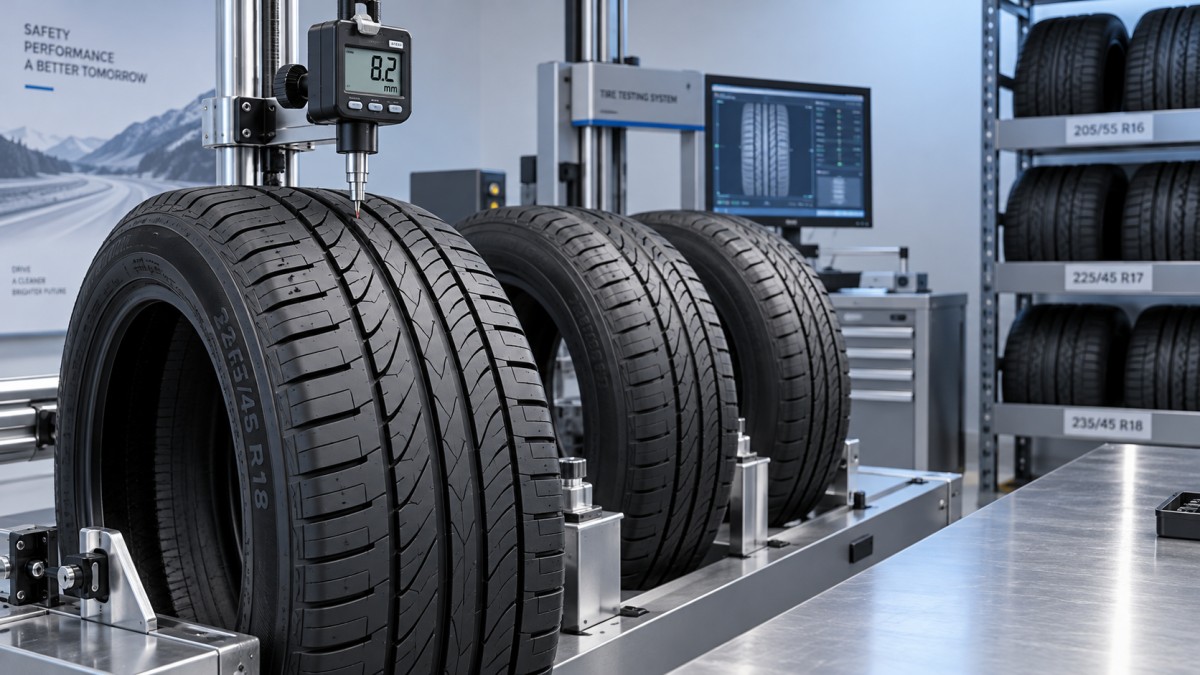
Routine checks can often precede destructive tests: verify identification, size, load index, speed symbol, tread depth, dimensions under specified conditions, and visible workmanship. Uniformity and balance checks require suitable equipment and agreed limits. Confirm test sequence with the laboratory rather than assuming every inspection is interchangeable.
More sizes do not necessarily mean identical testing for every size
A mixed-size order needs a coverage map. Different dimensions, load capacities, speed ratings, constructions, and tread designs can create distinct validation needs. Testing one popular size and applying its results to the whole catalog is difficult to justify without documented technical reasoning.
Grouping related specifications may reduce duplicated work, but only where the applicable procedure permits it and engineering evidence supports the grouping. The representative size should follow the relevant test rationale—not simply be the cheapest sample to ship.
Understand what a small sample cannot prove
Suppose a defect occurs independently in 5% of tires. Under a simple random-sampling model, testing twelve gives approximately a 46% chance of finding at least one affected tire: 1 − 0.9512. About 59 samples would be needed for a 95% chance of detecting at least one defect at that assumed rate.
This calculation illustrates detection probability, not an acceptable safety-defect rate or a recommended qualification quantity. It also assumes random selection, independence, and a test that reliably detects the defect. Real production problems may cluster by curing run, mold, shift, or material batch.
That is why sample origin matters. Request traceability to the production site, date, and available batch identifiers. For consistency assessment, select across relevant production groups. For shipment acceptance, use random selection from the actual lot. Supplier-selected showcase samples provide weaker evidence of routine output.
Keep passenger and truck tire evidence separate
Suppliers with broad portfolios may present technical documents covering several tire categories. Check that every report actually applies to the product being purchased. For example, HDT128 lists truck sizes including 11R22.5 and 11R24.5, with a 16-ply rating, speed symbol M, and 10.5 mm tread depth. Those specifications belong in a truck-tire assessment, not as supporting evidence for passenger radial tire approval.
Similarly, descriptions of steering, handling, or suitability for dry and wet roads are not substitutes for relevant test results. Compare the report’s model, size, construction, and rating with the purchase specification. Where a report covers a family, confirm the basis and permitted scope.
Jinan Xinkunyu International Trading Co., Ltd., founded in 2001 and formerly known as Jinan Kunyu, produces high-performance semi-steel radial tires, truck tires, and special tires. Its stated footprint is 360,000 square meters, with more than 1,000 employees, including 180 engineering and technical personnel. This breadth makes product-specific documentation particularly important: company scale does not replace evidence for the passenger tire under review.
Control cost through acceptance rules and staged release
Agree acceptance criteria before testing starts. Define applicable procedures, measurement tolerances, defect classifications, and the response to a failed result. A retest should follow a documented investigation, not simply replace an inconvenient result with another specimen. Relevant market approvals must be checked separately; a buyer’s sample test does not itself establish legal compliance.
Compare total qualification cost: samples, freight, laboratory charges, reference tires where required, destructive-test losses, and scheduling delays. Existing reports may reduce duplicated testing only when their identity, scope, and applicability are verified. New constructions or unexplained inconsistencies justify additional scrutiny.
Delivery planning also affects the budget. Xinkunyu’s dedicated logistics lines serve China and most countries and regions in Europe and Asia. For a specific project, confirm laboratory delivery, customs responsibilities, replacement-sample lead times, and whether trial and bulk shipments follow different arrangements.
Before committing to volume, approve a written sample allocation, traceability requirements, acceptance limits, and shipment-inspection plan. Where uncertainty remains, a limited initial order with defined release conditions may control exposure better than testing more unrepresentative samples. The right count is the one that supports these decisions—not merely the one that produces a reassuring stack of passing reports.
Chat Online