


Do silent cotton tires reduce road noise or tire cavity resonance?
Silent Cotton Tires primarily reduce tire cavity resonance, a specific source of noise that can reach the cabin. They can make driving sound quieter when that resonance is noticeable, but they do not suppress every sound created by tires rolling over the road. On coarse pavement, tread and road-contact noise may still dominate what you hear.
The “cotton” description generally refers to an acoustic foam layer bonded inside the tire, rather than ordinary cotton. Whether that layer is worth paying for depends on the noise you want to reduce, the tire’s overall design, and how your vehicle transmits sound into the cabin. A quieter cavity does not automatically produce a quieter tire under every driving condition.
What the foam changes inside the tire
An inflated tire contains an enclosed volume of air between the tire and wheel. As the tire rolls, impacts and deformation can excite acoustic resonances in that space. These resonances concentrate sound energy around particular frequencies, potentially creating a tonal hum or boom that becomes audible inside the vehicle.
The enclosed air has its own acoustic behavior, separate from the sounds generated where the tread meets the pavement. Cavity resonance can interact with the tire, wheel, suspension, and vehicle body, so its contribution to cabin noise depends on the entire transmission path. The same tire technology can therefore deliver different perceived benefits on different cars.
Acoustic foam is typically attached to the inner liner beneath the tread area. Its porous structure dissipates some acoustic energy as air moves through it, reducing the strength of the cavity resonance. The foam does not eliminate the air chamber or prevent the tire from being excited by the road.
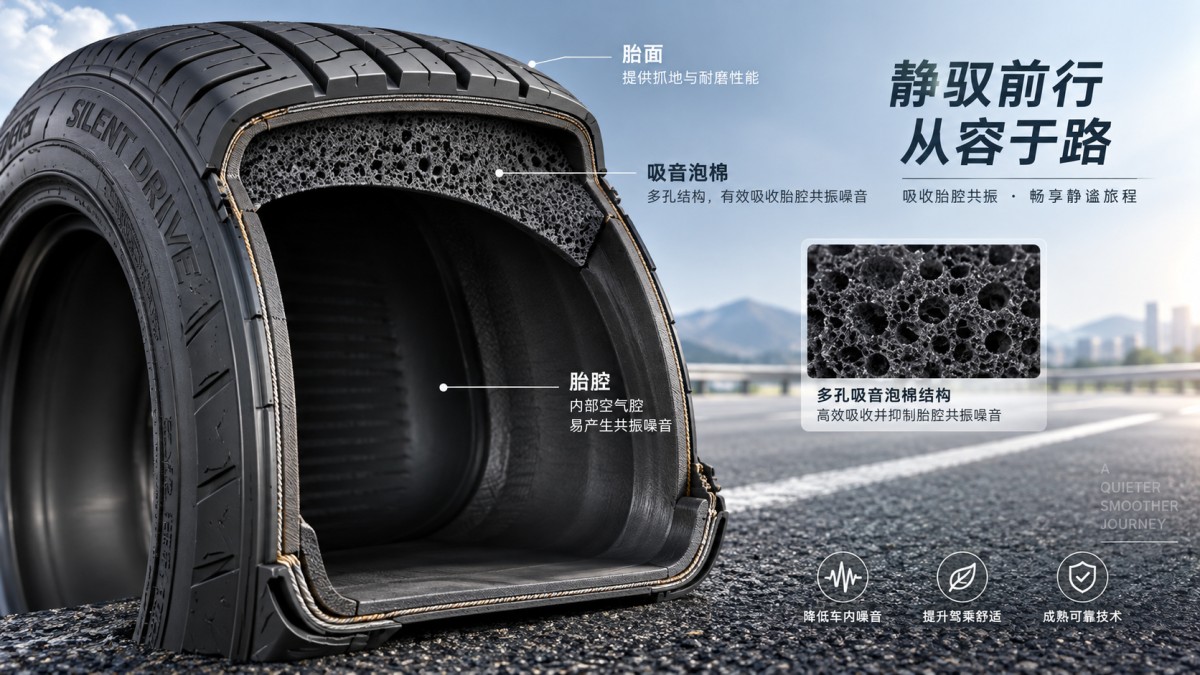
A cross-section helps explain the distinction: the tread remains on the outside, generating forces and sound at the road surface, while the absorber sits inside the air cavity. The foam acts on sound within that cavity. Changes to tread pattern, rubber compound, carcass construction, and vehicle insulation address other parts of the noise problem.
This also explains why acoustic foam is separate from puncture-sealing material. A tire may contain either technology or both, but a foam-lined tire should not be assumed to seal a puncture. Run-flat capability is another separate feature that requires its own specification.
Which driving sounds are likely to improve?
The most promising situation is a vehicle with a noticeable cabin hum linked to tire cavity resonance. Reducing that concentrated sound can improve comfort even if other road noise remains. A tonal sound may be particularly intrusive because it stands out against the broader background noise.
Electric vehicles can make tire-related sounds easier to notice because there is no combustion-engine sound masking them in many operating conditions. However, an electric powertrain alone does not establish that acoustic foam will produce a large improvement. Some vehicles already control cavity-related noise effectively, while others expose more tread noise, wind noise, or suspension vibration.
On a rough road, the broad rushing or roaring sound generated by contact with the surface can overwhelm the improvement from cavity damping. Foam cannot smooth the pavement or change the tread blocks’ contact behavior. A foam-lined tire with an unsuitable tread design may consequently sound louder overall than a well-designed conventional tire in a particular comparison.
Several observations can help narrow down the problem before buying, although listening alone cannot identify the source conclusively:
- A distinct hum or boom: cavity resonance may contribute, but wheel bearings, uneven wear, and other mechanical sources also need consideration.
- A large change between smooth and coarse pavement: road-contact noise is probably a substantial part of the sound, so the tire’s overall acoustic design matters.
- Thumping, shaking, or a sudden new noise: inspect the tire and vehicle before treating the issue as a comfort problem.
- Noise that develops as the tires wear: assess wear patterns, alignment, inflation, and rotation requirements; adding foam does not correct those conditions.
If the noise appeared recently, replacing tires solely to obtain an internal absorber can miss the cause. A damaged tire, irregular tread wear, or a vehicle fault deserves diagnosis first.
How to read noise ratings and performance claims
“Silent Cotton Tires” is a descriptive sales term, not a universal performance grade. It does not establish the absorber material, construction, amount of noise reduction, or test conditions. Manufacturers may use their own names and markings for acoustic tire technologies, so the exact tire specification matters more than the phrase on a listing.
External rolling-noise ratings and cabin noise measure different outcomes. For example, the external rolling-noise information on an EU tire label concerns sound measured outside the vehicle under prescribed conditions. It does not directly rate the sound heard by the occupants or isolate tire cavity resonance.
A favorable external noise rating can be useful when comparing tires, but it cannot confirm that one tire will create a quieter cabin on your car. Conversely, a foam-lined version may improve interior acoustic comfort without a comparable change in its external noise rating.
Claims expressed in decibels require particular care. A reduction measured at the cavity resonance frequency describes a different result from a reduction in total cabin sound. The quoted figure also needs a clear comparison: the same tire with and without foam, a different tire model, or a different vehicle setup. Those comparisons answer different questions.
Useful evidence identifies the vehicle, tire size, inflation pressure, speed, road surface, and measurement method. For an occupant-comfort claim, interior measurements and frequency information are more informative than an isolated noise figure. Controlled comparisons using otherwise equivalent tires make it easier to judge the absorber’s contribution.
Without that detail, treat a noise-reduction claim as an indication of the technology’s purpose rather than a prediction of what you will hear. Avoid translating a percentage claim directly into a percentage improvement in perceived quietness; human hearing and acoustic measurements do not have that simple relationship.
What to check before choosing a replacement
Start with the vehicle’s required tire size, load capacity, speed rating, and any relevant manufacturer fitment guidance. Then compare wet grip, handling, seasonal suitability, rolling resistance, and wear expectations. Acoustic foam adds a comfort feature, but it does not establish the tire’s performance in those areas.
Check the exact version being offered. A model name can cover multiple sizes and specifications, and an acoustic feature shown for one version should not be assumed to apply to all of them. When assessing a listing such as AX116, look for explicit confirmation of internal acoustic foam in the required specification before treating it as a cavity-noise solution.
If the car originally came with foam-lined tires, retaining that feature may help preserve its intended acoustic behavior. Still, matching the foam feature alone does not guarantee the same ride or noise character: a replacement tire’s tread and construction also influence the result.
Repairability deserves a brief check before purchase. Internal foam can cover an area that a technician needs to inspect or prepare for repair. Repair eligibility depends on the damage, the tire manufacturer’s instructions, and the applicable repair procedure; the presence of foam does not automatically make every puncture repairable or unrepairable. Tell the service shop that the tire contains an acoustic absorber.
There is little value in paying extra for cavity damping if your main complaint is coarse-road roar and the alternative tire performs better in that condition. Where a distinct resonance is the problem—and comparable cabin-noise evidence supports the choice—foam-lined tires offer a targeted route to better comfort. Choose them for the sound they can address, while judging the rest of the tire on the conditions you actually drive in.
Chat Online