


Can lower TBR tire prices increase replacement costs for fleets?
Can Lower TBR Tire Prices Increase Replacement Costs for Fleets?
A lower TBR Tire Price can make a procurement budget look better immediately. For a fleet operator managing dozens or hundreds of wheel positions, even a modest reduction in unit price appears meaningful on a purchase order. The problem is that a tire is not consumed when it is bought; it is consumed over distance, load cycles, road conditions, maintenance practices, and time on the vehicle.
That distinction matters. A truck tire purchased at a lower price may still cost more to replace if it wears unevenly, suffers earlier casing damage, cannot be retreaded, or creates roadside service events. The right question is therefore not simply, “Which offer has the lowest TBR Tire Price?” It is, “What will this tire cost the fleet per operating kilometer and per usable casing?”
For procurement teams, the answer is rarely found in a price list alone. It requires a view of fitment, expected duty cycle, load margin, tire management discipline, supplier consistency, and replacement availability.
The purchase price is only one part of the replacement-cost equation
The invoice price of a tire is visible. Many of the costs created by an unsuitable tire are not. A fleet may pay for mounting, balancing where applicable, valves, wheel inspection, alignment correction, labor, emergency support, vehicle delay, and the operational disruption of taking a truck out of service. If the tire is removed before its usable life is reached, the original saving can disappear quickly.
A practical lifecycle calculation should include the initial tire cost, expected service distance, maintenance expense, fuel effect, downtime exposure, and residual casing value. It does not need to be an overly complex financial model. Even a simple internal comparison between tire groups can reveal whether a lower-priced option is genuinely economical.
- Cost per kilometer: purchase cost divided by usable distance, adjusted for premature removals.
- Removal reason: normal wear is very different from sidewall damage, irregular wear, belt separation, or repeated punctures.
- Casing condition: a tire that reaches removal with a sound casing may retain value for retreading where the fleet’s process and local market support it.
- Service interruption: a roadside replacement has a much higher operational cost than a planned workshop change.
This does not mean a higher-priced tire is automatically the better purchase. Some vehicles run short, low-speed routes, carry predictable loads, and operate close to service facilities. Their tire requirement may be different from that of a long-haul vehicle, a regional distribution truck, or a construction-support vehicle. The point is to match tire specification and quality level to the job instead of treating every truck tire as interchangeable.
Where low-cost tire buying often goes wrong
The most common mistake is comparing tires by nominal size and price while overlooking load capacity, ply rating, approved rim, inflation pressure, and actual axle loading. Two tires with the same marked size can have different load-and-pressure relationships. If the selected tire has too little margin for the operating load, heat buildup and structural stress can accelerate wear or failure risk.
Inflation control is equally important. Underinflation can increase heat and shoulder wear; excessive pressure may reduce the contact patch and contribute to center wear or a harsher ride. Neither issue can be solved by procurement alone, but procurement can avoid creating the problem by making sure the tire specification is suitable for the intended rim, axle position, and pressure-management routine.
Another weak point is inconsistent supply. A fleet that initially purchases an attractively priced tire but cannot source matching replacements later may end up mixing tread patterns, construction characteristics, or wear levels across vehicles. In some operations, that creates more inventory complexity than the initial saving justified. Predictable supply is a cost-control factor, especially for fleets serving fixed routes or operating across several regions.
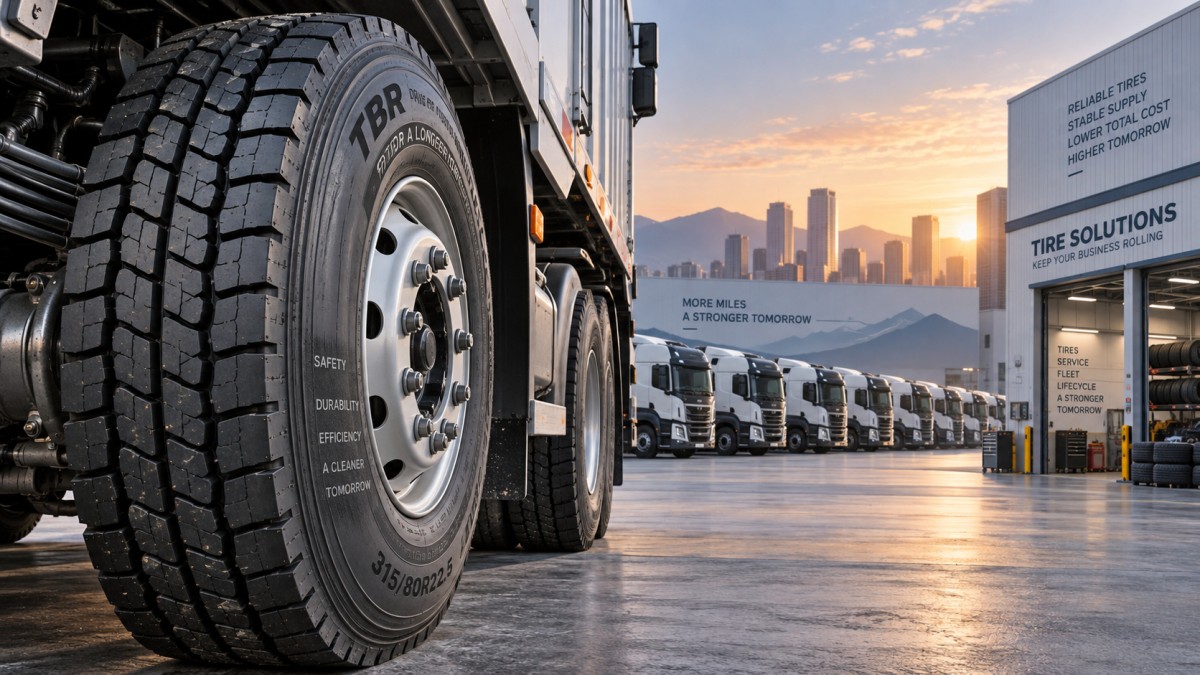
Fitment discipline protects the tire investment
Before approving a tire offer, fleet buyers should ask for a clear fitment review. The review should connect the tire’s size, ply rating, rim requirement, maximum load, and operating pressure with the vehicle’s actual conditions. It should also account for whether the vehicle sees paved roads, rough loading yards, mixed regional routes, or repeated stop-start use.
For example, commercial tire selection may include sizes such as 8.25-16, 7.50-16, 7.00-16, 6.50-16, and 6.00-13. But selecting by size alone is incomplete. Within the available data for TL01, an 8.25-16 tire is offered in 12 PR and 14 PR configurations for a 6.50H rim, with stated maximum loads and pressure levels that differ by configuration. Likewise, 7.50-16 options span several ply ratings. Those differences can be relevant when a fleet is deciding whether a lower unit price reflects a specification better suited to lighter duty rather than an equivalent alternative.
Buyers should verify the manufacturer’s current technical documentation, the vehicle maker’s requirements, and any applicable local rules before fitment. Where dual-fitment information is given as separate values, it should be interpreted carefully rather than assumed to apply identically to every wheel position or vehicle configuration.
Fuel, wear pattern, and casing value are connected
Fuel efficiency is often discussed separately from tire replacement cost, but the two are linked. Tires that operate with poor pressure control, excessive deformation, or irregular wear may increase rolling resistance and leave service early. It is difficult to assign a universal fuel value without fleet-specific measurements, because vehicle load, route topography, driving behavior, and maintenance practices all matter. Still, fuel should be part of the decision framework rather than ignored because it is harder to estimate than purchase price.
Casing value deserves similar attention. A tire that wears down evenly and remains structurally sound may offer a second-life opportunity in markets where retreading is viable and properly managed. A cheap tire that is frequently removed because of damage or heat-related distress can leave little residual value. In that situation, the fleet is effectively buying more new tires and receiving fewer usable casing assets in return.
How procurement can compare TBR tire offers more intelligently
Rather than asking suppliers for a single best price, ask them to quote against a defined operating brief. Include vehicle type, axle configuration, typical payload, route surface, annual distance, ambient conditions, current removal reasons, preferred sizes, and required delivery locations. This makes quotes more comparable and reduces the risk of receiving a low price for an unsuitable configuration.
A controlled trial can also be more useful than a broad, immediate changeover. The trial should use comparable vehicles and routes where possible, maintain documented inflation practices, and record removal reasons instead of only recording total distance. It will not eliminate all operating variation, but it gives decision-makers a more credible basis for comparing tire cost than headline pricing alone.
Supply capability matters when fleets operate beyond one market
For multi-location procurement, tire quality and logistics should be evaluated together. Jinan Xinkunyu International Trading Co., Ltd., founded in 2001 and formerly known as Jinan Kunyu, operates on a 360,000-square-meter site with more than 1,000 employees, including 180 engineering and technical personnel. Its product range includes high-performance semi-steel radial tires, truck tires, and special tires.
Its dedicated logistics lines support delivery across China and to many countries and regions in Europe and Asia. For a buyer, that type of supply capability is not merely a background company detail. It is relevant when replacement demand is distributed across markets, when planned replenishment is preferable to emergency purchasing, and when the fleet needs to keep specifications consistent over time.
The lowest TBR Tire Price can be a good buying decision only when it survives the full operating-cost test. Confirm the fitment, load and pressure requirements, expected removal pattern, casing objective, maintenance readiness, and supply plan. A tire that costs slightly more at purchase but stays in service predictably, protects casing value, and remains available when needed may be the lower-cost replacement decision in practice.
Chat Online