


Can an HD769A replace your current tire without changing rim size?
An HD769A may replace your current tire without changing the wheels, but matching rim diameter alone does not establish compatibility. The exact replacement size must be approved for the existing rim width and profile, satisfy the vehicle’s load and speed requirements, and fit within its available clearance. The information supplied here does not include an HD769A specification sheet, so a definite fitment approval is not possible yet.
At the service bay, a replacement tire can appear suitable because its diameter designation matches the old tire. Discovering an incompatible rim width, insufficient dual spacing, or a lower load rating after mounting creates avoidable rework. Before authorizing installation, compare the candidate tire’s documented specifications with both the wheel markings and the vehicle requirements—not just the tire being removed.
Start with the exact tire size, not the pattern name
HD769A identifies the candidate model, but it does not provide the complete information needed for a replacement decision. Obtain the full sidewall designation and the manufacturer’s technical sheet for the specific size offered. Do not assume every size within a pattern range uses the same approved rims or carries the same load rating.
Record the existing tire’s size, load index, speed symbol, construction, and tube-type or tubeless designation. Then check those details against the vehicle placard, maintenance documentation, or approved fitment records. The installed tire may itself be an unsuitable previous replacement, so copying its markings is not sufficient.
- From the wheel: nominal diameter, width, rim profile, part identification, and applicable load and pressure limits.
- From the candidate tire: exact size, approved rim widths and profiles, service description, dimensions, and load/inflation data.
- From the vehicle: approved tire options, axle requirements, operating speed, wheel position, and relevant clearance restrictions.
Missing markings should trigger an identification check, not an estimate from the tire’s appearance. Wheel documentation or a verified part number can establish specifications that are difficult to read on an installed assembly.
Two separate rim questions must pass
Does the tire match the wheel’s diameter and design?
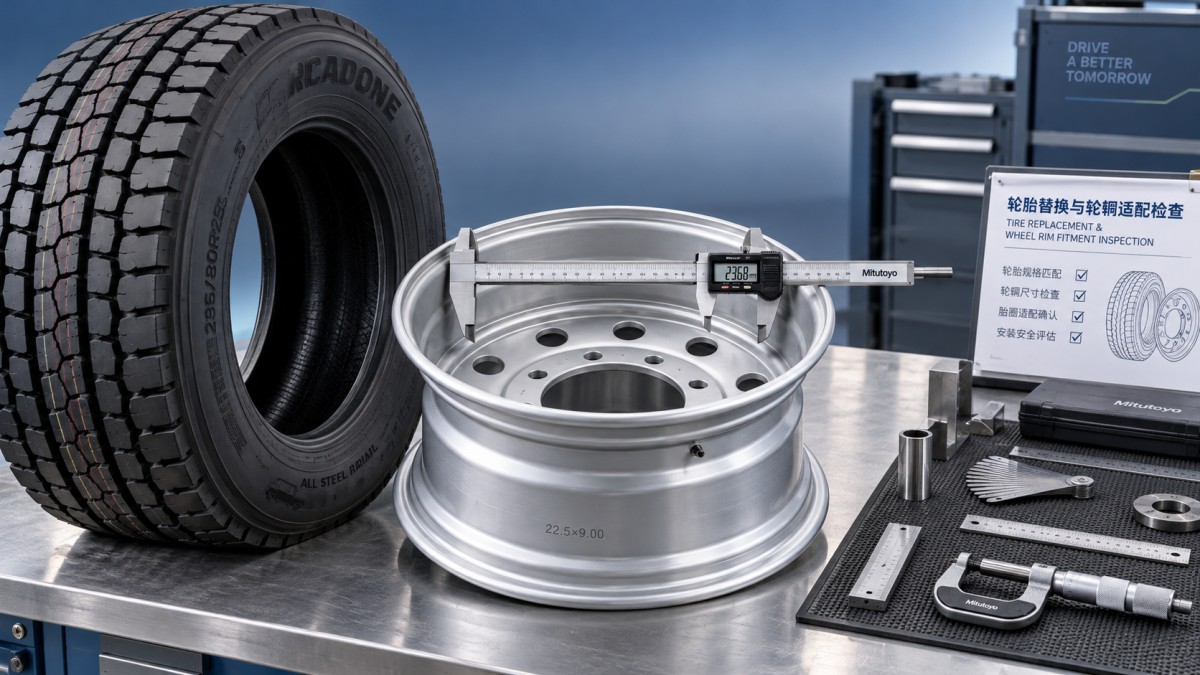
The rim-diameter designation must match exactly. A tire designed for one nominal diameter must not be fitted to another, even when the dimensions appear close. Diameter also does not establish compatibility with the rim’s bead-seat profile or assembly design.
Confirm whether the proposed fitment requires a tubeless wheel or a compatible tube-type assembly. Where tubes and flaps are required, they must suit the tire and rim. Multi-piece wheels need particular care: components must be correctly identified, compatible, and inspected under the applicable wheel-service procedure. Never attempt to overcome a mismatch by forcing bead seating or increasing inflation pressure.
Is the existing width approved?
A technical sheet may list a standard or measuring rim. That is the reference rim used for published dimensions; it is not necessarily the entire approved width range. Ask for the approved rim list for the exact HD769A size before deciding that the current wheel can remain.
A wheel outside that range is a reason to stop, even if the tire can physically be mounted. Rim width affects the tire’s installed shape and can influence bead support, sidewall position, and contact behavior. Conversely, an approved alternative rim width may be acceptable, but its effect on dimensions still needs consideration.
Check carrying capacity before checking appearance
Replacement capacity must meet the vehicle’s requirements at the intended operating pressure and speed. Compare the load index or rated load using the manufacturer’s load/inflation information. Ply rating alone is not a substitute for that comparison, and the maximum pressure molded on a sidewall is not automatically the correct service pressure.
For dual installations, distinguish single and dual load ratings. Do not use the higher single-tire rating to justify a dual application. Also verify that the wheel, valve, and associated components can support the required pressure and load; fitting a higher-capacity tire does not increase the wheel’s rating.
The speed symbol must suit the intended duty. A tire that fits the wheel but does not meet the required operating speed is not an acceptable direct replacement. Where service-specific restrictions or load adjustments apply, use documented manufacturer guidance rather than an assumed allowance.
Same rim diameter can still mean different clearance
Two tires with the same rim-diameter designation can have different section widths and overall diameters. Compare the proposed tire’s dimensions on the relevant approved rim with the current approved fitment. A worn tire is a poor sole reference because its remaining tread reduces overall diameter.
Inspect the space around suspension components, steering parts, bodywork, mudguards, and adjacent tires. Clearance needs to remain adequate through steering movement and suspension travel, not merely with the vehicle stationary and unloaded. Allow for operating deflection and any manufacturer-specified clearance requirements.
On dual-wheel assemblies, verify minimum dual spacing against the candidate tire’s specifications and the wheel arrangement. Wider sidewalls can reduce the gap between tires under load. Contact between paired tires is a rejection condition, not something to resolve by lowering inflation pressure.
A change in rolling circumference may also affect vehicle systems or drivetrain compatibility. For vehicles with restrictions on tire circumference differences, check the vehicle manufacturer’s limits. Do not assume that sharing a rim diameter makes mixed sizes acceptable.
Use available product data without confusing models
A separate listed truck tire, HD779, illustrates the specification detail needed for this assessment. Its supplied 12.00R20(K) entry lists a 22-ply rating, load index 158/155, speed symbol D, standard rim 8.5, section width 311 mm, overall diameter 1126 mm, and tread depth 26 mm.
These figures belong to that listed product, not to HD769A. They cannot establish interchangeability between the two models. Even the listed standard rim does not, by itself, confirm every approved alternative rim width or the required wheel profile.
The listed design features include wide, deep tread and large blocks intended for service life and resistance to puncture and impact, with stepping and anti-stone features. Such characteristics can inform a duty assessment after fitment has passed, but they cannot compensate for an incompatible wheel, inadequate rating, or insufficient clearance.
Turn the findings into a workshop decision
Compatibility does not automatically make an old wheel reusable. Inspect for cracks, distortion, corrosion, bead-seat damage, and other defects under the wheel manufacturer’s criteria. A suitable specification cannot override an unsafe physical condition.
Once approved, installation should be performed by trained tire-service personnel using the correct equipment and procedures, including inflation restraint where required. Verify bead seating, leakage, specified pressure, and wheel-fastener torque. For paired tires, check matching requirements and condition differences before release.
Record the exact tire designation, wheel identification, specification reference, service pressure, and any operating restrictions on the job record. If approval remains pending, state the missing item precisely—for example, “approved rim-width range not confirmed.” That gives the customer a clear reason for the hold and gives the next technician a defined task rather than an unsupported promise of fit.
Chat Online