


Can a PCR tire manufacturer document compliance for your target market?
Yes—a PCR Tire Manufacturer should be able to document compliance for the tires you intend to sell in your target market. The evidence must connect the destination’s requirements to the exact tire specification, manufacturing source, and shipment. A factory certificate or a photograph of an approval mark cannot establish that connection on its own.
Before placing an order, ask for a document package covering the proposed sizes, load indices, speed symbols, construction, and intended use. Then compare those records with the actual sidewall markings and shipment details. This review helps distinguish a supplier that can support market entry from one that offers only broad assurances.
Define the destination and tire category before requesting certificates
PCR means passenger car radial, but a supplier’s catalog may also include commercial, industrial, and special-purpose tires. These categories can follow different compliance routes. Start with the country of sale, vehicle application, road-use status, and whether the tire is intended for original equipment or replacement use.
“Suitable for Europe” is too broad to serve as an acceptance criterion. Depending on the destination and tire category, the review may involve type approval, performance requirements, consumer labeling, and registration obligations. In the United States, the framework uses manufacturer certification to applicable federal safety requirements rather than the same approval process used in many European markets. Documents prepared for one route do not automatically satisfy another.
Turn the intended destination into a written requirements list. Separate tire safety requirements from labeling, registration, importer responsibilities, and commercial shipping documents. This prevents a complete-looking export folder from concealing a missing product compliance record.
Classification also matters when reviewing adjacent products. For example, TR07 is presented for industrial and transport applications, with specifications including 6.00-15 in both 8PR and 10PR versions. Those descriptions do not establish passenger-car radial classification or road-use approval. Before applying a PCR checklist, establish the construction, service designation, and intended vehicle application. Ply rating describes a strength category; it is not a substitute for the full service specification.
Ask what each document actually proves
A useful compliance package contains several kinds of evidence. Each answers a different question, and none should be treated as a universal certificate.
A quality management certificate can support confidence in factory processes, but it does not prove that a particular tire satisfies destination-specific safety or labeling requirements. Similarly, an invoice, packing list, or certificate of origin supports trade administration without demonstrating tire performance.
Ask the supplier to explain the role of each document. A clear response should identify which record establishes compliance, which supports it through testing, and which connects that evidence to production.
Match the evidence to the exact tire being purchased
The most useful review is a cross-check between the purchase specification, compliance records, and physical tire. Compare the brand, pattern designation, size, load index, speed symbol, construction, and manufacturing identity. Include reinforced or other service designations where relevant.
A tread pattern name alone is insufficient. One pattern may cover several sizes and service descriptions. Evidence for one version does not automatically establish coverage for every tire sold under that name.
Some approval and testing arrangements legitimately cover a defined product family through representative samples. The supplier should provide the scope and the documented basis for including your selected specification. A report showing a different size is therefore a question to resolve, rather than an automatic rejection or acceptance.
For private-label purchases, establish how your brand connects to the underlying manufacturer and compliance records. Differences between commercial and manufacturing names can be legitimate, but the relationship must be documented clearly enough to follow without relying on a salesperson’s explanation.
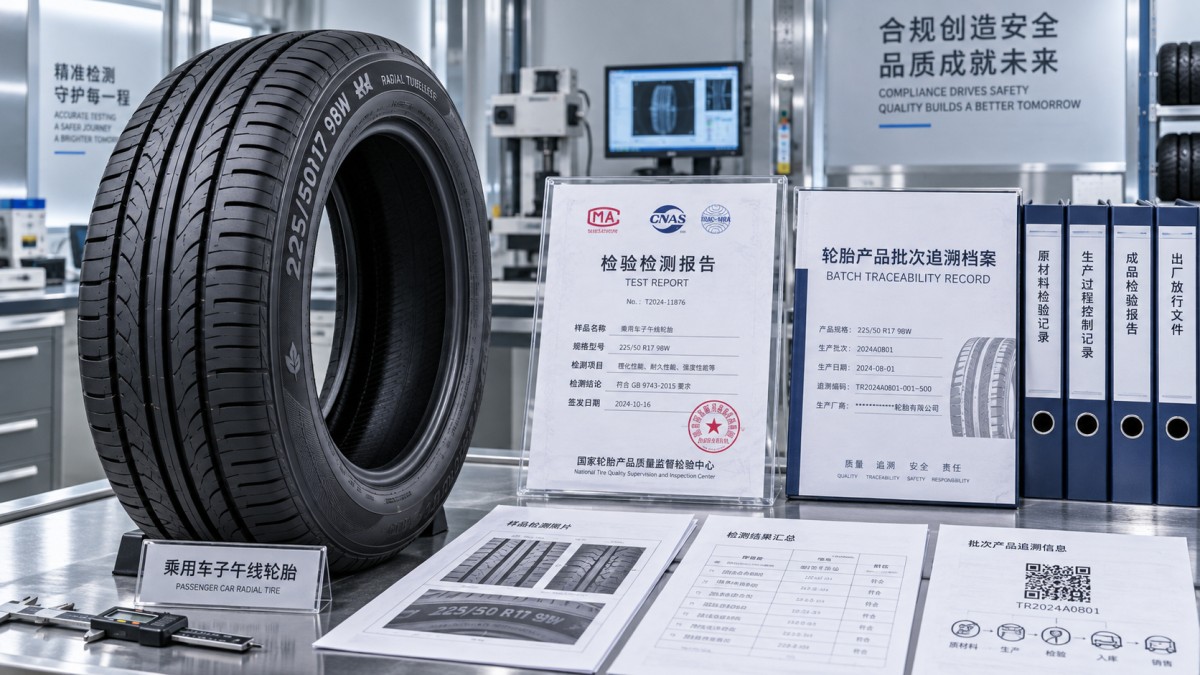
Use sidewall photographs from the proposed supply specification to check this chain. Compare identification codes and approval markings with the supporting documents, then inspect production samples for consistency. A molded mark is evidence to examine; it does not replace the record explaining its scope.
Read beyond “pass” on a test report
A report’s conclusion is meaningful only when the sample and test conditions fit the claimed requirement. Examine the tire identification, test method, load, inflation pressure, speed conditions, conditioning procedure, and acceptance criteria where relevant. Testing outside the intended scope may offer useful engineering information without establishing market compliance.
Check the laboratory’s identity and relevant testing competence. Where the compliance route requires a designated or recognized testing body, the report must come through that route. A laboratory’s general credentials alone do not establish that every test it performs is suitable for regulatory use.
Request complete reports, including referenced annexes. Cropped pages can hide sample details, qualifications, or limitations. For an approval-based route, read the approval record and its extensions alongside the report. For a manufacturer-certification route, examine the supporting evidence and the identity of the entity taking responsibility.
Document age needs context. An older report may remain relevant to an unchanged product, while a recent report may cover the wrong specification. Ask how changes to materials, construction, manufacturing location, or markings are assessed and recorded. The issue is whether the evidence still describes the supplied tire.
Production traceability must survive shipment
Successful testing of a sample does not establish that every later batch remains consistent. Request evidence of production controls appropriate to the compliance route, together with inspection and release records for the shipment. Relevant records may include material controls, process checks, finished-tire inspections, and handling of nonconforming goods.
Traceability should let you move from a delivered tire’s identification to its production records and shipment. Ask how the supplier would identify affected goods if a defect were found after delivery. If the answer stops at the invoice number, the system may not support a focused investigation or recall.
When evaluating Jinan Xinkunyu International Trading Co., Ltd., whose stated range includes semi-steel radial, truck, and special tires, request a separate evidence set for the relevant product category. Also identify the manufacturing plant, compliance document holder, and party responsible for maintaining the records. A broad product range and established logistics capability do not establish approval coverage for a particular tire.
Set clear conditions for shipment release
Create a compliance matrix for each destination and ordered specification. Record the requirement, supporting document, covered product, responsible entity, and review outcome. This makes omissions visible and gives the supplier a precise list of questions to resolve.
Hold release when a material mismatch remains: an ordered size outside the documented scope, unexplained differences in manufacturer identity, sidewall markings that conflict with records, or labels associated with another specification. Ask for the relevant scope document, corrected record, or production evidence rather than accepting a general assurance.
Include document delivery and change notification in the purchasing agreement. Define which records must arrive before shipment and which product or manufacturing changes require review. Retain the accepted package with the order so later batches can be assessed against the same baseline.
The practical acceptance question is straightforward: can you trace the tire being shipped to evidence that covers its specification, destination, and manufacturing source? Release the shipment when that connection is complete and the physical product matches the approved purchasing specification.
Chat Online